
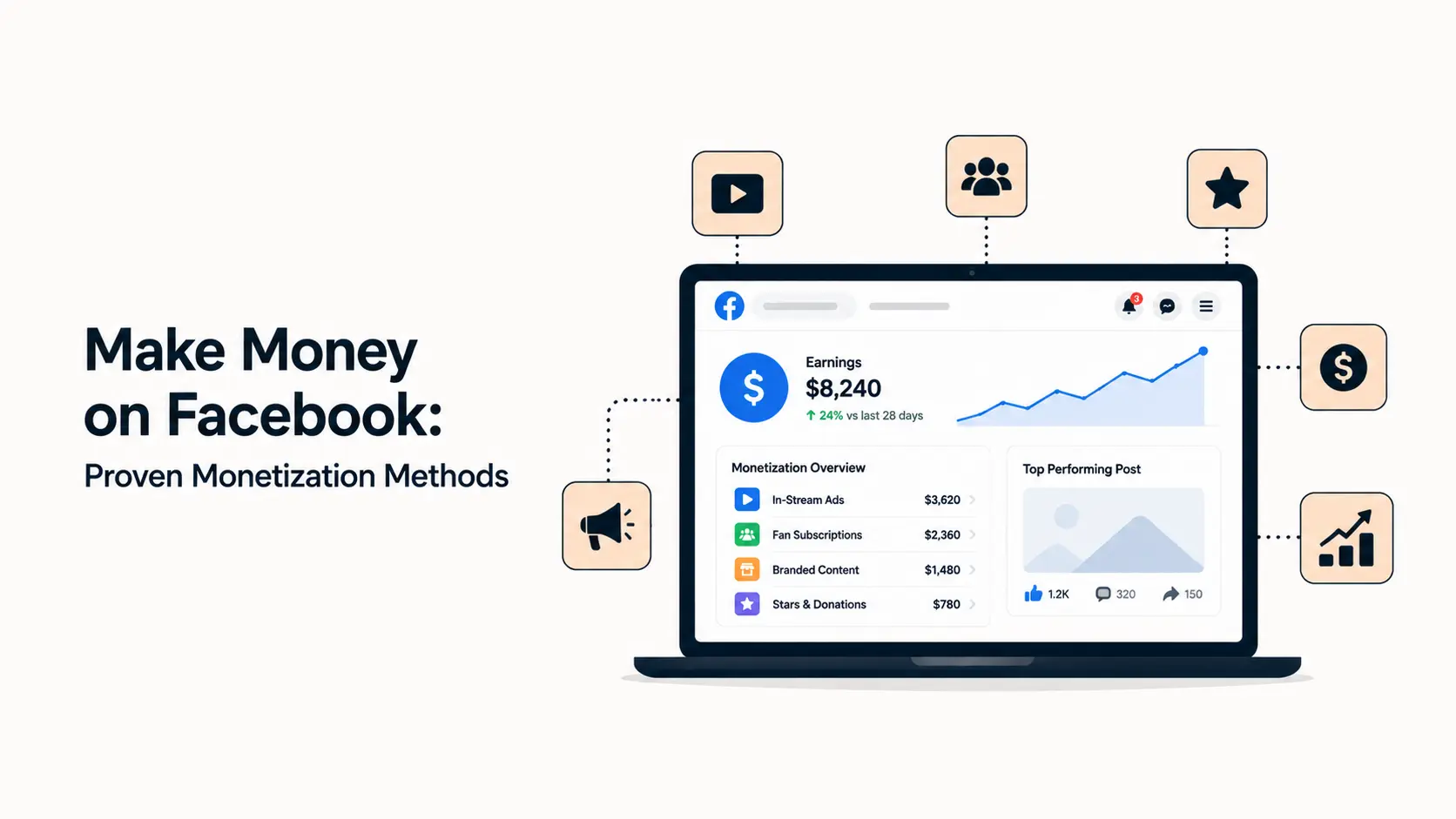


Facebook is no longer only a place to build an audience. In 2026, creators, publishers, small businesses, consultants, ecommerce brands, and niche communities can turn Facebook attention into revenue in several different ways. The important part is choosing a monetization model that fits your content, audience, and level of access to Meta’s native creator tools.
Some methods pay you directly through Facebook. Others use Facebook as the distribution channel that sends people to an affiliate offer, product, service, membership, or sponsor. The strongest Facebook monetization strategy usually combines more than one income source so revenue does not depend on a single program.
Meta says Facebook paid creators nearly $3 billion in 2025, up 35% from the previous year. The company is also putting more emphasis on original content, qualified views, deeper engagement, and longer watch time. Sustainable monetization in 2026 depends less on posting volume alone and more on content people genuinely choose to watch, read, share, and return to.
TL;DR
- Use Facebook Content Monetization if you are invited and eligible.
- Enable Stars when available so fans can directly support your content.
- Use Subscriptions to create recurring revenue from a loyal audience.
- Earn from brand deals and partnership ads when you have a trusted niche following.
- Promote relevant products with affiliate marketing and clear disclosures.
- Sell your own products, digital products, consulting, services, or courses.
- Use Facebook as a lead-generation channel when your audience has strong commercial intent.
- Prioritize original content. Reuploads, low-value edits, engagement bait, and spammy distribution can reduce reach and monetization.
How Can You Make Money on Facebook in 2026?
There is no single Facebook monetization method that is best for everyone. A creator with a large entertainment audience may earn mainly from Content Monetization, Stars, and sponsors. A local consultant may earn far more from ten qualified leads than from thousands of monetized views. An ecommerce brand may use Facebook primarily to generate product sales, while a niche reviewer may make affiliate revenue from high-intent content.
1. Earn Through Facebook Content Monetization
Facebook Content Monetization is the most important native creator payout program to understand in 2026. It combines the older In-stream Ads, Ads on Reels, and Performance Bonus systems into one performance-based program. Eligible creators can earn from several content formats rather than depending on one video product.
Meta says Content Monetization can pay for eligible short- and long-form video, Reels, Stories, photos, and text posts. In 2025, Meta reported that about 60% of its creator payouts went to Reels while the rest came from Stories, photos, and text posts. That gives creators more ways to earn without building an entire strategy around one format.
How Facebook Content Monetization pays
The program is performance based. Meta has introduced metrics such as Qualified Views, Earnings Rate, and Non-Qualified Views to help creators understand which views may generate earnings. Meta has also said it is placing greater emphasis on deeper engagement, longer watch time, qualified views, and original content.
There is no universal fixed CPM or guaranteed amount per 1,000 views. Earnings can vary with format, audience, performance, advertiser demand, qualified views, and other factors. Any promise of a guaranteed Facebook payout rate should be treated cautiously.
How to get access
As of 2026, Meta describes Facebook Content Monetization as invite-only. Creators can express interest from the Facebook mobile app by opening Professional Dashboard → Monetization → Content Monetization and completing the interest form when it appears.
If your goal is direct creator revenue, build a repeatable content system first. Our guide on how to grow on social media covers the audience and content fundamentals that matter before monetization becomes meaningful.
2. Earn Money With Facebook Stars
Facebook Stars let eligible fans financially support creators by sending Stars on participating content. Meta says Stars can appear on Live or gaming video, on-demand video, Reels, and other supported content when a creator has Stars enabled.
Stars work best when viewers feel connected to the creator. Tutorials, live Q&A sessions, gaming, educational content, commentary, community challenges, and recurring shows can create natural moments for fan support. Constantly asking for Stars without delivering value usually weakens the experience.
What Facebook checks for Stars
Meta reviews creators before Stars are enabled. Current help guidance says eligible content should meet Community Standards, follow Content Monetization Policies, create real engagement, and be original. Stars are not available in every country, so availability should be checked inside your own Professional Dashboard.
3. Build Recurring Revenue With Facebook Subscriptions
Facebook Subscriptions allow eligible creators to offer premium access for a recurring monthly fee. Subscribers can receive benefits such as exclusive content, subscriber badges, closer interaction, and other creator-defined perks. Recurring revenue can be more predictable than relying only on ad-style payouts because it is tied to an ongoing relationship with your most committed followers.
Subscriptions are strongest when the free audience already receives consistent value. Good subscriber benefits might include private Q&A sessions, members-only posts or videos, behind-the-scenes content, early access, exclusive tutorials, templates, discounts, or a recurring community discussion. The goal is not to lock every useful idea behind a paywall. It is to give your most engaged followers a reason to deepen the relationship.
How subscription revenue works
Meta states that for Subscription purchases made on a computer, creators receive 100% of their revenue after applicable taxes when Facebook pays them out. Mobile purchases can be reduced by Apple or Google app-store fees and applicable taxes. Fee structures can change, so creators should check the current payout terms in their own dashboard before forecasting revenue.
A simple planning formula is subscribers × monthly price × retained months. For example, improving retention can be just as valuable as acquiring new subscribers. Track cancellations, the perks people use, and the content that most often converts followers into paying members.
4. Get Paid for Brand Deals and Partnership Ads
Brand partnerships can become one of the highest-value Facebook monetization methods for creators with a specific audience. A sponsor is not only buying follower count. It is buying access to trust, context, and a creator’s ability to explain or demonstrate a product in a way that feels credible to that audience.
Meta uses partnership ads and branded-content disclosure tools for commercial collaborations. Eligible public content from Facebook Pages and profiles in professional mode can participate when the creator and content meet Meta’s requirements. Paid brand relationships also need clear disclosure so viewers understand the commercial nature of the post.
What makes a Facebook creator attractive to brands?
- A clearly defined audience instead of unrelated viral traffic.
- Consistent reach and engagement within one subject area.
- Original content that shows how you communicate and tell stories.
- Audience demographics that align with the brand’s customer.
- Evidence that followers click, comment, save, watch, or buy.
- Professional communication, deliverables, usage rights, and reporting.
You do not always need a massive following. A smaller creator in a high-value niche such as software, B2B, home improvement, parenting, fitness, beauty, finance, or specialist hobbies may be valuable because the audience has clear purchase intent.
5. Make Money With Facebook Affiliate Marketing
Affiliate marketing pays you a commission when someone completes a qualifying action through your tracked referral. Facebook can support affiliate revenue through product reviews, tutorials, comparison posts, Reels, Lives, niche communities, and educational content that naturally helps people choose a product.
The strongest affiliate content starts with a problem, not a link. A post such as “three tools I use to automate client reporting” gives the audience a reason to care before the recommendation appears. Explain who the product is for, where it falls short, and what alternatives exist. That builds more trust than repeatedly posting promotional links.
Facebook affiliate content ideas
- Product demonstrations and before-and-after examples.
- Side-by-side comparisons between two or three products.
- Step-by-step tutorials that use the affiliate product naturally.
- Buying guides for a specific audience or budget.
- Live Q&A sessions around a product category.
- Long-form posts explaining a workflow, setup, or result.
- Reels that introduce the problem and point viewers to a deeper resource.
Always disclose the affiliate relationship clearly when you may earn a commission. Also follow the affiliate program’s own rules about link placement, paid traffic, coupon claims, trademarks, and social-media promotion. Our YouTube affiliate marketing guide explains the same trust-first principle in more depth and can be adapted to Facebook content.
6. Sell Your Own Products or Services
For many businesses and experts, the most profitable way to make money on Facebook is not a creator payout at all. It is using content to sell something you own. That can include physical products, digital products, consulting, agency services, coaching, memberships, events, templates, software, courses, or paid communities.
This model gives you more control over pricing and customer value. A single qualified consulting client can be worth more than a large number of low-value views. An ecommerce brand can use Reels, product demonstrations, customer stories, educational posts, and retargeting to move people from discovery to purchase.
Build a simple conversion path
- Create content around a specific customer problem.
- Show useful proof, demonstrations, examples, or outcomes.
- Use a clear call to action that matches the content.
- Send people to a focused product page, landing page, booking form, or message flow.
- Follow up through email, Messenger, WhatsApp, or another owned channel when appropriate.
- Measure leads, sales, conversion rate, and customer value rather than only reach.
If you are building a business presence from scratch, start with our step-by-step Facebook Business Page guide. Ecommerce brands can also use the sales framework in our guide to increasing ecommerce sales.
7. Use Facebook for Lead Generation
Lead generation is especially effective for agencies, consultants, freelancers, local businesses, professional services, B2B companies, real estate businesses, healthcare providers, educators, and high-ticket sellers. The content earns attention, but the revenue is created when an interested person becomes a qualified lead and eventually a customer.
High-performing lead-generation content usually answers a question a potential customer is already asking. Case studies, audits, checklists, common mistakes, local guides, pricing explanations, comparisons, and process breakdowns can attract people much closer to a buying decision than generic inspirational posts.
Ways to capture Facebook leads
- Send people to a dedicated landing page or booking page.
- Use Messenger or WhatsApp for high-intent conversations.
- Offer a useful downloadable resource in exchange for contact information.
- Use Facebook Lead Ads when paid acquisition makes financial sense.
- Build an email list so you are not dependent on Facebook reach alone.
- Create a follow-up workflow so leads are contacted consistently.
Automation can help once the process is proven. Tenfic’s social media automation services and workflow automation work can connect content, lead capture, notifications, CRM steps, and follow-up without turning the public-facing content into low-quality automation spam.
8. Creator Fast Track for Established Creators
In March 2026, Meta launched Creator Fast Track for established creators who already have meaningful audiences on other platforms and are new to, or returning to, Facebook. It is not a general monetization program for every beginner, but it can be a meaningful shortcut for creators who qualify.
Meta says eligible creators in the program can receive increased reach on qualifying Reels, immediate access to Facebook Content Monetization, and three months of guaranteed pay. Meta announced $1,000 per month for creators with at least 100,000 followers on Instagram, TikTok, or YouTube, and $3,000 per month for creators with more than one million followers on at least one of those platforms, subject to program terms and eligibility.
Treat Fast Track as an opportunity, not a permanent business model. The guaranteed-pay period is temporary. The long-term value is using the initial reach and monetization access to build a Facebook audience that continues to engage after the program ends.
Which Facebook Monetization Method Should You Choose?
Choose the method that matches the economics of your audience. A large entertainment audience may support platform payouts. A small specialist audience may be better for subscriptions, sponsors, affiliates, or high-ticket services. A brand with products may care more about attributable sales than creator earnings.
If you are a new creator
Focus first on a clear topic, original content, consistent publishing, and audience feedback. Do not build your plan around an invite-only monetization program you do not yet have access to. Create something people repeatedly choose to consume, then add the revenue method that fits the audience.
If you already have an engaged audience
Test multiple revenue streams without overwhelming followers. Stars and Subscriptions can monetize loyalty, while sponsorships and affiliate offers monetize purchase intent. Keep the commercial content proportionate to the value you provide for free.
If you run a business
Prioritize leads, sales, customer acquisition cost, repeat purchase rate, and customer lifetime value. Facebook-native payouts can be useful, but they are usually secondary to the economics of your core business.
Original Content Matters More in 2026
Meta has become more explicit about rewarding original creators and reducing the reach of unoriginal content. Content filmed or produced directly by the creator or owner of a Page or professional profile is considered original. Third-party material can still be used when the creator adds meaningful new information, analysis, storytelling, or substantial transformation.
Meta says simple reuploads, stitched clips with little added value, minor edits, borders, captions, speed changes, or basic reactions may be treated as unoriginal. Accounts that repeatedly rely on low-value reused content can be deprioritized, lose recommendation eligibility, and potentially be demonetized.
The practical rule is simple: if removing your contribution leaves essentially the same experience, the content probably does not contain enough original value. Build around your expertise, voice, examples, reporting, experiments, storytelling, community, or production rather than trying to scale copied clips.
How Much Money Can You Make on Facebook?
There is no reliable universal income figure. Facebook earnings depend on the monetization method and the economics behind it. Content Monetization is performance based. Stars depend on fan support. Subscriptions depend on paying-member count and retention. Sponsors pay based on audience value and deliverables. Affiliate income depends on clicks, conversion rate, commission, and order value. Product and service revenue depends on your own pricing and conversion funnel.
For that reason, avoid comparing your Facebook income only by follower count. Two Pages with 50,000 followers can have completely different businesses. One may generate entertainment views but little purchase intent. Another may serve a smaller professional niche where a single client, software referral, or sponsorship is worth hundreds or thousands of dollars.
Track These Facebook Monetization Metrics
- Qualified views: views that may be eligible for Content Monetization earnings.
- Earnings rate: approximate earnings per 1,000 qualified views where Meta provides the metric.
- Watch time and retention: signals that show whether people actually stay with your content.
- Follower growth: useful when it comes from the audience you want to monetize.
- Stars per eligible post or Live: a measure of fan-supported revenue.
- Subscriber conversion and churn: critical for recurring membership revenue.
- Affiliate clicks and conversion rate: more useful than raw link clicks alone.
- Leads, cost per lead, sales, and customer value: the core business metrics for service and ecommerce monetization.
A 90-Day Facebook Monetization Plan
Days 1–30: Build the monetization foundation
- Choose one main audience and one clear content promise.
- Set up or optimize your Facebook Page or professional-mode profile.
- Check Professional Dashboard for Monetization, Stars, Subscriptions, and other available tools.
- Publish original content across two or three formats you can sustain.
- Create a simple profile-to-offer path if you sell a product, service, or affiliate product.
- Track which topics earn the strongest watch time, comments, shares, saves, leads, or clicks.
Days 31–60: Double down on proven topics
- Turn your best topics into recurring series rather than isolated posts.
- Repurpose ideas across Reels, longer video, Stories, photos, and text while adapting each format.
- Use Lives or Q&A content if your audience benefits from direct interaction.
- Introduce one monetization path that fits existing audience behavior.
- Collect email subscribers or customer contact details where appropriate so your business is not completely platform dependent.
Days 61–90: Add a second revenue stream
- If Content Monetization is available, analyze qualified views and earnings by format.
- If your audience is highly engaged, test Stars or Subscriptions where eligible.
- If viewers ask about tools or products, test a carefully chosen affiliate offer.
- If your audience has commercial value, prepare a simple sponsor/media kit.
- If you sell services or products, improve the landing page and follow-up process before increasing traffic.
- Remove low-value content patterns that attract the wrong audience or weaken trust.
Facebook Monetization Mistakes to Avoid
- Buying followers or engagement: inflated numbers rarely create real monetization and can damage account quality.
- Reposting other creators at scale: unoriginal content can lose distribution and monetization.
- Publishing unrelated viral topics: random reach can build an audience that never converts.
- Overloading posts with promotional links: repeated selling without useful content reduces trust.
- Ignoring disclosures: paid partnerships and affiliate relationships should be disclosed clearly.
- Depending on one program: platform rules, invitations, payouts, and availability can change.
- Optimizing only for views: a monetization strategy should track revenue quality, not only reach.
- Automating low-quality content: automation should improve operations, not mass-produce repetitive posts that people do not value.
Where to Check Your Facebook Monetization Status
Use your Professional Dashboard or Meta Business Suite to see the monetization tools currently available to your Page or professional-mode profile. Eligibility, country availability, and program access can differ by account, so your own dashboard is the final source of truth.
For current policy details, review Meta’s official information on monetization and payouts, Facebook Stars, Subscriptions, and Creator Fast Track and Content Monetization.
Conclusion
The best way to make money on Facebook in 2026 is to match the revenue model to the audience you are building. Content Monetization, Stars, and Subscriptions can turn engagement into direct creator revenue. Sponsorships and affiliate marketing can monetize trusted recommendations. Products, services, and lead generation can turn Facebook into a customer-acquisition channel with much higher revenue per conversion.
Start with original content and a clear audience. Build enough consistency to learn what people actually value. Then add one monetization method at a time, measure the business result, and diversify once the first method works. Facebook can be a meaningful revenue channel, but the durable asset is the audience trust and offer system behind the account.
Frequently Asked Questions
Can you really make money on Facebook in 2026?
Yes. Eligible creators can earn directly through tools such as Facebook Content Monetization, Stars, and Subscriptions. Creators and businesses can also earn through brand partnerships, affiliate marketing, product sales, services, and lead generation. Availability and eligibility vary by account and country.
How many followers do you need to make money on Facebook?
There is no single follower threshold that applies to every monetization method. Native tools have their own eligibility rules, while affiliate marketing, sponsorships, services, and product sales depend more on audience quality and purchase intent. Check Professional Dashboard for the tools available to your account.
What is Facebook Content Monetization?
Facebook Content Monetization is Meta’s performance-based creator program that can pay eligible creators for multiple content formats, including Reels, longer videos, Stories, photos, and text posts. In 2026 Meta describes the program as invite-only, although creators can express interest from Professional Dashboard.
Does Facebook pay for Reels in 2026?
Eligible Reels can earn through Facebook Content Monetization. Meta reported that Reels accounted for about 60% of its total creator payouts in 2025. Earnings are performance based rather than a guaranteed fixed amount per view.
Can I make money from a Facebook Page without Content Monetization?
Yes. A Page can generate revenue through affiliate offers, sponsorships, consulting, services, ecommerce sales, digital products, lead generation, and other business models even if it does not have access to Facebook Content Monetization.
Can I monetize reposted videos on Facebook?
Relying on reposted or minimally edited content is risky. Meta says it is prioritizing original creators and can deprioritize, restrict recommendations, or demonetize accounts that repeatedly publish unoriginal content without substantial creative value.
Are Facebook Stars available to everyone?
No. Stars require eligibility and Meta approval, and availability differs by country and account. Check the Monetization area of Professional Dashboard to see whether Stars are available for your Page or professional profile.
What is the most profitable Facebook monetization method?
It depends on the audience. Large entertainment creators may do well with platform payouts, Stars, and sponsorships. Experts and businesses can often earn more per customer through services, products, affiliate offers, or qualified leads. The best method is the one that matches audience intent and unit economics.