
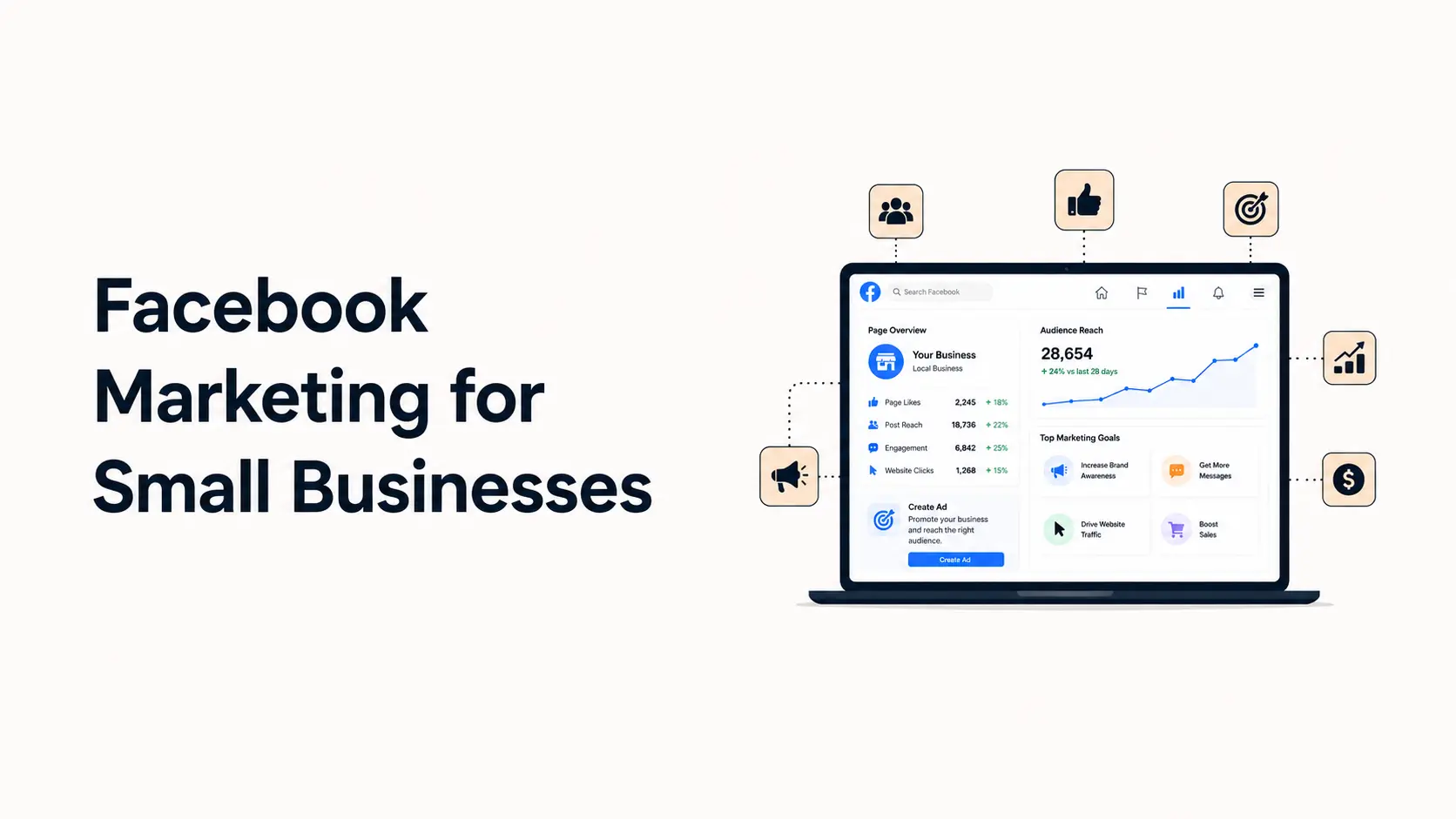

Facebook marketing for a small business in 2026 is less about posting constantly and more about building a connected customer journey. Your Page establishes trust, content creates demand, Messenger or WhatsApp handles conversations, and paid campaigns help you reach people who are likely to take the next step.
The strongest strategy depends on the business model. A local contractor may care about qualified messages and calls. A restaurant may care about local reach, reservations, and repeat visits. An ecommerce store may care about product discovery, retargeting, and purchases. A consultant may use educational content and lead forms to generate appointments.
This guide shows how to build a practical Facebook marketing system that a small team can run without turning social media into a full-time job.
TL;DR
- Optimize your Facebook Business Page before spending money on promotion.
- Build content around customer questions, proof, offers, and short-form video rather than random updates.
- Use Meta Business Suite to plan content, manage comments and messages, and keep the workflow consistent.
- Use Messenger or WhatsApp when conversation is naturally part of the buying process.
- Choose the ad objective that matches the business outcome: leads, sales, messages, calls, or awareness.
- Measure qualified leads, sales, cost per result, and repeat customers alongside reach and engagement.
Why Facebook still matters for small businesses in 2026
Facebook combines a business profile, local discovery, content distribution, communities, messaging, lead capture, and paid advertising in one ecosystem. That breadth is useful because small-business customers rarely move from first impression to purchase in one step.
Messaging is especially important for service businesses and high-consideration purchases. Meta says more than 1 billion people message a business each week across its platforms. Its lead ads with messaging are designed to move prospects from an ad directly into Messenger, Instagram Direct, or WhatsApp.
Facebook also connects closely with Instagram, Messenger, and WhatsApp. A customer can discover a business in a Reel, visit the Page, read reviews or posts, send a question, and then book or buy without the business needing a separate channel for every stage.
1. Start with one business goal
Do not start with a posting calendar. Start with the outcome Facebook should produce for the business. Followers and engagement can support growth, but they are intermediate signals rather than the final goal.
| Business type | Primary Facebook goal | Useful KPI |
|---|---|---|
| Local service business | Calls, messages, bookings | Qualified leads and booked jobs |
| Ecommerce store | Product discovery and sales | Revenue and cost per purchase |
| Consultant or agency | Consultations and inquiries | Qualified lead rate |
| Restaurant or retail store | Visits, reservations, local awareness | Reservations, redemptions, store actions |
| Creator-led business | Audience growth and monetization | Returning viewers, leads, revenue |
Use one primary goal per campaign or content series. Educational posts, lead-generation ads, and retargeting campaigns should not all be judged by the same metric.
2. Build a trustworthy Facebook Business Page
Your Page is the trust layer behind your marketing. If it is not set up yet, follow Tenfic’s Facebook Business Page setup guide first.
Facebook Page optimization checklist
- Use the real business or brand name consistently.
- Choose the most relevant Page category.
- Write a short bio that explains the offer and customer type.
- Claim a clean username when available.
- Use recognizable profile and cover images.
- Add accurate phone, email, website, hours, and location information.
- Choose an action button that matches the main conversion goal.
- Connect Instagram and WhatsApp when they are part of the customer journey.
- Review Page access so team members and agencies only receive the permissions they need.
A polished Page does not create reach by itself, but it reduces friction after someone becomes interested. Small businesses often lose leads because the Page looks inactive, contact information is outdated, or the next action is unclear.
3. Define the audience before creating content
Good Facebook marketing starts with a specific customer problem, not a broad demographic. A useful audience definition combines who the customer is, what they are trying to accomplish, what stops them from buying, and what evidence they need before they trust a business.
For example, a roofing company does not need content for every homeowner. It can focus on homeowners dealing with leaks, storm damage, aging roofs, insurance questions, or replacement decisions in the areas it actually serves.
Build a simple customer message map
| Customer question | Content angle | Possible CTA |
|---|---|---|
| Can I trust this company? | Reviews, case studies, team/process posts | See our work / message us |
| Is this right for me? | FAQs, comparisons, educational posts | Learn more |
| How much will it cost? | Pricing factors, packages, estimates | Get a quote |
| What result can I expect? | Before/after, demonstrations, outcomes | Book a consultation |
| Why act now? | Seasonal timing, availability, problem cost | Call / reserve / buy |
This message map gives the business a repeatable content engine. Each customer objection or buying question can become several posts, Reels, ads, email follow-ups, or sales scripts.
4. Use four content pillars instead of posting randomly
A small business does not need dozens of content categories. Four strong pillars are usually enough to keep the Page useful and commercially relevant.
Pillar 1: Education
Answer questions customers ask before buying. Explain processes, mistakes, costs, options, and tradeoffs. Educational content builds trust and can generate saves, shares, and search visibility.
Pillar 2: Proof
Show reviews, testimonials, results, demonstrations, customer stories, before-and-after examples, or completed projects. Proof helps reduce perceived risk.
Pillar 3: Human and local
Show the people behind the business, local involvement, behind-the-scenes work, events, partnerships, or practical day-to-day moments. This is particularly useful for local businesses where trust and familiarity matter.
Pillar 4: Offers and conversion
Publish clear commercial posts: new services, seasonal offers, product launches, availability, consultations, events, bundles, or booking reminders. A business Page should not be afraid to ask for the sale, but promotional posts work better when the rest of the content creates context and trust.
A practical weekly content mix
| Day | Example | Purpose |
|---|---|---|
| Monday | Customer question or quick tip | Education |
| Wednesday | Case study, review, or project result | Proof |
| Friday | Reel, behind-the-scenes, or local story | Reach and familiarity |
| Weekend / as needed | Offer, booking reminder, event, product | Conversion |
This is a starting point, not a rule. A business that can produce two strong posts per week should not force seven weak ones. Consistency and relevance matter more than filling every calendar slot.
5. Make Reels part of the content system
Short vertical video remains an important discovery format across Facebook and Instagram. Small businesses can use Reels without expensive production: demonstrations, quick tips, product use cases, transformations, FAQs, reactions, short customer stories, and behind-the-scenes clips can all work.
For paid distribution, Meta recommends vertical 9:16 creative with audio and key messages kept inside the safe zone. Its Reels ads guidance also emphasizes creating assets specifically for the placement rather than simply cropping a horizontal ad.
Simple Reel formula for a small business
- Hook: state the problem or outcome in the first seconds.
- Value: demonstrate, explain, compare, or show proof.
- Context: connect the example to the customer’s situation.
- CTA: ask for a message, visit, booking, quote, product view, or follow when appropriate.
Do not turn every Reel into an advertisement. Reach-focused Reels should be useful or interesting on their own; conversion can happen through the Page, comments, retargeting, or later content.
6. Use comments, groups, and community activity carefully
Organic Facebook growth still depends partly on interaction. Respond to meaningful comments, answer questions, and treat conversations as customer service rather than an engagement trick.
Local businesses can also participate in relevant community groups when group rules allow it. The best approach is to contribute expertise, answer questions, and become recognizable before promoting an offer. Repetitive self-promotion usually produces weak trust and can violate group rules.
For events, workshops, openings, local promotions, or live sessions, Facebook Events can provide another discovery and reminder surface. Keep event details accurate and make the next step clear.
7. Turn Messenger and WhatsApp into a lead channel
Messaging is one of Facebook’s biggest advantages for small businesses because many customers want a quick answer before they call, book, or buy. Use it when the sales process benefits from questions, qualification, estimates, availability checks, or appointment scheduling.
A useful messaging workflow is simple: acknowledge the inquiry, ask only the questions needed to qualify it, explain the next step, and move the prospect toward a call, booking, quote, or checkout.
Example message flow
- Greeting: confirm what the customer is asking about.
- Qualification: ask two to five essential questions.
- Recommendation: explain the relevant service, product, or next step.
- Conversion: offer the booking link, quote, payment link, call, or appointment.
- Follow-up: if the customer does not convert, send one useful reminder rather than repeated sales messages.
Meta recommends keeping automated lead-chat questions concise; its current guidance says six questions or fewer is usually optimal for lead ads that click to message.
8. Use Meta Business Suite as the operating dashboard
Meta Business Suite can reduce the administrative burden of Facebook marketing. Use it to plan and schedule content, manage messages and comments, review basic performance, and coordinate Facebook and Instagram activity from one place.
Small businesses that want a broader social workflow can also review Tenfic’s social media automation services. Automation is most useful for repetitive publishing, routing, reporting, and follow-up tasks; customer-facing replies and sensitive issues should still receive human review.
9. Add paid Facebook advertising when the funnel is ready
Paid ads can accelerate reach, leads, and sales, but they amplify the system that already exists. If the offer is weak, the landing page is confusing, or leads are not followed up, increasing the ad budget usually increases waste.
Choose the objective that matches the actual business result. Service businesses often start with leads, calls, or messaging. Ecommerce businesses usually care more about sales and purchase value. Local awareness campaigns can make sense for openings, events, or geographically limited offers.
Useful paid campaign types for small businesses
| Campaign type | Best fit | What to optimize |
|---|---|---|
| Leads | Services, consultations, estimates | Qualified lead cost |
| Sales | Ecommerce and measurable online purchases | Cost per purchase / ROAS |
| Click-to-message | Businesses that sell through conversation | Qualified conversations |
| Awareness | Local launches, events, broad reach | Reach / incremental actions |
| Retargeting | Warm visitors and engagers | Conversion rate / cost per sale |
Meta’s current Advantage+ leads setup uses automation across audience, placement, and budget. Meta reports that Advantage+ lead campaigns delivered a 14% lower cost per lead and 10% lower cost per qualified lead on average in its cited studies. Treat these as Meta-reported benchmarks, not guarantees for an individual business.
How much should a small business spend on Facebook ads?
There is no universal starting budget. Use a test budget that can generate enough conversions to learn without putting the business under financial pressure. A $10-per-day test can be meaningful for a low-cost local lead in one market and nearly useless for a high-cost B2B offer in another.
Budget decisions should start with unit economics. If a qualified lead is worth $80 in expected gross profit, the business cannot sustainably pay $120 to acquire it. Work backward from gross margin, close rate, repeat purchase rate, and customer lifetime value.
10. Retarget people who already know the business
Warm audiences often convert differently from cold audiences. Depending on the business and tracking setup, retarget website visitors, customer lists, video viewers, Page engagers, Instagram engagers, or people who opened a lead form but did not submit.
Retargeting creative should move the customer forward rather than repeat the first ad. Use stronger proof, FAQs, case studies, product benefits, availability, guarantees, comparisons, or a clear offer.
Connect first-party data where practical. CRM or customer-list signals can help distinguish existing customers, warm prospects, and new audiences. Meta’s Advantage+ tools can use audience suggestions while still searching more broadly for likely converters.
11. Create a simple Facebook sales funnel
| Stage | Facebook tactic | Goal |
|---|---|---|
| Discover | Reels, educational posts, local content, awareness ads | Earn attention |
| Trust | Reviews, case studies, FAQs, demonstrations | Reduce risk |
| Consider | Retargeting, comparisons, offers, Messenger | Create intent |
| Convert | Lead form, call, booking, checkout, sales campaign | Generate revenue |
| Retain | Customer content, updates, offers, community | Repeat purchase / referral |
This funnel also fits the broader principles in Tenfic’s social media growth strategy guide: content should move people toward a business outcome rather than optimize every post for isolated engagement.
12. Measure Facebook marketing with business metrics
Facebook Page Insights and Ads Manager provide many numbers, but small businesses need a short scorecard tied to revenue and customer acquisition.
| Metric | What it tells you | Watch for |
|---|---|---|
| Reach / impressions | How much distribution you earned or bought | Useful context, not success by itself |
| Engagement | Whether content creates interaction | Quality matters more than raw reactions |
| Qualified messages / leads | How many real prospects were generated | Lead quality and response time |
| Cost per qualified lead | Paid acquisition efficiency | Compare with close rate and margin |
| Conversion rate | How well the next step performs | Landing page and sales-process friction |
| Revenue / purchase value | Commercial result | Profit, refunds, repeat purchases |
| Repeat customers | Retention quality | Long-term value |
Review performance by content theme, offer, audience, and funnel stage. Avoid declaring a format successful because one post received unusually high reach if it produced no useful business action.
13. Build a 90-day Facebook marketing plan
Days 1–30: Fix the foundation
- Complete the Page profile and conversion actions.
- Define one primary business goal and customer segment.
- Create the four content pillars.
- Publish consistently for several weeks and answer every meaningful inquiry.
- Set up Meta Business Suite and basic tracking.
- Collect customer questions, objections, reviews, and proof for future content.
Days 31–60: Find repeatable content and offers
- Identify the posts and Reels that attract the right people.
- Turn winning topics into new formats and angles.
- Create one clear lead, booking, or sales offer.
- Test Messenger or WhatsApp as a conversion path if appropriate.
- Build warm audiences from visitors and engagers when tracking allows it.
Days 61–90: Add paid distribution and optimization
- Launch one campaign around the primary business objective.
- Test multiple creatives before multiplying audience complexity.
- Retarget warm audiences with proof and conversion-focused messaging.
- Track qualified leads, sales, and cost per result.
- Scale only when lead quality, close rate, and unit economics support it.
Common Facebook marketing mistakes small businesses should avoid
- Posting only promotions and giving people no reason to follow or trust the Page.
- Buying followers, engagement, or fake reviews.
- Using one generic ad for every audience and placement.
- Sending paid traffic to an incomplete Page or poor landing page.
- Ignoring comments and messages for days.
- Measuring success only by likes, followers, or video views.
- Running lead ads without a fast follow-up process.
- Over-automating customer communication until replies sound irrelevant or insensitive.
- Copying competitors without adapting the strategy to your own margins, location, offer, and customers.
Facebook marketing checklist for a small business
- Page is complete and trustworthy.
- Primary marketing goal is defined.
- Customer segment and buying questions are documented.
- Four content pillars are active.
- Reels or short video are tested regularly.
- Comments and messages have an owner and response process.
- Meta Business Suite is configured.
- Paid campaigns use the correct objective.
- Retargeting and first-party audiences are used where appropriate.
- Performance is reviewed against leads, sales, and customer value.
Conclusion
Facebook marketing still offers small businesses a useful mix of discovery, trust building, conversation, lead generation, and paid distribution in 2026. The advantage comes from connecting those pieces. A strong Page supports content, useful content creates warm audiences, messaging converts questions into opportunities, and paid campaigns accelerate what is already working.
If the business also wants to monetize an audience directly, Tenfic’s guide to making money on Facebook in 2026 covers Facebook Content Monetization, Stars, subscriptions, partnerships, affiliate income, products, services, and lead generation.
Frequently Asked Questions
Is Facebook marketing still worth it for small businesses in 2026?
Yes, when the audience and buying process fit the platform. Facebook is especially useful for local discovery, community visibility, messaging, lead generation, retargeting, ecommerce, and reaching existing customers. The business should judge it by qualified leads, sales, bookings, or retention rather than followers alone.
How often should a small business post on Facebook?
There is no required posting frequency. A small business is better served by two to four useful posts per week than daily low-value updates. Choose a cadence the team can maintain while still responding to comments, messages, and leads.
What should a small business post on Facebook?
A practical mix includes educational answers, customer proof, behind-the-scenes or local content, Reels, product or service demonstrations, FAQs, case studies, events, and clear offers. Build posts around real customer questions and buying objections.
Do Facebook Reels help small businesses?
Reels can help discovery because short vertical video is a major content format across Facebook and Instagram. Small businesses can use demonstrations, quick tips, transformations, FAQs, customer stories, and behind-the-scenes footage without needing expensive production.
How much should a small business spend on Facebook ads?
Start from the economics of the offer rather than a universal dollar amount. Estimate what a qualified lead or sale is worth, then test with a budget large enough to generate useful conversion data without creating financial risk. Scale only when the numbers support it.
Are Facebook lead ads good for local businesses?
They can be effective when the business follows up quickly and the form or message flow asks only the information needed to qualify the prospect. Lead quality matters more than collecting the cheapest possible form submissions.
Should I use Messenger or WhatsApp for Facebook marketing?
Use messaging when customers naturally need a conversation before buying, such as estimates, consultations, bookings, availability, or product questions. Make response ownership and follow-up clear so leads do not sit unanswered.
What is the most important Facebook marketing metric?
The most important metric is the one tied to the business goal. For many small businesses that is qualified leads, booked appointments, purchases, revenue, or cost per acquisition. Reach and engagement are useful diagnostic metrics but should not replace commercial outcomes.