
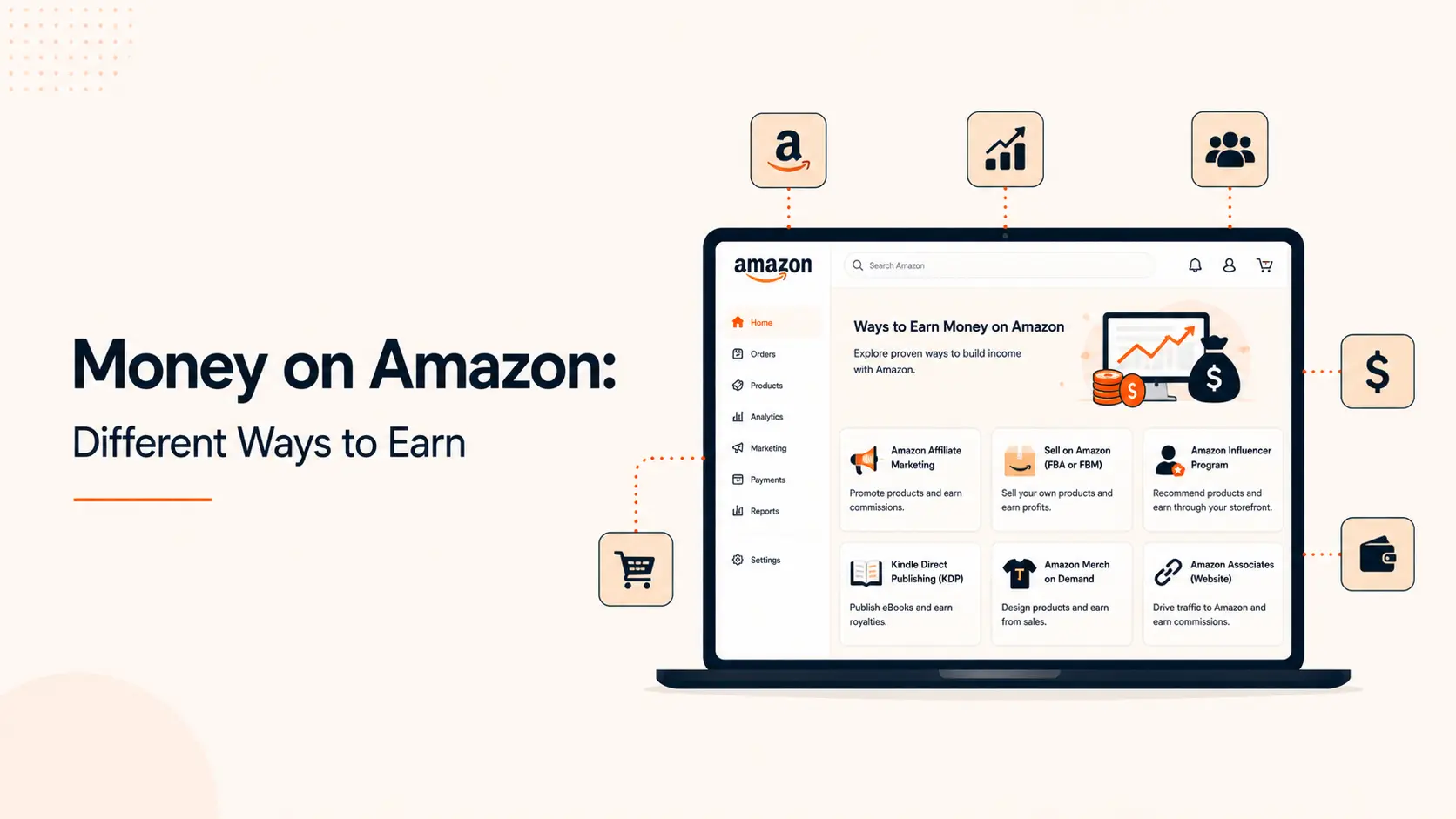


There is no single way to make money on Amazon in 2026. One person may build a private-label ecommerce brand, another may publish books through Kindle Direct Publishing, a creator may earn affiliate commissions, and someone else may use Amazon Flex for active income. Those models have very different startup costs, margins, skills, and risks.
Amazon says US-based independent sellers averaged more than $375,000 in annual sales in its store in 2025. That is a sales figure, not profit, and it should not be read as a typical take-home income. The useful lesson is that Amazon can support serious businesses, but revenue only matters after product cost, Amazon fees, fulfillment, advertising, returns, taxes, and overhead are accounted for.
This guide compares the main ways to earn through Amazon in 2026, explains how each model works, and shows which routes make sense for different budgets and skill sets.
TL;DR: The best Amazon income model depends on what you already have: capital, products, creative skills, an audience, or time.
- Want to build an ecommerce business? Consider resale, wholesale, private label, or Handmade through Seller Central.
- Want Amazon to handle fulfillment? FBA can store, pick, pack, ship, and handle parts of customer service, but it adds fulfillment and inventory costs.
- Have creative or publishing skills? KDP, ACX, and Merch on Demand can monetize books, audiobooks, and designs without holding traditional inventory.
- Already have traffic or followers? Amazon Associates and the Amazon Influencer Program can monetize recommendations.
- Want active rather than scalable income? Amazon Flex and Mechanical Turk are work-based options, not ecommerce businesses.
- Do not choose by revenue screenshots. Compare net profit, cash requirements, policy risk, time commitment, and how much control you retain.
Ways to make money on Amazon in 2026
The table below is a practical starting point. “Startup cost” is relative because product category, country, inventory depth, equipment, advertising, and professional help can change the actual amount dramatically.
| Method | Best for | Startup cost | Income type | Main constraint |
|---|---|---|---|---|
| Reselling products | Beginners learning marketplace operations | Low to medium | Business/scalable | Sourcing, restrictions, thin margins |
| Wholesale | Operators with supplier relationships and working capital | Medium to high | Business/scalable | Inventory capital and competition |
| Private label | Brand builders | Medium to high | Business/scalable | Product risk, launch cost, compliance |
| Amazon Handmade | Makers and craft businesses | Low to medium | Business/scalable | Production capacity |
| Merch on Demand | Designers and niche creators | Low | Royalty/scalable | Design quality, demand, IP compliance |
| Kindle Direct Publishing | Writers, experts, publishers | Low to medium | Royalty/scalable | Book quality and discoverability |
| ACX audiobooks | Authors and audio creators | Low to medium | Royalty/scalable | Production quality and audience |
| Amazon Associates | Publishers and content creators | Low | Commission/scalable | Traffic and conversion |
| Amazon Influencer Program | Creators with an established social presence | Low | Commission/scalable | Eligibility and audience trust |
| Amazon Flex | Drivers in supported areas | Vehicle/time dependent | Active income | Local availability and vehicle costs |
| Mechanical Turk | People seeking small online tasks | Very low | Active income | Task availability and low scalability |
First, understand the difference between Amazon sales and Amazon profit
A common mistake is to ask how much an Amazon seller “makes” without defining whether that means gross sales, gross margin, operating profit, or personal take-home income. For a physical product, a simple contribution calculation is:
Selling price − product cost − Amazon referral fee − fulfillment/shipping − inbound freight − advertising − storage/returns allowance = contribution before overhead and tax.
Amazon’s current US seller pricing lists $0.99 per item sold for the Individual plan or $39.99 per month for the Professional plan. Referral fees vary by category, and optional services such as Fulfillment by Amazon add separate costs. Amazon notes that FBA can include per-unit fulfillment fees, monthly storage fees, aged-inventory surcharges, and other inventory-related charges.
That is why a product with strong sales can still be a poor business. Before buying inventory, use Amazon’s current fee and revenue calculators rather than relying on an old fee table or a creator’s profit screenshot.
1. Resell products through Amazon Seller Central
The simplest physical-product model to understand is resale: buy an existing product legitimately and sell it in Amazon’s store. This can include used products, clearance inventory, retail or online arbitrage, and other forms of authorized resale.
The attraction is speed. You do not need to invent a product or build a brand before learning listings, pricing, inventory, fulfillment, customer metrics, and marketplace economics. The weakness is that the same low barrier can create intense competition.
What you need to watch
- Category and product restrictions: Some products, brands, or categories require approval or may be restricted.
- Authenticity: You need reliable sourcing and documentation. A cheap item is not a good opportunity if you cannot prove where it came from.
- Price volatility: A profitable listing can become unprofitable when more sellers enter or the Buy Box price falls.
- Inventory depth: Test demand before tying up too much cash in one SKU.
- Returns and condition: Used, collectible, open-box, and refurbished products require accurate condition handling.
Reselling can be useful for learning, but it becomes harder to defend as a long-term business when your only advantage is finding the same item slightly cheaper than another seller.
2. Buy wholesale and resell established products
Wholesale sellers buy products in larger quantities from brands, manufacturers, or authorized distributors and resell them. Compared with arbitrage, wholesale can produce more repeatable supply and stronger documentation, but it usually needs more working capital.
The business is less about finding one-off bargains and more about evaluating catalogs. You may review hundreds of SKUs to find a smaller group with enough demand, stable pricing, acceptable competition, and sufficient margin after Amazon fees.
Wholesale works best when you can
- Build legitimate supplier relationships and obtain commercial invoices.
- Reorder winning inventory rather than constantly searching for new one-off deals.
- Negotiate better pricing as order volume grows.
- Avoid listings where price wars leave no room after referral, fulfillment, advertising, and return costs.
- Manage cash conversion carefully because money can sit in inventory before it returns as available cash.
Wholesale can be more predictable than arbitrage, but it still leaves you dependent on products and brands you do not own.
3. Build a private-label brand
Private label means selling a product under your own brand rather than competing only as another reseller on an existing product. The upside is greater control over positioning, packaging, product improvements, listing content, pricing, and long-term brand value.
The downside is risk. You may pay for samples, product development, manufacturing, freight, inspections, compliance, photography, trademarks, packaging, launch advertising, and inventory before you know whether customers will buy at the expected rate.
A sensible private-label process
- Start with a customer problem or underserved use case, not a generic product copied from a bestseller list.
- Estimate demand and competition, then calculate landed cost before placing a production order.
- Check product-safety, labeling, import, intellectual-property, and category requirements.
- Order samples and improve the product before scaling inventory.
- Build listing assets around real differentiation rather than cosmetic branding alone.
- Treat reviews as customer feedback. Do not use review manipulation or incentives that violate Amazon policy.
If you are building a broader ecommerce brand, Amazon can be one sales channel rather than your entire business. Tenfic’s guide to starting an ecommerce business explains the wider decisions around products, operations, channels, and validation.
FBA vs FBM: fulfillment is not the business model
FBA and FBM are often described as different ways to make money, but they are primarily fulfillment choices. You can use either one with resale, wholesale, or private-label products.
| Factor | Fulfillment by Amazon (FBA) | Fulfilled by Merchant (FBM) |
|---|---|---|
| Storage | Inventory stored in Amazon fulfillment network | You or a third party store inventory |
| Picking and shipping | Amazon handles fulfillment | You manage fulfillment |
| Fees | FBA fulfillment and inventory-related fees apply | Your own postage, labor, warehouse, or 3PL costs |
| Operational workload | Lower day-to-day shipping workload | More control but more operational work |
| Inventory risk | Slow inventory can generate storage-related costs | Storage economics depend on your own setup |
| Best fit | Standard products where Amazon fulfillment economics work | Bulky, slow-moving, custom, or operationally suitable products |
FBA can simplify operations, but it does not fix weak unit economics. Compare the total delivered cost of FBA with your own fulfillment or a third-party logistics provider before deciding.
4. Sell handcrafted products with Amazon Handmade
Amazon Handmade is designed for approved makers selling products that are hand-altered, hand-designed, handcrafted, repurposed, or upcycled. Amazon currently requires applicants to register on the Professional selling plan and complete a maker application.
For approved Handmade sellers, Amazon Handmade says the ongoing Professional monthly fee is waived after the first month. Handmade currently charges a referral fee of 15% or $0.30 per unit shipped, whichever is greater. Makers can create a storefront, and eligible product categories include areas such as home, jewelry, clothing, stationery, toys, artwork, and pet supplies.
Handmade makes the most sense when the product itself is genuinely differentiated by craftsmanship or design. Your bottleneck is usually production capacity, not marketplace access. If you sell customized Handmade products through Amazon Custom, Amazon states those custom orders must be fulfilled by the seller rather than FBA.
5. Sell designs with Amazon Merch on Demand
Amazon Merch on Demand is a print-on-demand route for creators who can make original designs. You upload artwork, choose supported products and pricing, and Amazon can produce and ship the item after a customer orders. Amazon’s own seller guidance describes this as a way to sell apparel and accessories without managing traditional inventory, printing, or shipping.
This reduces inventory risk, but it does not remove the two hard parts: creating designs people actually want and owning the rights to what you upload. Copyright, trademark, celebrity, sports, brand, slogan, and character infringement can turn a seemingly easy design into an account problem.
Treat Merch on Demand as a catalog and intellectual-property business. Build original niches, test concepts, improve listings, and expect most designs to produce little or no revenue while a smaller group generates the majority of results.
6. Publish eBooks and print books with Kindle Direct Publishing
Kindle Direct Publishing (KDP) remains one of Amazon’s most accessible publishing routes because the platform itself is free to use. Authors can publish Kindle eBooks as well as print-on-demand paperbacks and hardcovers.
For eBooks, KDP currently offers 35% and 70% royalty options, subject to pricing, territory, content, and other eligibility rules. A notable 2026 change took effect on July 7: according to KDP’s current list-price requirements, the Amazon.com price range for the 70% option expanded to $2.99–$12.99. For print books, Amazon advertises royalties of up to 60%, with printing costs deducted from the royalty calculation. Authors enrolled in KDP Select can also earn from eligible Kindle Unlimited pages read.
KDP is not automatically passive income. The durable advantage comes from publishing something readers value: useful nonfiction, strong fiction, reference material, educational work, or a genuine niche publication. Topic research, manuscript quality, editing, cover design, metadata, reviews earned legitimately, and long-term catalog building matter more than uploading a large volume of weak books.
For creators building organic demand around books or other products, Tenfic’s social media SEO guide covers how search visibility can extend beyond traditional Google rankings.
7. Create audiobooks through ACX
If you own or control audiobook rights, ACX provides a route to produce and distribute audiobooks through Audible and related channels. This option is especially relevant for authors who already have books with proven demand.
ACX introduced a major royalty change in 2026. Under Audible’s new royalty model, new users and newly covered titles earn a 50% royalty rate for exclusive distribution and 30% for non-exclusive distribution. The new model began applying to new users and relevant new productions from May 26, 2026.
Audiobooks add production decisions that eBooks do not: narration, editing, mastering, pronunciation, pacing, and audio quality. You can view the audiobook as an additional format for an existing intellectual-property asset rather than a completely separate business.
8. Earn commissions with Amazon Associates
Amazon Associates lets eligible publishers, bloggers, app owners, and content creators earn commission income by sending qualified traffic to Amazon through approved affiliate links. You do not handle inventory, orders, fulfillment, or customer service.
Commission rates vary significantly by product category. Amazon’s current US Associates commission statement, for example, lists different fixed rates across categories such as luxury beauty, physical books, kitchen, apparel, home, sports, toys, and other product groups. Always check the current commission schedule before estimating revenue.
Amazon’s current Associates application review process requires at least three qualifying sales within the first 180 days before the application is reviewed, and the sites you submit need substantive original content. Requirements vary by property type, and program policies can change.
What makes affiliate income work
- Content with real purchase intent, such as comparisons, tutorials, buying guides, and problem-solving articles.
- Search or audience traffic that is relevant to the products you recommend.
- Original analysis rather than thin pages that simply repeat Amazon descriptions.
- Clear affiliate disclosure and compliance with Amazon’s linking and trademark rules.
- Tracking revenue by page, topic, traffic source, and product category.
A 2026 Associates policy update also expanded disqualified purchases to include products purchased through paid or boosted advertisements that link to Amazon, subject to limited exceptions. Do not assume you can simply buy ads to an affiliate link and collect standard commissions.
If affiliate publishing is part of your strategy, a strong owned site matters. Tenfic’s content marketing services and SEO services focus on building useful content and discoverability rather than thin affiliate pages.
9. Monetize a social following with the Amazon Influencer Program
The Amazon Influencer Program is related to Associates but is designed around social creators. Eligible influencers can receive an Amazon storefront/presence and a creator link so followers can shop recommended products in one place.
Amazon’s Influencer Program policy says participation is country-specific and applicants must meet qualitative and quantitative thresholds. For eligible creators, shoppable content such as videos, photos, Idea Lists, and livestreams where available may also be selected for placements on Amazon. When Amazon displays eligible content onsite and shoppers make qualifying purchases, creators can earn onsite commissions in addition to commissions from traffic they directly send.
This route is strongest when an audience already trusts your recommendations. A storefront does not create demand by itself. The real asset is the relationship you have built on YouTube, Instagram, TikTok, a website, email list, or another approved channel.
If you are still building that audience, Tenfic’s social media growth guide and YouTube niche ideas can help with the audience side before monetization.
10. Deliver packages with Amazon Flex
Amazon Flex is an active-income option rather than a product business. Flex works with independent delivery partners who use the app to choose available delivery opportunities, including scheduled blocks or instant offers in supported markets.
Availability, onboarding, delivery types, and earnings vary by location. More importantly, gross Flex earnings are not the same as net earnings. Drivers should account for fuel or charging, tolls, parking, vehicle maintenance, depreciation, insurance requirements, and taxes.
Flex can be useful if you want a more direct exchange of time for money and have access to a supported area and suitable vehicle. It is less suitable if your goal is to build a scalable digital or ecommerce asset.
11. Complete small online tasks with Mechanical Turk
Amazon Mechanical Turk (MTurk) is another active-income option. Workers complete Human Intelligence Tasks (HITs) created by requesters. Current examples include image classification, data verification, surveys, transcription, translation, search-result evaluation, and information gathering.
Requesters determine task rewards and approve submitted work. Amazon notes that new workers have an initial holding period before rewards can be transferred, and payment options differ by country.
MTurk is useful to understand because it genuinely is a way to earn through an Amazon-owned marketplace, but it should not be confused with a scalable Amazon business. Task availability, qualification requirements, approval rates, and reward levels determine what you can realistically earn.
Which Amazon income model is best for you?
| Your situation | Best routes to investigate first | Why |
|---|---|---|
| You have product-sourcing experience | Resale or wholesale | You can use sourcing knowledge immediately |
| You want to build a defensible brand | Private label | Greater control and potential brand equity |
| You make physical products | Amazon Handmade | Designed specifically for approved makers |
| You are a designer | Merch on Demand | No traditional finished-goods inventory |
| You write or teach | KDP, then possibly ACX | Monetizes intellectual property in multiple formats |
| You own a content site | Amazon Associates | Turns buying-intent traffic into commissions |
| You have a social following | Amazon Influencer Program | Monetizes trusted product recommendations |
| You need active local income | Amazon Flex | Time-for-income delivery work |
| You want small online tasks | Mechanical Turk | Remote task marketplace, but low scalability |
There is no universal “best” route. A private-label business can create more long-term enterprise value than MTurk, but it also exposes you to inventory, compliance, and capital risk. Associates can start cheaply, but it requires traffic. KDP can start with little inventory cost, but a weak book still earns little.
Can you combine multiple Amazon income streams?
Yes, and combining compatible models can reduce dependence on a single revenue source. The key is to combine assets that reinforce each other rather than launching unrelated side hustles.
- Author: Publish an eBook and print edition through KDP, then produce an audiobook through ACX.
- Creator: Use Associates for outbound recommendations and, if eligible, an Influencer storefront for curated products and onsite content.
- Maker: Sell qualifying products through Handmade while building an owned website and email list.
- Brand owner: Sell on Amazon while also developing your own ecommerce site so customer acquisition is not dependent on one marketplace.
- Publisher: Build helpful search content, monetize some pages with Associates, and create original products or books where the audience signals demand.
For brand owners, Tenfic’s best ecommerce platforms guide compares options for building an owned store alongside marketplace sales.
How to calculate whether an Amazon opportunity is actually worth it
Before you start, define the economic model for the route you are considering.
For physical products
- Selling price and expected discounting
- Cost of goods and packaging
- Freight, duties, inspections, prep, and inbound shipping
- Selling-plan and referral fees
- FBA or merchant-fulfillment cost
- Advertising and promotional cost
- Storage, returns, removals, damage, and shrinkage allowance
- Software, contractors, accounting, and other overhead
- Taxes and cash tied up in inventory
For Associates or Influencer income
A useful model is: qualified traffic × click-through rate × Amazon conversion rate × average qualifying order value × effective commission rate. Traffic with weak purchase intent can be large but still earn very little.
For KDP, ACX, and Merch
Separate creation costs from per-sale economics. Track editing, design, narration, software, research, advertising, and your time. A royalty stream only becomes attractive if the catalog continues producing enough gross profit to cover those acquisition and creation costs.
For Flex
Track net hourly earnings after vehicle costs rather than only the amount shown for a delivery block. A route that pays more gross can be worse if it creates significantly higher mileage, tolls, parking, or deadhead driving.
Common mistakes that reduce Amazon earnings
- Confusing revenue with profit. High sales do not prove a healthy business.
- Buying inventory before checking restrictions and fees. Margin spreadsheets should come before purchase orders.
- Using FBA by default. FBA is valuable when the economics fit; it is not automatically the cheapest fulfillment choice.
- Launching generic private-label products. A logo on a commodity is not meaningful differentiation.
- Ignoring intellectual property. Merch, KDP, listings, images, packaging, and brand names can all create copyright or trademark issues.
- Manipulating reviews. Build a customer experience that earns legitimate feedback. Tenfic’s ecommerce review guide focuses on compliant ways to increase customer feedback.
- Treating publishing as upload volume. More low-quality books or designs do not create a moat.
- Depending on one marketplace. Policies, fees, rankings, account health, and competition can change.
- Ignoring cash flow. Profitable inventory can still create a cash squeeze if stock turns slowly.
- Using outdated Amazon fee or commission tables. Recheck official program pages before making financial decisions.
A practical 90-day Amazon starting plan
Days 1–14: choose one model
- List the assets you already have: money, audience, writing/design skill, products, supplier relationships, vehicle, or specialized knowledge.
- Choose one primary route rather than opening several programs at once.
- Read the current Amazon program rules and country eligibility.
- Build a simple profit model using current fees and realistic conversion assumptions.
Days 15–30: validate before scaling
- Sellers: research a small number of products and suppliers before buying deep inventory.
- Authors: validate topic/genre demand and complete a quality manuscript plan.
- Creators: map content topics to products people already ask about.
- Makers/designers: create a small, coherent collection rather than dozens of unrelated items.
- Flex/MTurk: test actual net earnings and availability in your location.
Days 31–60: launch a controlled test
- Keep inventory, advertising, or production spend small enough that a weak result does not damage your finances.
- Track the few metrics that determine the model: unit contribution, conversion, return rate, royalty per title, affiliate earnings per visitor, or net hourly income.
- Document policy questions and resolve them before increasing volume.
Days 61–90: scale only what survives the math
- Reorder or expand products with proven contribution margin and stable demand.
- Publish follow-up content around topics that actually convert.
- Improve listings, covers, designs, or creative assets based on customer behavior.
- Stop weak SKUs, books, designs, or traffic sources rather than keeping them alive for vanity metrics.
- Start building assets Amazon does not own: an email list, brand site, customer research database, supplier relationships, and original intellectual property.
How much money can you realistically make on Amazon?
There is no responsible single answer. Amazon itself reports very large seller sales figures, while Flex, MTurk, affiliates, authors, makers, and influencers all operate under completely different economics.
For physical sellers, the right question is not “What do Amazon sellers make?” but “What contribution margin can I earn on capital after all variable costs, and how quickly does that capital turn?” For creators, ask how much revenue each thousand qualified visitors, viewers, readers, or product impressions produces. For active work, calculate net hourly income after expenses.
The strongest Amazon strategies usually improve one of four assets over time: brand equity, proprietary products, intellectual property, or an audience. If a model creates none of those and depends entirely on finding the next temporary opportunity, it may still make money, but it is harder to defend.
Conclusion
Amazon offers several legitimate ways to earn in 2026, but they should not be lumped together as one “Amazon side hustle.” Selling physical products, publishing books, licensing designs, earning commissions, and delivering packages require completely different operating skills.
Choose the model that matches the assets you already have, validate the economics using current Amazon rules and fees, and start small enough to learn without forcing a bad idea to work. The best route is the one that produces sustainable net income while building an asset you can keep improving.
Frequently asked questions
What is the easiest way to make money on Amazon for a beginner?
The easiest route depends on what you already have. Someone with a website or audience may find Amazon Associates simpler than buying inventory. A maker may be a better fit for Handmade, while a writer may prefer KDP. Reselling can teach marketplace operations quickly, but it still requires product research, sourcing, and fee calculations.
Can I make money on Amazon without selling physical products?
Yes. Current options include Kindle Direct Publishing, ACX audiobooks, Merch on Demand, Amazon Associates, the Amazon Influencer Program, Amazon Flex, and Mechanical Turk. Each has different eligibility, costs, and income mechanics.
How much does it cost to start selling on Amazon?
In the US, Amazon currently offers an Individual plan at $0.99 per item sold and a Professional plan at $39.99 per month, plus referral fees. Your real startup cost can also include inventory, shipping, FBA fees, packaging, software, advertising, compliance, and taxes, so there is no universal startup amount.
Is Amazon FBA passive income?
No. FBA can outsource storage, picking, packing, shipping, and parts of customer service, but sellers still need to source products, forecast inventory, manage listings and account health, monitor fees, handle advertising, manage cash flow, and deal with returns and slow stock.
What is the difference between Amazon Associates and the Amazon Influencer Program?
Amazon Associates is the broader affiliate program for eligible publishers and creators who send traffic through approved links. The Influencer Program is aimed at eligible social creators and can include an Amazon storefront or creator page plus opportunities for shoppable content and onsite commissions.
Is Amazon KDP still worth using in 2026?
KDP is still active and offers 35% or 70% eBook royalty options subject to eligibility, plus print royalties and Kindle Unlimited opportunities. Whether it is worthwhile depends on book quality, demand, discoverability, competition, and the cost of creating and marketing the title.
Can I start Amazon FBA with no money?
A genuine inventory-based FBA business normally requires money for products and other operating costs. Even if you minimize software and advertising, you still need to account for sourcing, shipping, Amazon fees, returns, and working capital. Models such as Associates, KDP, or Merch may have lower inventory requirements.
What is the best long-term way to make money on Amazon?
For long-term value, prioritize models that build a defensible asset: a differentiated brand, proprietary product, catalog of intellectual property, or trusted audience. Private label, original publishing, Handmade, and creator-led businesses can fit that goal, but the best choice depends on your skills, capital, and risk tolerance.