
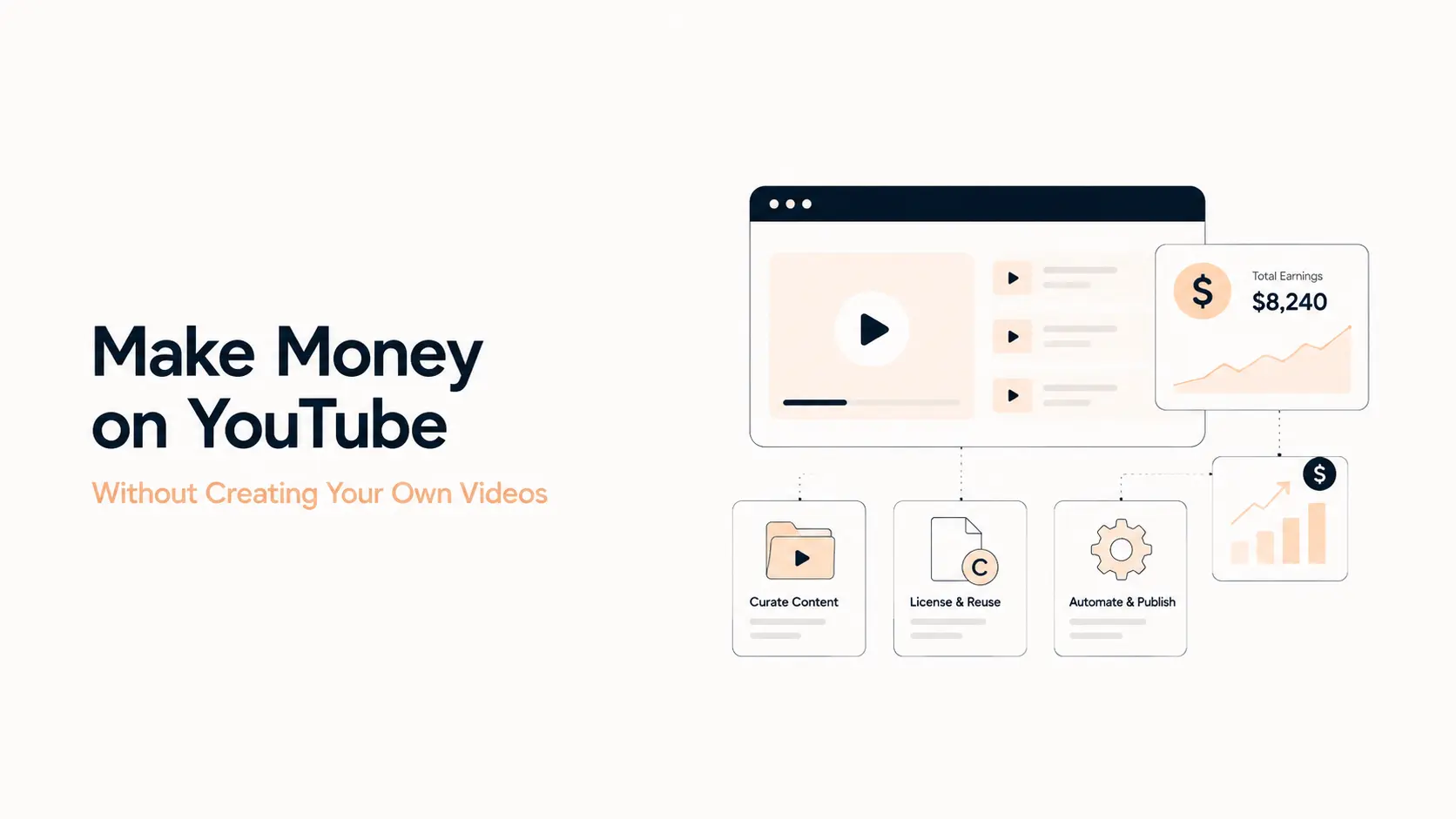

You do not need to appear on camera, film original footage, or personally edit every frame to build a YouTube business. But there is an important line between not filming your own videos and simply reposting other people’s work. The first can become a legitimate media business. The second can trigger copyright claims, reused-content problems, or loss of monetization.
In 2026, YouTube is especially clear that monetized channels must add original, authentic value. Its channel monetization policy says borrowed material needs significant transformation, and its inauthentic-content rules also target mass-produced or repetitive template content. That means a sustainable “no filming” strategy still needs editorial judgment, rights clearance, original scripting, commentary, storytelling, analysis, or another contribution viewers can clearly recognize.
This guide explains the business models that can work, the ways you can earn, the YouTube Partner Program thresholds that matter, and the approaches most likely to fail. If your real goal is a channel where you never show your face, Tenfic’s faceless YouTube channel guide is a useful companion.
TL;DR
- You can make money on YouTube without filming yourself, but you still need original value and commercial rights to the material you use.
- The safest models include outsourced faceless production, licensed stock footage with original narration, transformative commentary, and operating channels for creators or brands.
- YouTube’s reused-content policy is separate from copyright. Permission to use a clip does not automatically make a minimally changed compilation eligible for monetization.
- Full ad-revenue eligibility generally requires 1,000 subscribers plus 4,000 public long-form watch hours in 365 days or 10 million public Shorts views in 90 days.
- Income can come from ads, YouTube Premium, affiliate commissions, sponsorships, products, services, and channel-management fees or revenue-share deals.
- Generic AI slideshows, scraped clips, song collections, social-media compilations, and mass-produced template videos are poor foundations for a monetized channel.
Can You Really Make Money on YouTube Without Creating Your Own Videos?
Yes, if “without creating your own videos” means you are not personally recording footage or doing all the production yourself. You can hire editors and voice actors, license footage, use public-domain material where appropriate, work with a creator who supplies the raw footage, or build videos around original commentary and analysis. In all of those models, your channel can still be responsible for producing a distinct final work.
The risky interpretation is “download videos from elsewhere, make small edits, and upload them for ad revenue.” YouTube says reused content includes material repurposed from YouTube or other online sources without significant original commentary, substantive modification, or educational or entertainment value. It also says this policy applies to the channel as a whole, not just one video.
There is another nuance: copyright permission and YouTube monetization eligibility are not the same thing. YouTube explicitly notes that a channel can violate its reused-content rules even when the uploader has permission from the original creator. You therefore need both the legal right to use the material and a final product that is sufficiently original for the monetization program.
The Best Business Models at a Glance
| Model | What you contribute | Main revenue options | Policy risk |
|---|---|---|---|
| Outsourced faceless channel | Research, topic strategy, scripts, creative direction | Ads, affiliate, sponsors, products | Low when the output is original |
| Licensed footage + original narration | Rights clearance, script, voiceover, editing | Ads, affiliate, sponsors | Low to moderate |
| Transformative commentary or curation | Analysis, criticism, context, narrative | Ads, sponsors, affiliate | Moderate; copyright still matters |
| Channel operator for a creator/brand | Strategy, publishing, optimization, monetization | Management fee, revenue share | Low when rights are clear |
| Affiliate-first channel | Useful buying guidance and qualified traffic | Affiliate commissions, Shopping | Low if content is original and disclosures are clear |
| Sponsor-led niche media channel | Audience, editorial format, brand integrations | Sponsorships, ads, affiliate | Low when promotions are disclosed |
1. Build a Faceless Channel and Outsource the Production
The most straightforward model is to own the channel and its editorial system while other people produce the individual assets. You choose the niche, research topics, define the voice, approve scripts, and control quality. A freelancer or team can handle narration, motion graphics, stock footage selection, editing, thumbnails, and upload preparation.
This is not the same as buying cheap “done-for-you” videos from a content farm. YouTube’s current inauthentic-content policy specifically warns against repetitive, mass-produced, generic template content. A scalable channel should still have distinct topics, useful research, a recognizable editorial viewpoint, and enough variation that videos do not feel interchangeable.
What you can outsource
- Topic research and competitor research
- Script drafting and fact checking
- Voiceover or narration
- Video editing and motion graphics
- Thumbnail design
- Captions and localization
- Publishing support and analytics reporting
Your role becomes closer to a publisher or executive producer. The advantage is leverage: you are building a repeatable media operation rather than trading your own filming time for every upload. The disadvantage is cost. Weak topic selection or low retention can burn through a production budget quickly, so validate formats before scaling.
Tenfic’s YouTube content strategy guide covers the planning layer: audience, content pillars, formats, publishing cadence, and performance feedback loops.
2. Use Licensed, Stock, Creative Commons, or Public-Domain Footage With Original Editorial Value
Another model is to build videos from visuals you did not shoot yourself. Examples include licensed stock video, properly licensed Creative Commons material, public-domain archives, screen recordings you have the right to use, charts you create from data, and footage supplied by a client or partner.
The key is that the finished video should not feel like a stock-footage slideshow with a generic script. The original value can come from your research, narration, analysis, storytelling, data interpretation, editing, graphics, or a specific educational framework. A documentary-style business explainer built from licensed archival footage is fundamentally different from a copied compilation.
Rights checklist before you publish
- Confirm that the license permits commercial use, not only personal use.
- Check whether attribution is required and where it must appear.
- Keep invoices, licenses, permission emails, or contracts in a rights folder.
- Check music, sound effects, photos, fonts, and graphics separately; video rights do not automatically cover every asset.
- Do not assume “Creative Commons” means every possible commercial use is allowed. Read the specific license terms.
- For public-domain material, verify the status in the relevant jurisdiction rather than trusting a random upload description.
YouTube’s copyright guidance lists permission, applicable copyright exceptions, public-domain material, and Creative Commons licensing among possible ways to use third-party work. It also warns that none of these routes guarantees you will avoid a Content ID claim or other dispute.
3. Create Transformative Commentary, Review, Reaction, or Compilation Content
YouTube does allow some content built from third-party clips when the final video is meaningfully transformed. Its monetization examples include critical reviews, reaction videos with commentary, sports replays that explain strategy, edited footage with a new storyline, and reused footage with substantive audio and visual editing.
This model works when the viewer is coming primarily for your explanation, criticism, humor, reporting, or narrative. The borrowed clip supports the point; it is not the entire product. A ten-minute movie-scene compilation with a short intro is very different from a ten-minute film-analysis essay that uses selected excerpts to support a detailed argument.
What “transformative” should look like in practice
- Use only the amount of third-party material needed to make the point.
- Add frequent, substantive narration or on-screen analysis rather than one short introduction.
- Restructure the source material around a new argument, lesson, comparison, or story.
- Create original graphics, annotations, timelines, data, or examples where they improve understanding.
- Make it obvious from the channel description, titles, and videos what you contribute to the final work.
Do not treat the word “fair use” as a permission slip. YouTube notes that fair use in the United States is decided case by case by courts, and merely giving credit, adding a disclaimer, or adding some original material does not automatically make a use fair. Copyright exceptions also vary by country.
4. Operate a YouTube Channel for Someone Who Already Creates the Raw Content
You can make money from YouTube without owning a traditional creator channel at all. Many experts, founders, coaches, podcasters, agencies, and brands already have the knowledge or raw footage but do not want to manage the channel. You can become the operator who turns their source material into a functioning YouTube growth system.
The creator might record a weekly podcast or Zoom session. Your team can identify clips, build long-form episodes, write titles, design thumbnails, upload, optimize descriptions, create playlists, track retention, and repurpose useful moments into Shorts. You are not monetizing content you stole; you are providing a production and distribution service under an agreement with the rights holder.
Ways to get paid as a channel operator
- Fixed monthly management fee
- Per-video production fee
- Performance bonus tied to agreed metrics
- Revenue share on ad, affiliate, or sponsorship income
- Hybrid retainer plus revenue share
Put ownership, channel access, usage rights, revenue attribution, expenses, termination, and post-termination rights in writing. Revenue-share agreements sound attractive but can become messy if neither side defines which income is included or how production costs are handled.
For a broader production workflow, Tenfic’s content marketing services and AI content automation services illustrate how research, content operations, and automation can be combined without removing editorial control.
5. Earn With Affiliate Marketing
Affiliate marketing can monetize a YouTube audience before ad revenue becomes meaningful. You recommend a relevant product or service, disclose the affiliate relationship, and earn a commission when a viewer buys through your tracked link or eligible tagged product.
You do not need to rely only on YouTube Shopping. External affiliate programs can work through links in descriptions or other permitted placements, subject to the affiliate program’s own terms and applicable disclosure rules. This can be especially effective for software tutorials, gear comparisons, business tools, home products, education, travel, and hobby niches where viewers already have purchase intent.
YouTube Shopping in 2026
YouTube also offers a Shopping affiliate program for eligible YPP creators in supported countries. Current YouTube help pages list availability in markets including the United States, India, Japan, Korea, Brazil, Mexico, Indonesia, Malaysia, the Philippines, Singapore, Taiwan, Thailand, Vietnam, and Argentina. Availability and thresholds can change, so creators should check the Earn section in YouTube Studio for their own channel.
A useful affiliate channel still needs original content. Simply reposting a manufacturer’s promo video and adding an affiliate link is a weak monetization strategy and can raise both reused-content and disclosure issues. Build comparison, demonstration, research, or buying-guide value around the offer.
Affiliate disclosure matters
If you have a financial or other material relationship with a brand, disclose it clearly. The U.S. Federal Trade Commission says disclosures should be hard to miss and placed with the endorsement itself; for video endorsements, the disclosure should appear in the video rather than only being buried in the description. YouTube also requires creators to declare paid promotions when applicable.
6. Earn Through Sponsorships and Brand Deals
A niche channel with a commercially valuable audience can attract sponsors even if the host never appears on camera. A cybersecurity explainer channel, productivity channel, travel-guide channel, or B2B software channel can integrate sponsors through original narration, graphics, demonstrations, or a host voiceover.
Sponsor pricing depends on the niche, audience geography, average views, conversion potential, exclusivity, usage rights, and the scope of the integration. Do not focus only on subscriber count. A smaller channel with consistent views from decision-makers can be more valuable to a B2B advertiser than a much larger entertainment channel.
YouTube requires creators to mark content that includes paid product placements, sponsorships, endorsements, or other qualifying commercial relationships. It can then show a paid-promotion disclosure. Local law may require additional disclosure, so the built-in YouTube label should not be treated as a universal substitute for legal compliance.
7. Use YouTube to Sell Your Own Products or Services
YouTube does not need to pay you directly for the channel to make money. A video can attract qualified viewers who later buy a course, template, consulting package, software product, community membership, physical product, newsletter sponsorship, or service.
This model can work before YPP eligibility because the business value happens off-platform. A channel about local SEO could generate audit leads. A channel about automation could drive visitors to an implementation service. A design channel could sell templates. The channel becomes a demand-generation asset rather than only an ad-revenue asset.
The strongest version of this model solves a specific problem in the video, then gives viewers a logical next step. Avoid turning every upload into a long commercial. Useful content earns the attention that makes the offer work.
How YouTube Monetization Works in 2026
If you want YouTube’s own monetization features, the Partner Program thresholds matter. YouTube’s current help documentation separates earlier access to some fan-funding features from the higher threshold for advertising revenue.
| Monetization level | Current channel threshold | What it can unlock |
|---|---|---|
| Earlier YPP access in eligible markets | 500 subscribers + 3 public uploads in 90 days + either 3,000 public long-form watch hours in 365 days or 3 million public Shorts views in 90 days | Features such as channel memberships and certain Shopping/fan-funding access, subject to feature and country requirements |
| Advertising revenue | 1,000 subscribers + either 4,000 public long-form watch hours in 365 days or 10 million public Shorts views in 90 days | Watch Page ads, Shorts Feed ads, plus eligible YouTube Premium revenue |
| Shopping from other brands | Additional channel, subscriber, country, and content requirements apply | Commissions from eligible products tagged through YouTube Shopping |
Hitting the numbers does not guarantee acceptance. YouTube reviews channels for monetization policy compliance and continues reviewing channels after approval. A channel built on copied or low-value material can reach the thresholds and still be rejected or later demonetized.
What YouTube Does Not Want You to Do
The fastest way to misunderstand this business model is to confuse “no filming” with “no original work.” YouTube’s current monetization policy gives several examples that are poor candidates for monetization.
- Movie, television, sports, or viral clip compilations with little or no narrative.
- Short videos downloaded from TikTok, Instagram, or other social platforms and compiled together.
- Collections of songs from different artists, even when the uploader has permission.
- Content copied from another online source with only minimal edits.
- Channels that mainly read articles, news feeds, or other text the channel did not create.
- Image slideshows or scrolling text with little narrative or educational value.
- Generic AI-generated videos made from repetitive templates that appear mass-produced.
- Pitch- or speed-modified songs that remain essentially the same as the original.
These examples do not mean you cannot use AI, stock assets, clips, or templates. YouTube explicitly allows creative tools to assist production when the final work still demonstrates original perspective and value. The problem is automation that removes the substance.
A Practical Workflow for a No-Filming YouTube Business
Step 1: Choose a niche with repeatable viewer demand
Pick a niche where you can generate useful ideas for months, not one viral topic. Look for recurring problems, buying decisions, questions, comparisons, stories, or news that your format can cover consistently.
Step 2: Define the source-material policy before production
Decide what kinds of footage and audio you will use, where they can come from, which licenses are acceptable, and how you will document permission. This prevents an editor from introducing rights problems late in production.
Step 3: Create an original editorial format
Define the elements that make the channel yours: research depth, narration style, story structure, data visualization, commentary, humor, expert interviews, scoring system, or another recognizable contribution.
Step 4: Build the production team or tool stack
Start lean. One researcher/scriptwriter, one editor, and a voiceover solution can be enough. Add specialists only after the format proves it can generate retention and repeat views.
Step 5: Publish enough videos to validate the format
Do not judge a channel from two uploads. Build a small batch around one audience and analyze click-through rate, first-30-second retention, average percentage viewed, returning viewers, traffic sources, comments, and conversion on any affiliate or product offer.
Step 6: Monetize in layers
Start with the revenue source that matches viewer intent. A software tutorial channel may monetize affiliate links before ads. A niche business channel may attract sponsors or leads. Once YPP eligibility arrives, ads and Premium revenue become another layer rather than the entire business model.
Step 7: Scale only what already works
Outsourcing becomes valuable after you know the format. Scale winning topics, improve production bottlenecks, and document the process. Avoid multiplying weak videos simply because AI or cheap editing makes volume easy.
How Much Can You Make?
There is no useful universal earnings number. Two channels with the same views can earn very different amounts because audience location, niche, advertiser demand, seasonality, watch time, video length, affiliate conversion, sponsorship value, and product economics vary widely.
A better model is to track revenue per 1,000 views across each income stream. If 100,000 monthly views produce $300 in ads, $1,200 in affiliate commissions, and $2,000 from one sponsor, the channel is a $3,500 media asset for that month. Another channel might earn almost entirely from services or products and treat ad revenue as incidental.
| Revenue source | What to measure | Main dependency |
|---|---|---|
| YouTube ads / Premium | Revenue per 1,000 views, watch time, monetized playbacks | YPP eligibility, niche, viewer geography |
| Affiliate marketing | Clicks, conversion rate, EPC, commission per sale | Buyer intent and offer fit |
| Sponsorships | Average views, audience fit, effective CPM, renewals | Commercial value of the audience |
| Products or services | Leads, conversion rate, customer value | Problem-solution fit and trust |
| Channel management | Retainer, production cost, margin, performance bonus | Client retention and operating efficiency |
Which Model Is Best for You?
- If you want to own an asset: build an outsourced faceless channel with original scripts and rights-cleared visuals.
- If you are strong at analysis: use commentary, reviews, explainers, or documentary-style formats where your editorial contribution is obvious.
- If you are strong at operations: manage channels for experts, brands, or creators who already supply the intellectual property or footage.
- If you understand buying intent: build an affiliate-first review, comparison, or tutorial channel.
- If you already sell something: use YouTube as an acquisition channel for your product or service rather than waiting for ad revenue.
There is no need to force a single revenue model. Many mature YouTube businesses combine ads, Premium revenue, affiliate links, sponsors, and owned offers. Diversification can reduce the risk of relying on one algorithm, advertiser category, or partner program.
Conclusion
You can make money on YouTube without filming your own videos, appearing on camera, or personally doing every production task. The viable path is to think like a publisher, producer, analyst, marketer, or channel operator rather than a reuploader.
Build a clear editorial contribution, secure the rights you need, and create a final product that viewers would consider meaningfully different from the source material. Then choose monetization that fits the audience: ads, affiliate commissions, sponsorships, services, products, or channel-management revenue.
If your plan is to build a scalable no-camera channel, start with the faceless YouTube channel guide, then use the YouTube content strategy framework to plan formats and publishing.
Frequently Asked Questions
Can you make money on YouTube without making your own videos?
Yes, if you mean you do not personally film the footage. You can outsource production, license footage, manage another creator’s channel, or make transformative commentary. Simply reposting other people’s videos with minimal changes is not a reliable monetization model.
Can I monetize videos if I have permission from the original creator?
Permission can help with copyright rights, but it does not automatically satisfy YouTube’s reused-content policy. YouTube says reused-content monetization is a separate review and can apply even when you have permission.
Can Creative Commons videos be monetized on YouTube?
Potentially, if the specific license allows commercial use and you follow its conditions. You also need to satisfy YouTube’s monetization rules, so a minimally changed reupload can still have reused-content problems even when the license permits use.
Can I use AI to make YouTube videos?
Yes, but YouTube’s monetization rules focus on whether the final content is original and authentic. Generic, repetitive, mass-produced AI template videos can be ineligible. AI works better as a production tool inside a researched, differentiated editorial process.
Do faceless YouTube channels qualify for the YouTube Partner Program?
Yes. You do not need to show your face. The channel still needs to meet YPP thresholds and monetization policies, including originality, rights clearance, advertiser-friendly rules, and other applicable requirements.
Can I make money from YouTube before I reach 1,000 subscribers?
Yes. External affiliate programs, sponsors, services, products, or channel-management work do not depend on YouTube ad eligibility. In eligible markets, some YPP fan-funding features can also become available at the lower 500-subscriber threshold when the additional requirements are met.
Is fair use enough to avoid copyright claims?
No. Fair use is a case-specific legal doctrine, not an automatic YouTube permission. YouTube notes that courts ultimately decide fair use and that even short uses can receive Content ID claims. Rules also vary outside the United States.
What is the safest way to use footage I did not record?
Use footage you created, commissioned, licensed for commercial use, received from a rights holder under a clear agreement, or verified as public domain, then add substantial original editorial value. Keep documentation for the rights to every important asset.