
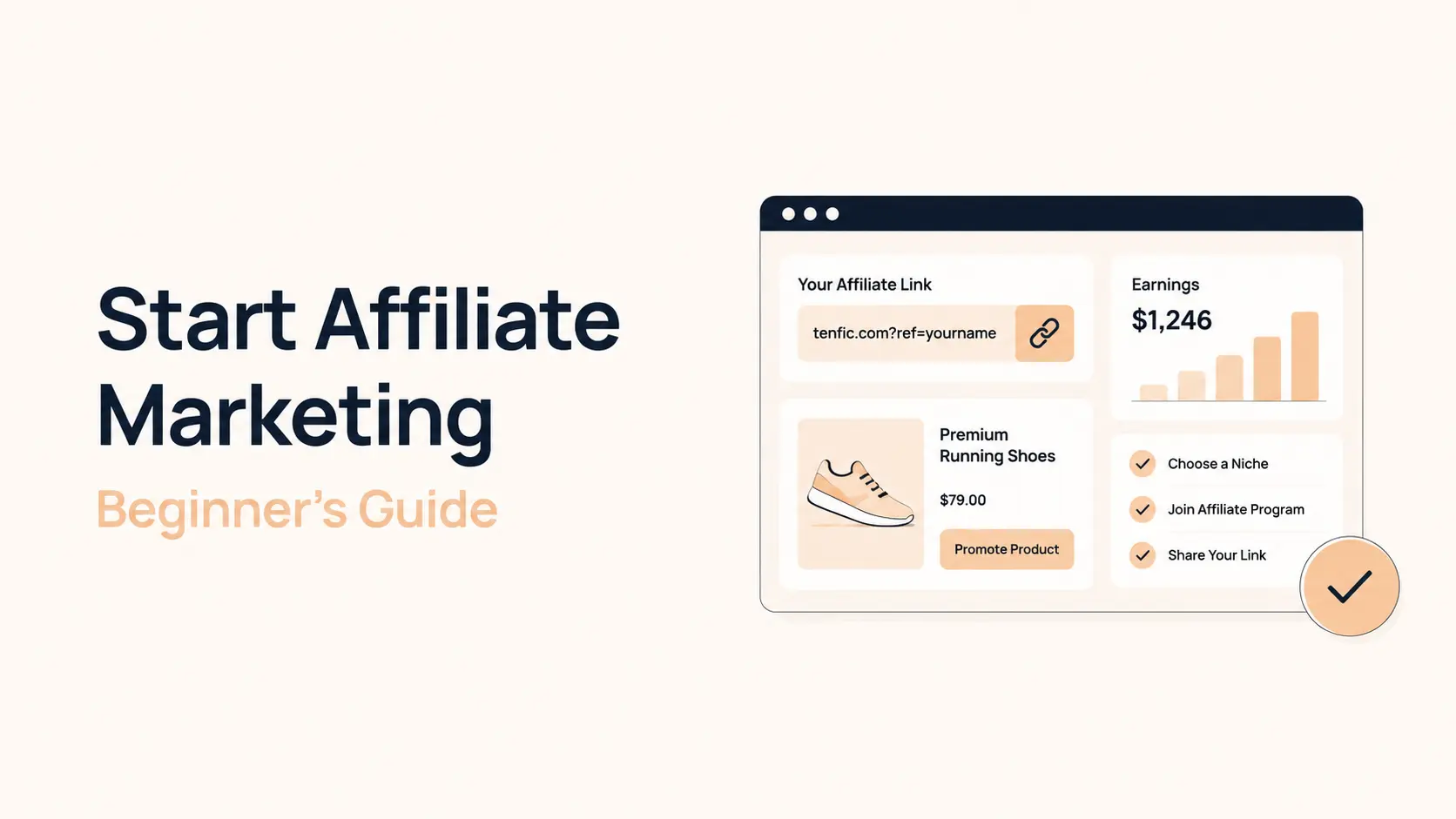


Affiliate marketing is one of the simplest online business models to understand: recommend a product or service, send a potential customer through a tracked link, and earn a commission when the program records a qualifying action. The mechanics are simple. Building reliable affiliate income is not. Beginners still need the right niche, useful content, relevant traffic, trustworthy offers, and a repeatable way to measure what converts.
The best way to start affiliate marketing in 2026 is to treat it as a small publishing and recommendation business, not a shortcut to passive income. Pick an audience you understand, solve buying problems with useful content, choose programs that fit that audience, disclose your commercial relationship, and improve your recommendations from real click and conversion data.
This beginner’s guide walks through the complete process from choosing a niche to earning and optimizing commissions. If you already understand the basics and mainly need help comparing offers, use Tenfic’s guide to choosing the best affiliate program alongside this article.
TL;DR: The fastest way to understand the guide is to start with these points.
- Choose one clear audience and a niche with real purchase intent.
- Start with one primary traffic channel you can publish on consistently.
- Join affiliate programs based on product fit, conversion potential, tracking, payout reliability, and program rules, not commission percentage alone.
- Create tutorials, comparisons, reviews, alternatives, buying guides, and problem-solving content that helps people make decisions.
- Disclose affiliate relationships clearly and place disclosures close to recommendations or links.
- Track clicks, conversion rate, approved commissions, earnings per click, and revenue by page or campaign.
- Expect a learning period. Build useful assets and a repeatable system before trying to scale.
What is affiliate marketing?
Affiliate marketing is a performance-based arrangement between a merchant and a publisher, creator, or marketer. The affiliate promotes the merchant’s product using a unique tracking link or code. When a user completes an eligible action such as a purchase, signup, lead, or subscription, the affiliate can earn a commission according to the program’s terms.
There are normally four parties in the process: the merchant, the affiliate, the customer, and sometimes an affiliate network or tracking platform. Networks can provide tracking, reporting, payments, and access to multiple merchants, while direct programs are managed by the merchant itself.
| Participant | Role | Example |
|---|---|---|
| Merchant | Sells the product or service and funds commissions | Software company, retailer, course business |
| Affiliate | Publishes content and sends qualified traffic | Blogger, YouTuber, newsletter publisher, creator |
| Customer | Clicks the recommendation and completes an eligible action | Reader, viewer, subscriber or buyer |
| Network or platform | May handle tracking, reporting and payments | Affiliate network or partner platform |
How does affiliate marketing work?
The basic flow is straightforward. You apply to a program, receive a trackable affiliate link, place that link in useful content, and send interested visitors to the merchant. The merchant’s tracking system attributes eligible conversions to your referral based on its cookie, session, coupon, account, or other attribution rules.
Not every click or purchase automatically becomes commission. Programs can exclude certain products, traffic sources, geographies, coupons, self-purchases, refunded orders, or transactions outside the attribution window. That is why reading the program terms is part of affiliate marketing, not administrative trivia.
Amazon Associates illustrates how specific tracking rules can be. Its current US program generally starts a session when a shopper clicks a Special Link and ends it after 24 hours, when the shopper places an order, or when the shopper follows another qualifying affiliate link, subject to additional cart and eligibility rules.
Is affiliate marketing a good business model for beginners?
Affiliate marketing can be beginner-friendly because you do not need to manufacture a product, manage inventory, process customer payments, or provide the merchant’s core product support. You can start with content and distribution skills, then add tools as the business proves itself.
The tradeoff is that you do not control the product, conversion funnel, commission rate, attribution rules, or program availability. A merchant can change terms, reduce commissions, close a program, or reject certain traffic. Your business is therefore stronger when you build an audience and content assets you control rather than depending on one program.
- Low inventory and fulfillment burden
- Can start with a website, social account, newsletter, video channel, or community
- Works across physical products, software, services, education, and financial products where permitted
- Income can compound as older useful content continues attracting qualified traffic
- Platform and merchant dependence can create concentration risk
How much money can a beginner make with affiliate marketing?
There is no reliable universal income figure. Affiliate earnings depend on traffic quality, buyer intent, conversion rate, average order value, commission model, reversals, attribution, and how well your content matches the offer. A small page that ranks for a high-intent comparison can earn more than a large audience with little purchase intent.
A better beginner formula is: qualified clicks × conversion rate × average commission per approved conversion. If 1,000 qualified visitors produce 250 affiliate clicks, 5% of those clicks convert, and the average approved commission is $20, the model produces $250 in commissions. The purpose of the formula is not to promise an outcome. It shows which variables you can improve.
| Metric | What it tells you | Beginner question |
|---|---|---|
| Qualified traffic | How many relevant people see the recommendation | Am I attracting people with the problem this product solves? |
| Affiliate click-through rate | How often visitors click your affiliate link | Is the recommendation relevant and visible? |
| Conversion rate | How often referred visitors buy or complete the goal | Does the offer match the audience and intent? |
| Average approved commission | Commission after returns or reversals | What is each accepted conversion actually worth? |
| Earnings per click | Approved earnings divided by affiliate clicks | Which programs and pages monetize traffic best? |
Step 1: Choose a niche with problems and purchase intent
A niche should be narrow enough that you can understand the audience and broad enough to support many useful content topics and products. “Technology” is too broad for a beginner. “Home office equipment for remote workers” or “email marketing software for small ecommerce stores” gives you clearer problems, products, and search intent.
Look for a combination of recurring questions, purchase decisions, active products, and enough content depth to publish for months. You do not need to be the world’s leading expert, but you should be willing to learn the category well enough to make accurate recommendations.
- Can I identify a specific audience?
- Does that audience repeatedly buy products or services?
- Are there multiple merchants or programs so I am not locked to one company?
- Can I create at least 30 genuinely useful content ideas?
- Can I test or research products well enough to make responsible recommendations?
- Are there legal, licensing, or platform restrictions I must understand before promoting the category?
Avoid choosing a niche only because commissions look high
High commissions can attract beginners into categories they do not understand. That often creates thin content, weak trust, and poor conversion. A lower-paying product that naturally solves your audience’s problem can outperform a high-paying offer that requires aggressive persuasion.
Regulated areas such as finance, health, gambling, supplements, or legal services can also carry extra advertising, disclosure, licensing, and platform restrictions. Do not enter them simply because individual programs advertise attractive payouts.
Step 2: Define the audience before choosing products
Write a simple audience profile: who they are, what outcome they want, what they have already tried, what blocks them, what they worry about before buying, and what evidence they need to trust a recommendation.
This helps prevent random affiliate promotion. If your audience is “freelance designers trying to manage client projects,” relevant offers may include project management software, proposal tools, invoicing systems, design resources, cloud storage, and education. A random kitchen product does not belong simply because it has a commission.
Step 3: Choose your main traffic channel
Affiliate marketing needs distribution. You can use search-driven websites, YouTube, email newsletters, Pinterest, social platforms, communities, podcasts, or combinations of them. Beginners usually progress faster when they pick one main channel and one supporting channel instead of trying to publish everywhere.
| Channel | Strength | Main limitation | Good affiliate content |
|---|---|---|---|
| SEO website | Captures specific search intent and builds owned content assets | Can take time to rank | Reviews, comparisons, alternatives, tutorials, buying guides |
| YouTube | Demonstrates products and builds trust through explanation | Production and consistency matter | Reviews, demos, tutorials, comparisons |
| Email newsletter | Direct access to subscribers and repeat promotions | Requires audience acquisition first | Curated recommendations, launches, educational sequences |
| Can send discovery and search traffic over time | Works better in visual categories | Guides, templates, products, inspiration | |
| Social media | Fast feedback and distribution potential | Reach is platform-dependent | Short demos, educational posts, recommendations |
If video suits your skills, Tenfic’s YouTube affiliate marketing guide explains product-focused video strategies in more depth. For Pinterest-led niches, see how to make money on Pinterest.
Step 4: Research what your audience already searches and asks
Do not create affiliate content from imagination alone. Study search results, autocomplete, Reddit discussions, product reviews, YouTube comments, competitor content, retailer questions, support forums, and communities. Look for repeated buying questions such as “which is better,” “is it worth it,” “best for beginners,” “alternative to,” and “how do I use.”
This research produces both content topics and customer language. Tenfic’s free market research tools guide provides a practical stack for trends, keywords, competitor research, audience conversations, ads, surveys, and public data.
Step 5: Find relevant affiliate programs
Search the websites of products you already trust, affiliate networks in your niche, creator partnership platforms, and program directories. You can also search for a brand name plus “affiliate program” or “partner program.” Do not assume every program is open to every publisher, country, traffic source, or promotional method.
Before applying, review product fit, commission structure, cookie or attribution window, reversal rules, payout threshold, payment methods, reporting, prohibited traffic, trademark rules, paid-search restrictions, email restrictions, coupon policies, and termination clauses.
Use the Tenfic affiliate program comparison guide if you are choosing between several programs. It includes a 100-point scorecard and effective-earnings framework.
Affiliate network vs direct affiliate program
| Option | Advantages | Tradeoffs |
|---|---|---|
| Direct program | Closer merchant relationship, sometimes stronger economics or custom support | Separate dashboards and payment rules for each merchant |
| Affiliate network | Multiple merchants, consolidated tracking or payments, easier discovery | Network rules and fees may affect the relationship |
| Creator platform | Often combines brand discovery, campaigns, tracking, or product tagging | Eligibility and supported markets can be limited |
Step 6: Apply with a credible publisher profile
Some programs approve almost anyone, while others manually review websites, channels, audience quality, geography, content standards, or traffic. A half-finished site with copied content and no clear niche is harder to approve than a small but focused publication.
Before applying, publish enough original content to make your audience and editorial approach obvious. Add an About page, contact information, privacy policy where relevant, and clear disclosure practices. Describe your traffic sources accurately. Never inflate audience numbers or hide promotional methods.
Step 7: Create content that helps people make decisions
Strong affiliate content solves a problem before asking for a click. The best formats usually sit close to a real decision: reviews, comparisons, alternatives, tutorials, buying guides, “best for” lists, setup guides, case studies, and problem-solution articles.
Avoid repeating merchant copy. Add original analysis, demonstrations, screenshots where useful, limitations, who the product is for, who should skip it, pricing context, alternatives, and your reasoning. Amazon’s 2026 Associates policy updates, for example, explicitly added an original-content definition requiring commentary, analysis, or transformation that provides additional value.
| Content type | User intent | Affiliate role |
|---|---|---|
| Tutorial | “How do I solve this?” | Recommend tools used in the workflow |
| Comparison | “Which option should I choose?” | Explain tradeoffs between competing products |
| Review | “Is this product worth it?” | Evaluate one product with evidence and limitations |
| Alternatives | “What else can I use?” | Match different options to different needs |
| Buying guide | “What should I buy?” | Shortlist products using transparent criteria |
| Case study | “Does this work in practice?” | Show a real process and tools involved |
Step 8: Place affiliate links where they are genuinely useful
Affiliate links should support the content, not interrupt it. Put links near the relevant recommendation, product name, comparison result, or call to action. Avoid covering every paragraph with buttons or turning educational content into a sales wall.
Use descriptive calls to action. “Check current pricing,” “view the plan details,” or “see product specifications” tells the reader what happens next. Track links by page, campaign, or placement when the program supports sub-IDs or tracking parameters.
Step 9: Disclose affiliate relationships clearly
If you can earn money from a recommendation, tell the audience. In the United States, the FTC says affiliate relationships should be disclosed clearly and conspicuously, and the closer the disclosure is to the recommendation, the better. A vague label that readers may not understand is weaker than plain language.
A practical disclosure can say that you may earn a commission if a reader buys through links in the article, at no additional cost to the reader where that is accurate. Platform-specific rules and laws vary by country, so follow both the affiliate program’s requirements and the regulations that apply to your audience and business.
Amazon Associates separately requires participants to make the program’s required associate identification statement. Program-specific disclosures do not automatically replace broader legal obligations, so review both.
Step 10: Build a simple content funnel
Most buyers do not move directly from a broad educational post to a purchase. Build internal paths from informational content to decision content. A beginner may discover your article through “how to choose project management software,” then move to “Trello vs Asana,” then to a detailed product review before clicking an affiliate link.
A useful affiliate site therefore needs both traffic content and commercial content. Pure “best product” publishing can become repetitive and unhelpful. Educational content builds topical coverage, trust, and internal-link opportunities.
- Top of funnel: explain problems, concepts, workflows, and beginner questions
- Middle of funnel: comparisons, alternatives, feature breakdowns, use cases
- Bottom of funnel: product reviews, pricing pages, demos, buying guides, implementation content
- Retention: newsletters, updated recommendations, new tutorials, follow-up content
Step 11: Get traffic without relying on one source
Start with one main acquisition channel, but build toward diversification. Search traffic can change after algorithm updates. Social reach can disappear. Paid traffic may be prohibited by a program or become too expensive. Email and direct audiences reduce some platform risk.
For organic social distribution, Tenfic’s social media growth guide covers channel strategy. If affiliate marketing is only one part of a broader business, How to Start an Online Business in 2026 explains offer, platform, payment, acquisition, and business fundamentals.
Step 12: Track the metrics that actually affect earnings
Do not judge affiliate marketing only by pageviews or follower count. Track qualified traffic, affiliate clicks, click-through rate, conversion rate, approved commissions, reversals, earnings per click, and revenue by content asset. If possible, also track new versus returning visitors and the path people take before converting.
| Metric | Formula or meaning | Why it matters |
|---|---|---|
| Affiliate CTR | Affiliate clicks ÷ relevant page views | Shows whether visitors find the recommendation useful |
| Conversion rate | Conversions ÷ affiliate clicks | Measures offer and traffic fit |
| Approval rate | Approved conversions ÷ tracked conversions | Shows impact of refunds, invalid leads, and reversals |
| Earnings per click | Approved commission ÷ affiliate clicks | Makes different programs easier to compare |
| Revenue per 1,000 visitors | Approved commission ÷ visits × 1,000 | Shows monetization efficiency by page or channel |
| Program concentration | Share of affiliate revenue from one merchant | Highlights dependency risk |
A realistic 90-day affiliate marketing plan for beginners
| Period | Primary goal | Actions |
|---|---|---|
| Days 1 to 15 | Choose niche and audience | Define one audience, map buying problems, study competitors, shortlist programs, select one main traffic channel |
| Days 16 to 30 | Build a useful foundation | Publish 5 to 8 original pieces, create About/disclosure/privacy pages, apply to relevant programs, set up tracking |
| Days 31 to 60 | Build content depth | Publish tutorials, comparisons, alternatives and reviews; add internal links; distribute each asset on your chosen supporting channel |
| Days 61 to 90 | Optimize from evidence | Update pages based on clicks and search data, improve calls to action, compare EPC and approval rates, expand winning topics, remove weak promotions |
The goal after 90 days is not a guaranteed income number. It is a functioning system: a defined audience, relevant programs, useful content, real traffic data, and enough conversion evidence to decide what deserves more effort.
Can you start affiliate marketing with no money?
Yes, but “no money” usually means trading money for time. Free social platforms, YouTube, community participation, and some newsletter tools can let you publish without paying for hosting. The limitation is that you depend more heavily on platforms you do not control.
A simple website and email list can become valuable once you know the niche is worth pursuing. You do not need an expensive tool stack at the beginning. Spend only when a tool removes a proven bottleneck.
Do you need a website for affiliate marketing?
Not always. Many creators use YouTube, social platforms, newsletters, podcasts, or platform-native shopping features. Whether a program accepts those channels depends on its policies.
A website is still useful because you control the content structure, internal links, search optimization, analytics, and email capture. It also gives you a stable home for comparison pages and evergreen tutorials. Tenfic’s web development services are relevant if you later need a custom affiliate or content site rather than a basic publishing setup.
Common affiliate marketing mistakes beginners should avoid
- Choosing products only because the commission is high
- Promoting too many unrelated products before earning audience trust
- Publishing generic AI-generated summaries with no original experience or analysis
- Ignoring program rules, trademark restrictions, paid-search rules, or disclosure obligations
- Joining many programs but never creating enough quality content for any of them
- Sending broad traffic to products with weak purchase intent
- Tracking clicks but not approved commissions, reversals, or EPC
- Depending on one merchant or one traffic platform for nearly all revenue
- Making unrealistic earnings or product claims
How AI can help affiliate marketers in 2026
AI can speed up research, outlining, keyword clustering, content repurposing, data analysis, spreadsheet cleanup, and workflow automation. It can also help compare program terms or summarize customer feedback before you verify the important details yourself.
It should not replace product research, factual checking, original judgment, or disclosure. Thin automated review pages are especially risky because affiliate content depends on trust. Use AI to reduce repetitive work, then add evidence, experience, screenshots, comparisons, and human editorial decisions.
How to scale affiliate marketing after your first conversions
Once a few pages or videos convert, expand around the reason they work. Build supporting content, negotiate better terms if the program allows it, add complementary products, improve email follow-up, update high-performing content, and test alternate merchants.
Scaling also means reducing dependency. Build multiple acquisition channels, maintain first-party audience access where possible, and avoid letting one program represent all affiliate revenue. A sustainable affiliate business owns useful content and audience relationships even when specific merchant relationships change.
Beginner affiliate marketing checklist
- Choose one clear niche and audience
- Select one main traffic channel
- Research 20 to 30 real buying questions
- Shortlist relevant affiliate programs
- Read commission, attribution, payout and promotional terms
- Publish original helpful content before applying to stricter programs
- Add clear affiliate disclosures
- Track affiliate clicks and approved revenue
- Publish consistently for at least one full testing cycle
- Review winners, weak programs, and concentration risk every month
Conclusion
To start affiliate marketing successfully, focus on matching useful content to real buying decisions. The business is not the affiliate link itself. The business is the audience insight, content, trust, distribution, and measurement system around that link.
Start narrow. Pick an audience, one traffic channel, a handful of relevant products, and a repeatable publishing schedule. Use real click and conversion data to decide what to scale. If you need to choose between programs next, use Tenfic’s affiliate program comparison guide. If you are still comparing affiliate marketing with other models, review the best online business ideas to start in 2026.
Frequently asked questions about starting affiliate marketing
What is the easiest way to start affiliate marketing as a beginner?
Choose one niche you understand, one traffic channel you can use consistently, and a small set of relevant affiliate programs. Publish useful content around real customer questions before trying to scale.
How long does it take to make money with affiliate marketing?
There is no fixed timeline. It depends on your channel, audience, content volume, traffic quality, offer fit, and conversion rate. A social or email audience may generate feedback faster, while search-led websites can take longer to build organic visibility.
Do I need followers to start affiliate marketing?
No. You need qualified attention, not necessarily a large follower count. Search traffic, a small newsletter, niche communities, or a focused YouTube channel can all produce affiliate clicks if the audience has relevant intent.
Can I do affiliate marketing without showing my face?
Yes. Websites, newsletters, screen-recorded tutorials, faceless videos, comparison content, Pinterest, and some community formats can work without a personal on-camera brand. Trust still requires accurate, useful, original content.
How many affiliate programs should a beginner join?
Start with a small number that closely match your audience. A few programs are easier to understand, track, and compare than dozens. Add more after you have content and data showing what your audience buys.
What is a good affiliate commission rate?
There is no universal good rate. Physical products may pay lower percentages than software or digital products, but conversion rates, order value, recurring revenue, cookie rules, refunds, and approval rates can matter more than the headline percentage.
Is affiliate marketing passive income?
Affiliate content can continue earning after publication, but the business still needs research, updates, traffic acquisition, program monitoring, disclosure maintenance, and optimization. It is better viewed as a content and distribution business with potentially compounding assets.
Do I need to disclose affiliate links?
If you have a financial relationship that could affect how people interpret a recommendation, disclose it clearly. In the US, the FTC says affiliate relationships should be disclosed clearly and conspicuously near the recommendation. Other countries and platforms have their own rules.