
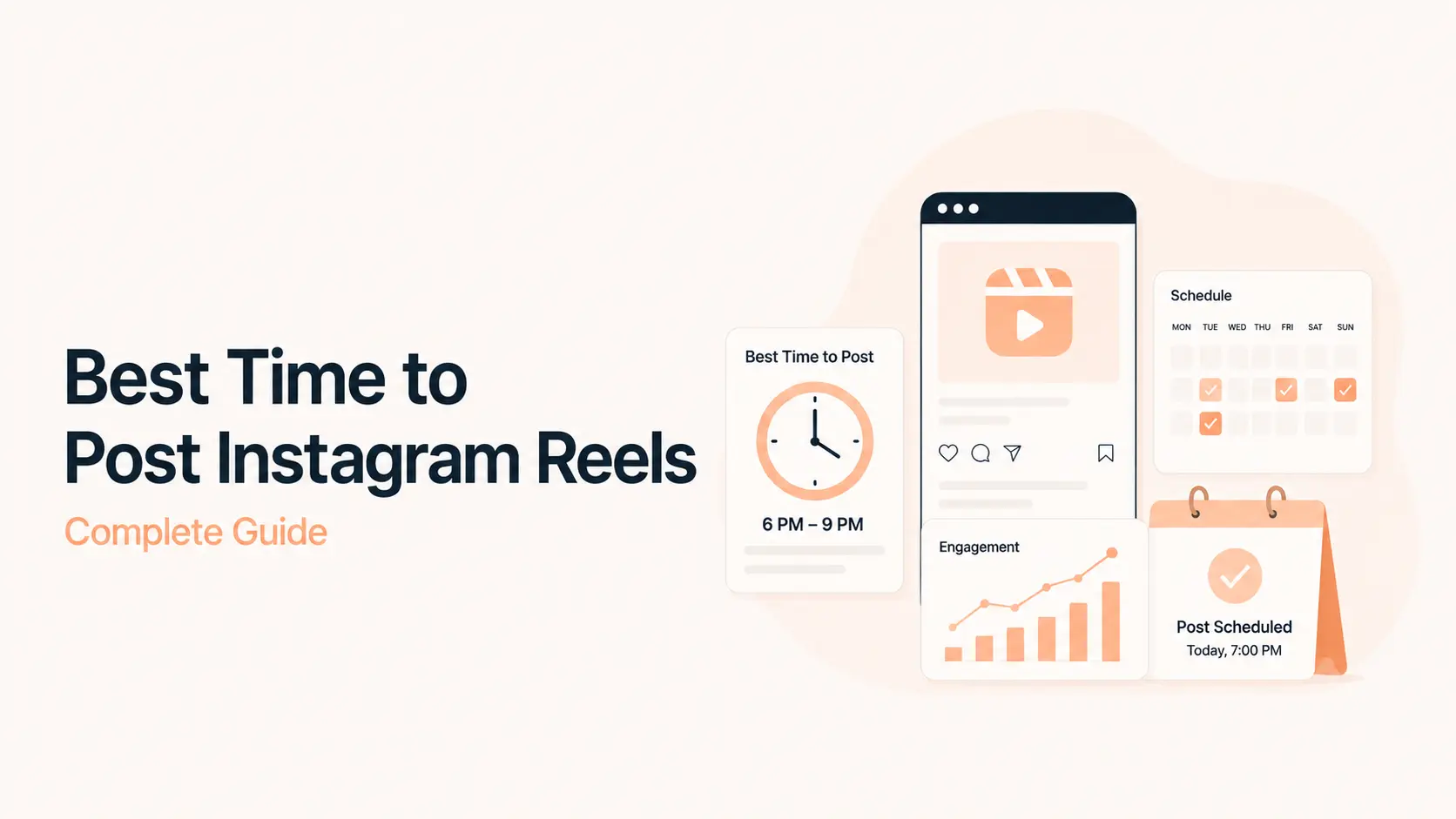

The best time to post Instagram Reels in 2026 depends on your audience, but current large-scale studies point to three useful starting windows: Monday around midnight to early morning, midweek afternoons, and Wednesday or Thursday evenings. The important part is that these studies use different datasets and methodologies, so there is no single hour that will outperform for every creator, brand, industry, and time zone.
Later analyzed more than 975,000 Instagram Reels and found 12 a.m. to be the strongest overall posting time, with Monday performing best and high engagement continuing through roughly 6 a.m. Buffer’s July 2026 Instagram study analyzed 9.6 million posts across formats and found evening engagement strongest on most weekdays, with Wednesday and Thursday especially strong for Reels. Sprout Social’s 2026 analysis points to a different midweek pattern, with Monday through Thursday afternoons generating high Instagram engagement.
This guide turns those benchmarks into a practical Instagram Reels posting schedule. You will see the best times by day, how to handle time zones, how Reels timing differs from feed posts, when timing matters most, which Instagram Insights metrics to use, and how to run a simple test to find the best time for your own account.
TL;DR
- Best Reels-specific benchmark: Later’s analysis of 975K+ Reels found 12 a.m. strongest overall, with Monday the best day and 12 a.m. to 6 a.m. a strong Monday window.
- Best evening benchmark: Buffer’s 2026 Instagram data favors 6 p.m. to 11 p.m. for Reels, especially Wednesday and Thursday.
- Best midweek benchmark: Sprout Social reports strong Instagram activity Monday 2–4 p.m., Tuesday 1–7 p.m., Wednesday 12–9 p.m., and Thursday 12–2 p.m.
- Use local audience time: apply benchmarks to the time zone where your target audience lives, not automatically to your own location.
- Best starting days: test Monday, Tuesday, Wednesday, and Thursday before putting your strongest Reel on a weaker weekend slot.
- Check your own data: Instagram Insights shows your followers’ most active times when you have a professional account and enough follower data.
- Measure more than likes: compare reach, views, watch time, average watch time, shares, saves, follows, and non-follower exposure.
- Timing cannot rescue weak content: the opening, retention, shareability, topic, and audience fit still matter more than a perfect publishing minute.
What is the best time to post Instagram Reels in 2026?
If you need one simple starting answer, test Wednesday or Thursday between 6 p.m. and 9 p.m. in your audience’s local time. Buffer’s latest 2026 analysis says Reels are strongest in the broader 6 p.m. to 11 p.m. evening window on those days. This is useful for creators and brands that want a practical schedule without starting at midnight.
If you are willing to test more aggressively, add Monday between 12 a.m. and 6 a.m. Later’s Reels-specific dataset found this to be the strongest day and window. That recommendation looks unusual, but the study analyzed more than 975,000 Reels rather than treating Reels exactly like photos and carousels.
A third useful benchmark comes from Sprout Social’s 2026 Instagram timing research. Its dataset, based on nearly 2 billion engagements across roughly 307,000 global social profiles, shows especially broad engagement windows on Tuesday and Wednesday. Sprout reports Monday 2–4 p.m., Tuesday 1–7 p.m., Wednesday 12–9 p.m., and Thursday 12–2 p.m. as strong Instagram periods.
The difference between these studies is not a problem to solve by choosing one “correct” source. They measure different account populations, time periods, and engagement patterns. Use them as testable starting points, then let your own Instagram Insights decide which window deserves a permanent place in your posting calendar.
Best times to post Instagram Reels by day
The table below combines current 2026 research into a practical testing schedule. It does not claim that every listed hour is a universal Reels peak. Use the primary window first, then test the secondary window if your account publishes often enough to compare results.
| Day | Primary Reels window to test | Secondary window | How to use it |
|---|---|---|---|
| Monday | 12 a.m.–6 a.m. | 6 p.m.–8 p.m. | Strong Reels-specific early window from Later; evening is easier for many local audiences |
| Tuesday | 3 p.m.–7 p.m. | 1 p.m.–3 p.m. | Strong midweek afternoon into evening period across Buffer and Sprout patterns |
| Wednesday | 6 p.m.–9 p.m. | 12 p.m.–3 p.m. | One of the strongest overall Instagram days; excellent starting day for important Reels |
| Thursday | 6 p.m.–9 p.m. | 9 a.m.–2 p.m. | Buffer favors Reels evenings while broader Instagram data also shows a Thursday daytime opportunity |
| Friday | 8 p.m.–10 p.m. | Late afternoon | Weaker overall day in Buffer’s dataset, so use for lighter or timely Reels |
| Saturday | 8 p.m.–10 p.m. | Test only if audience data supports it | Often weaker than midweek; entertainment niches may still perform well at night |
| Sunday | 8 p.m.–10 p.m. | Late evening | Useful weekend wind-down period before Monday |
All of these times should be read as audience-local time. If most of your followers live in New York, use Eastern Time. If most live in Dhaka, use Bangladesh Standard Time. If your audience is split across several countries, prioritize the region that matters most commercially or build separate test windows for each major audience cluster.
Monday: test midnight to early morning first
Monday is the most interesting day because Later’s Reels-specific analysis differs sharply from the midweek evening pattern found elsewhere. After analyzing more than 975,000 Reels, Later found 12 a.m. to be the strongest overall time and Monday to be the best Reels day, with high engagement extending through 6 a.m.
Do not assume this means your followers are awake at 3 a.m. One possible reason early posting can work is that the Reel has time to collect initial distribution before the audience begins its morning scroll. Global audiences can also create engagement while one region is asleep. The practical way to use this finding is to schedule a small group of Monday Reels between midnight and 6 a.m. and compare their 24-hour performance with your normal evening posts.
Tuesday: afternoon to early evening is a strong baseline
Tuesday is one of the stronger Instagram days across current studies. Sprout Social reports a broad 1 p.m. to 7 p.m. engagement window. Buffer’s data also shows Tuesday strength around 3 p.m., 5 p.m., and 7 p.m. across Instagram posts.
For Reels, start around 3 p.m. to 7 p.m. This gives you several audience behaviors to work with: afternoon breaks, commute periods, and evening entertainment. Educational, product, creator, and B2B Reels may perform differently inside that range, so compare two or three fixed slots rather than shifting the publishing time randomly every week.
Wednesday: one of the best days for important Reels
Wednesday is the safest high-priority testing day. Buffer ranks Wednesday as the strongest Instagram day overall and recommends Wednesday or Thursday evening for Reels. Sprout Social shows a very wide Wednesday engagement window from noon through 9 p.m.
If you have one flagship Reel for the week, test 6 p.m. to 9 p.m. Wednesday. If your audience is active during the workday, also test 12 p.m. to 3 p.m. This is useful for tutorials, industry commentary, educational Reels, and content designed for lunch-break viewing.
Thursday: evening for Reels, daytime as a second test
Thursday is another strong Reels day in Buffer’s latest guidance. Its 2026 study specifically recommends Wednesday and Thursday evenings, generally between 6 p.m. and 11 p.m., when people have more time for entertainment-led scrolling.
Thursday is also unusual because Buffer’s overall Instagram data shows a strong morning peak around 7 a.m. to 9 a.m., while Sprout Social favors noon to 2 p.m. That gives you a good A/B testing opportunity. Use one Thursday evening slot for discovery-led Reels and one daytime slot for informational or professional content, then compare watch time, shares, saves, and follows.
Friday: use evening slots, but save your best Reel for midweek
Friday is a weaker Instagram day in Buffer’s 2026 dataset. That does not mean you should stop posting. It means your highest-value launch, collaboration, tutorial, or campaign Reel may have a better statistical starting point earlier in the week.
If Friday is part of your schedule, try 8 p.m. to 10 p.m. when audiences are more likely to be in leisure mode. Entertainment, fashion, food, travel, nightlife, events, and weekend-related content may naturally fit Friday better than B2B or work-focused Reels.
Saturday: audience fit matters more than a global benchmark
Saturday often performs weaker in platform-wide Instagram timing studies, but category behavior can override the average. A restaurant, fashion creator, travel page, sports account, local event brand, or entertainment creator may have an audience that is especially active on Saturday.
Start with 8 p.m. to 10 p.m. and compare it with a weekday control slot. If Saturday repeatedly delivers higher shares, views, or non-follower reach for your niche, trust your account data rather than forcing the global average onto your strategy.
Sunday: test the evening wind-down period
Sunday evening is a useful weekend window because people often return to their phones before the workweek begins. Buffer’s overall Instagram data highlights roughly 8 p.m. to 10 p.m. on Sunday, with 9 p.m. especially strong.
This window works well for planning content, weekly recaps, motivation, educational tips, product inspiration, and Reels that naturally lead into Monday. If your audience is primarily students, shift the experiment earlier to match evening routines before classes or work.
Why Buffer, Later, and Sprout Social recommend different times
Timing studies are often presented as if one source must be right and the others wrong. That is not how social media data works. The studies are measuring different groups of accounts, different time periods, and sometimes different content formats.
| Source | Dataset | Main Reels/Instagram finding | Important caveat |
|---|---|---|---|
| Later | 975K+ Reels; 6M+ Instagram posts overall | 12 a.m. strongest for Reels; Monday best, especially 12–6 a.m. | Historical dataset spans a different period and account mix |
| Buffer | 9.6M Instagram posts in 2026 report | Reels: 6–11 p.m., strongest Wednesday and Thursday | Format guidance uses an all-post dataset rather than a separate Reels-only sample |
| Sprout Social | Nearly 2B engagements across 307K profiles | Strong Instagram engagement Monday–Thursday, especially midweek afternoons | Aggregates engagement across Instagram content types |
| Instagram Insights | Your own followers and Reel performance | Shows when followers are active and how individual Reels perform | Your most active follower time is not automatically your highest-performing posting time |
The useful conclusion is not “nobody knows.” It is that platform-wide studies give you candidates, while your own account data chooses the winner. Start with two or three evidence-backed windows and test them consistently enough to separate timing from content quality.
Does posting time really matter for Instagram Reels?
Yes, but timing is a multiplier rather than the foundation. Publishing while more relevant users are active can improve the chance of early views, shares, saves, comments, and follows. Those early responses give Instagram more evidence about who may find the Reel useful or entertaining.
Timing still cannot compensate for a weak first second, unclear topic, poor retention, copied content, misleading hook, or video that gives people no reason to share. If your Reels consistently lose viewers immediately, changing from 5 p.m. to 7 p.m. will not fix the core problem.
This is why timing should sit inside a broader social media growth strategy. Distribution starts with getting the Reel in front of people, but sustainable growth comes from holding attention and converting that attention into repeat viewers, followers, site visits, leads, or sales.
How Instagram Reels timing differs from normal Instagram posts
Reels are consumed differently from carousels, photos, and Stories. People often open Reels for entertainment and discovery, while carousels may be used more deliberately for education, reference, or deeper reading. That makes evening leisure periods a logical Reels test even when another format performs well earlier in the day.
Buffer’s 2026 research explicitly notes that Reels make sense in the evening because users have more time to watch and share entertainment content. Later’s separate Reels dataset complicates that picture by finding strong midnight and early-morning performance. The safest strategy is to keep Reels timing as its own experiment rather than assuming the best time for a carousel is automatically the best time for a Reel.
Best time to post Reels for views vs engagement
The “best time” depends on what you are trying to improve. One window may generate more views, another may generate stronger saves and shares, and another may create more profile visits or follows. Do not optimize every Reel around likes alone.
- For views and non-follower reach: test high-activity evening windows and broad midweek periods when discovery audiences are active.
- For shares: entertainment, relatable, practical, or identity-based Reels may benefit from evening downtime when people are actively messaging friends.
- For saves: tutorials, checklists, recipes, workouts, educational tips, and reference content can perform during lunch or evening planning periods.
- For follows: measure which posting windows produce profile visits and follows from individual Reels, not only raw views.
- For clicks or sales: align the Reel with the audience’s buying or decision-making context, which can differ from the highest-engagement hour.
Use your audience’s time zone, not your own
A posting-time chart is useless if you apply it to the wrong clock. When a study says Wednesday at 6 p.m., interpret that as 6 p.m. where the audience you want to reach is located unless the source explicitly uses a fixed time zone.
If most followers are in one country
Use that country’s local time. A Bangladesh-based creator targeting Bangladesh should schedule around Bangladesh Standard Time. A Bangladesh-based agency targeting businesses in New York should test Eastern Time instead.
If your audience spans the United States
Eastern and Pacific Time are three hours apart. A practical compromise is to test late afternoon Eastern Time, which lands around early afternoon Pacific Time, or publish separate high-value Reels for the region that matters most. Do not try to make every post perfect for every US time zone.
If your audience is global
Look at your follower locations in Instagram Insights and identify the top two or three regions. Build separate test slots around those regions. Large global accounts may discover that an unusual local posting time performs well because another major audience cluster is awake.
How to find your personal best time to post Instagram Reels
Instagram gives professional accounts first-party data about audience activity. According to Instagram’s official Insights documentation, Total followers insights can show follower growth, top locations, age ranges, and the times followers are most active on Instagram when the account has enough follower data.
Use this data as a starting signal, then combine it with the performance of actual Reels. Follower activity tells you when followers are online. It does not prove they are most likely to watch, share, or save your Reels at that exact hour.
- Open your Instagram profile and go to the Professional dashboard.
- Open Insights and review your follower or audience activity information.
- Note your strongest days and the hours when followers are most active.
- Choose two or three publishing windows that overlap your audience activity and current 2026 benchmark data.
- Publish comparable Reels in those windows for several weeks.
- Review each Reel’s views, reach, watch time, average watch time, saves, shares, comments, and follows.
- Keep the windows that repeatedly produce stronger business or growth outcomes.
Instagram’s official Reel Insights also reports views, accounts reached, watch time, average watch time, likes, comments, saves, shares, and follows generated by a Reel. That gives you a much stronger timing test than simply asking which post got the most likes.
A 30-day Instagram Reels timing test
You do not need a complicated analytics model. A four-week experiment is enough to identify whether your account behaves more like the early-morning Later dataset, the midweek Sprout pattern, or the evening Buffer pattern.
Week 1: establish three timing windows
- Window A: Monday between 12 a.m. and 6 a.m.
- Window B: Tuesday or Wednesday between 1 p.m. and 5 p.m.
- Window C: Wednesday or Thursday between 6 p.m. and 9 p.m.
Keep the content quality reasonably comparable. Do not test a weak filler Reel at midnight against your best collaboration Reel at 7 p.m. and conclude that the timing caused the difference.
Week 2: repeat the windows
Run the same windows again with different but similarly important content. Look for repeated patterns rather than one viral outlier. Record performance after consistent intervals such as 2 hours, 24 hours, and 7 days.
Week 3: narrow the winning window
If evening Reels consistently win, narrow the experiment to 6 p.m., 8 p.m., and 10 p.m. If early posts win, test 12 a.m., 3 a.m., and 5 a.m. If afternoons win, compare 1 p.m., 3 p.m., and 5 p.m.
Week 4: match timing to content type
Now split the schedule by content. Your educational Reels may perform best during lunch, while entertainment-led Reels may perform better at night. Product demos, local content, news, trends, or event-related videos can also have their own timing patterns.
Best Reels posting time by content type
| Reel type | Useful starting window | Why it may fit |
|---|---|---|
| Entertainment and relatable content | 6–11 p.m. | Users have more leisure time and may be more likely to share with friends |
| Educational tutorials | 12–3 p.m. or 6–9 p.m. | Lunch breaks and evening learning sessions |
| B2B and professional content | 9 a.m.–2 p.m. midweek | Closer to working and decision-making hours |
| Food and recipes | Late morning, lunch, or early evening | Matches planning and meal-related intent |
| Fitness | Early morning or early evening | Aligns with common workout planning periods |
| Beauty and fashion | Afternoon or evening | Works with inspiration, browsing, and shopping behavior |
| Local events and nightlife | Afternoon into evening | Closer to when people decide what to do |
| Product demos | Lunch and evening | Provides time to watch, compare, and click |
These are behavioral starting points, not guaranteed algorithm rules. Industry and audience intent can shift the best posting time substantially.
How often should you post Instagram Reels?
There is no universal Reels frequency that guarantees growth. Buffer’s broader Instagram research suggests a useful overall feed cadence of roughly three to five posts per week across Reels, carousels, and photos. Your mix depends on production quality, audience appetite, and whether Reels are your main acquisition format.
If Reels drive most of your non-follower reach, you might publish three Reels per week and use carousels, Stories, or photos around them. If one high-quality Reel takes several days to research and produce, two strong Reels can be better than five rushed ones.
For a broader follower-growth plan, see Tenfic’s guide to growing Instagram followers in 2026. Timing works best when the profile, content promise, recommendation eligibility, and follow conversion path are already clear.
Can you schedule Instagram Reels?
Yes. Scheduling is useful when your best audience time falls outside your normal working hours. It also makes timing experiments more reliable because you can publish at the same controlled slots rather than whenever someone on the team remembers.
For brands running multiple platforms, a structured social media automation workflow can handle scheduling, approvals, asset routing, and reporting while keeping content strategy and final creative review human-led.
Do hashtags, keywords, and Instagram SEO change the best time?
Keywords and timing solve different problems. Timing helps your Reel enter the system when more relevant users may be active. Instagram and social media SEO help the platform and audience understand what the content is about and where it may be relevant in search and discovery.
Use clear topic language in the caption, on-screen text, spoken content, and profile context where it fits naturally. Relevant hashtags can add classification context, but they do not turn a weak Reel into a strong one. Search optimization can also extend the useful life of a Reel beyond the first hour, which reduces the pressure to hit one perfect posting minute.
What metrics should you track after posting a Reel?
Instagram’s official Reel Insights gives professional accounts several metrics that are useful for timing analysis. Build a small scorecard instead of relying on likes alone.
| Metric | What it tells you | Why it matters for timing |
|---|---|---|
| Views | Total starts and replays | Shows overall consumption, though repeat views can inflate the count |
| Accounts reached | Unique accounts that saw the Reel | Useful for comparing distribution between posting windows |
| Watch time | Total time spent watching | Helps separate high reach from genuinely consumed content |
| Average watch time | Average viewing duration | Shows whether a time slot brings a more attentive audience |
| Shares | How often people shared the Reel | Important for discovery and word-of-mouth distribution |
| Saves | How often users kept the Reel | Strong signal for reference or educational value |
| Follows | Followers generated by the Reel | Connects timing to actual account growth |
Compare these metrics by content series as well as by time slot. A timing window that looks weak overall may be excellent for one specific type of Reel.
Common Instagram Reels timing mistakes
- Using your own time zone automatically: schedule for the audience you want to reach.
- Testing every Reel at a different time: random timing makes patterns difficult to identify.
- Comparing unequal content: a viral collaboration and an average filler post are poor controls for a timing test.
- Judging performance after 20 minutes: give Reels enough time to distribute before declaring a slot a failure.
- Optimizing only for likes: watch time, shares, saves, follows, and reach often tell you more.
- Following one global benchmark forever: account behavior changes as your audience, region, content mix, and follower count change.
- Posting weak content at a “perfect” time: creative quality and audience relevance still determine whether viewers stay.
- Ignoring search intent: some Reels earn ongoing discovery from search and recommendations long after the initial posting window.
A simple weekly Instagram Reels posting schedule
If you want a schedule you can use immediately, start with three Reels per week. This gives you enough data to compare timing without forcing daily production.
| Slot | Time | Purpose |
|---|---|---|
| Monday test | 12 a.m.–6 a.m. | Test Later’s Reels-specific early window |
| Wednesday core slot | 6–9 p.m. | Use for one of the week’s strongest discovery Reels |
| Thursday core slot | 6–9 p.m. | Repeat the evening pattern or compare against a 9 a.m.–2 p.m. daytime slot |
After four weeks, keep the two strongest windows and replace the weakest with a new test. If your account needs a larger publishing system across Reels, TikTok, X, and other channels, Tenfic’s content pillar guide can help turn repeated topics into a more sustainable content calendar.
How Reels timing fits with TikTok and other short-form platforms
Do not assume one short-form video schedule works everywhere. TikTok and Instagram have different audiences, recommendation systems, search behavior, and engagement patterns. A video can also need a different hook, caption, cover, and length on each platform.
If you publish on both platforms, compare this guide with Tenfic’s best time to post on TikTok in 2026. Repurpose the underlying idea, then schedule and package each version for the platform where it appears.
Build your Reels schedule around evidence, not one magic hour
The best time to post Instagram Reels in 2026 is not one universal timestamp. Current data gives you several strong starting points: Monday midnight to early morning from Later’s Reels-specific dataset, midweek afternoons from Sprout Social, and Wednesday or Thursday evenings from Buffer’s latest Instagram research.
Pick two or three windows, apply them to your audience’s local time, and run a controlled test. Then compare reach, watch time, shares, saves, follows, and business outcomes. Once your own data is strong enough, it should outrank every generic benchmark in this article.
If the challenge is producing enough high-quality content to test consistently, Tenfic’s content marketing services can help build the research, production, and distribution system around your social content.
Frequently asked questions
What is the best time to post Instagram Reels in 2026?
A practical starting window is Wednesday or Thursday from 6 p.m. to 9 p.m. in your audience’s local time. Buffer’s 2026 data favors 6 p.m. to 11 p.m. for Reels, while Later’s Reels-specific study found Monday from 12 a.m. to 6 a.m. especially strong. Test both patterns against your own Insights.
What is the best day to post Instagram Reels?
Later’s Reels-specific dataset found Monday strongest, while Buffer’s broader 2026 Instagram analysis ranks Wednesday highest overall and recommends Wednesday and Thursday evenings for Reels. Your own audience may favor one pattern more strongly.
Is morning or evening better for Instagram Reels?
Both deserve testing. Later found strong Reels performance at midnight and early Monday morning, while Buffer recommends evening Reels between 6 p.m. and 11 p.m. Compare early and evening windows on your own account rather than assuming one applies universally.
Should I post Reels in my time zone or my audience’s time zone?
Use the time zone of the audience you want to reach. If you live in Bangladesh but most customers are in the United States, schedule around the relevant US audience rather than Bangladesh time.
How can I see when my Instagram followers are most active?
Professional accounts can use Instagram Insights to review follower trends, top locations, and most active times when enough follower data is available. Use those activity periods as candidate posting windows and validate them with actual Reel performance.
Does posting time affect Instagram Reel views?
It can affect early distribution because more relevant viewers may be active when the Reel is published. However, the topic, opening, watch time, shareability, originality, and audience fit usually have a larger effect than the difference between two nearby posting times.
How often should I post Reels for growth?
There is no required Reels frequency. A practical starting approach is two or three strong Reels per week, then add other Instagram formats around them. Increase frequency only when you can maintain content quality and meaningful audience response.
What is the worst time to post Instagram Reels?
Later’s analysis of more than 975,000 Reels found Wednesday at 2 a.m. to be the weakest Reels-specific slot in its dataset. Buffer’s broader Instagram research also finds overnight periods generally weak, although the Later study shows some early-morning exceptions.
Should I post a Reel exactly when followers become active?
Not necessarily. Follower activity tells you when people are online, not the exact moment they will engage most with your content. Test posting slightly before and during the strongest activity period and compare real performance.
Do Instagram Reels need a different posting schedule than carousels?
They can. Reels are often consumed for entertainment and discovery, while carousels may attract more deliberate reading and saving behavior. Keep separate timing data for Reels when the format is important to your strategy.