
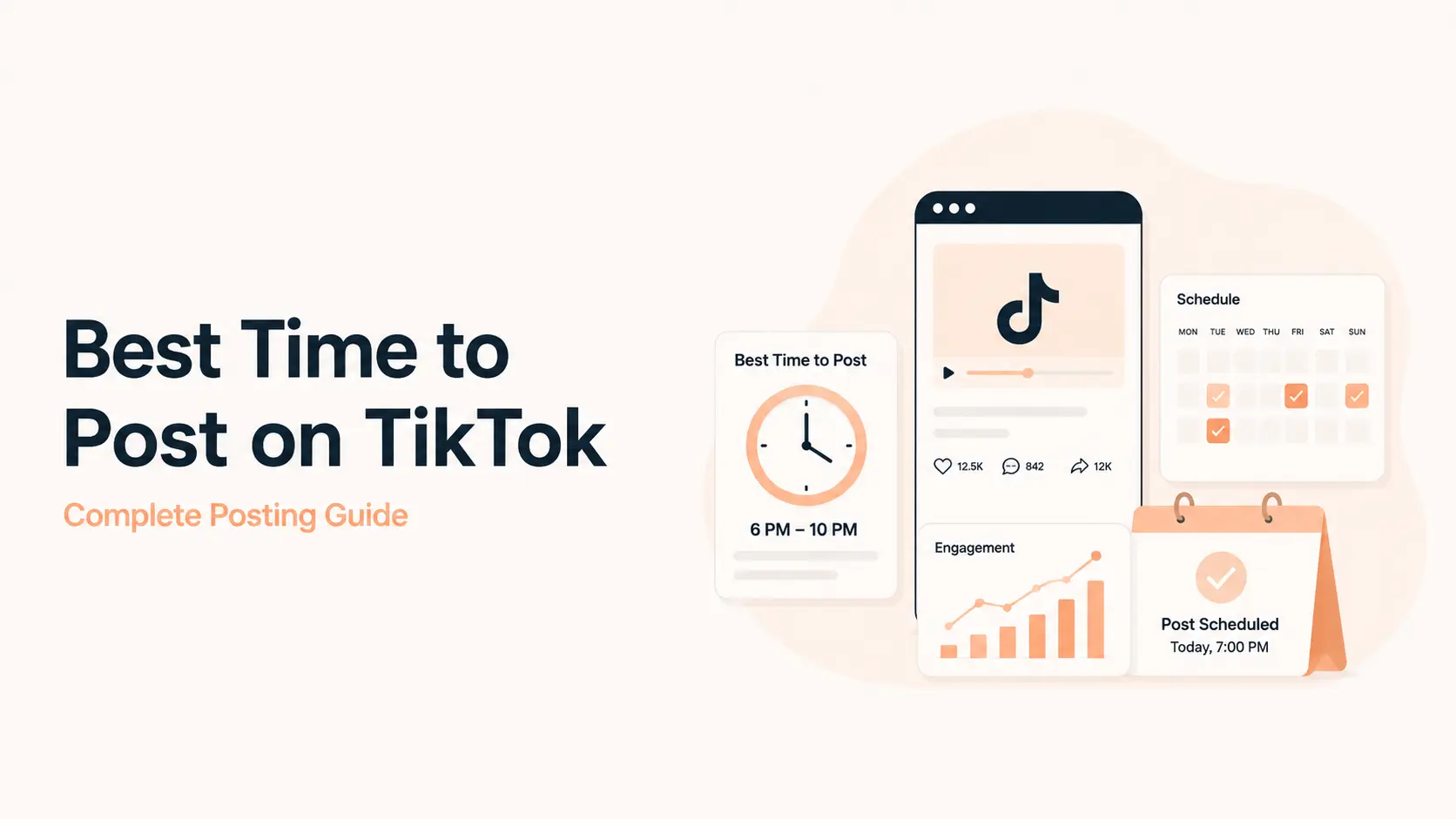

The best time to post on TikTok in 2026 is not one universal hour. The strongest current datasets point to several reliable windows, but they do not agree on one perfect slot. Buffer’s July 2026 analysis of 7.1 million TikTok posts found the single strongest time was Sunday at 9 a.m., with evenings and weekends performing well overall. Sprout Social’s 2026 study, based on nearly 2 billion social engagements across 307,000 global profiles, found the strongest TikTok window was Tuesday through Thursday from 2 p.m. to 6 p.m. local time.
That difference is not a problem. It is the most useful lesson in the data. The best TikTok posting time depends on your audience, location, niche, content format, and goal. A gaming creator with a young evening audience may see a completely different pattern from a B2B software brand whose viewers scroll during work breaks.
This guide gives you the best TikTok posting times by day, explains what the major 2026 studies actually found, shows how time zones change your schedule, and gives you a simple testing method for finding the best time to post on TikTok for your own account.
TL;DR
- Best single time from Buffer’s 2026 data: Sunday at 9 a.m.
- Best overall day from Buffer: Saturday, followed by Monday and Sunday.
- Strongest general window from Sprout Social: Tuesday through Thursday, 2 p.m.–6 p.m. local time.
- Strong recurring pattern: Buffer found engagement generally improves from 6 p.m.–11 p.m., especially toward the weekend.
- Do not blindly convert global charts: use the times as audience-local starting points, then check TikTok Studio Analytics for your own viewers’ activity times.
- Post slightly before a known activity peak: testing 15–60 minutes before your audience’s busiest period can give the post time to collect early views.
- Timing cannot rescue weak content: watch time, completion, shares, comments, saves, and skips still matter more than the clock.
- Best practical approach: test two or three strong time slots for at least several weeks and compare median performance instead of judging one viral post.
Best time to post on TikTok in 2026 at a glance
If you need a schedule before you have enough account data, Buffer’s 2026 study offers a useful starting point. It analyzed median engagement across 7.1 million TikTok posts and reported the following top times for each day.
| Day | Best time | Other strong times | Practical starting window |
|---|---|---|---|
| Monday | 1 p.m. | 11 a.m., 8 a.m. | Late morning to early afternoon |
| Tuesday | 6 a.m. | 10 p.m., 7 a.m. | Early morning or late evening |
| Wednesday | 10 p.m. | 6 a.m., 9 p.m. | Early morning or late evening |
| Thursday | 1 p.m. | 10 p.m., 6 a.m. | Lunch period or late evening |
| Friday | 6 p.m. | 10 p.m., 8 p.m. | Evening |
| Saturday | 5 p.m. | 4 p.m., 3 p.m. | Mid-to-late afternoon |
| Sunday | 9 a.m. | 1 p.m., 12 p.m. | Morning to early afternoon |
Source: Buffer’s 2026 TikTok timing analysis. Buffer says its recommended times were normalized so they can be used as general local-time starting points rather than converted from one fixed time zone.
Sprout Social reaches a different conclusion. Its 2026 TikTok posting study found the strongest overall engagement from Tuesday through Thursday between 2 p.m. and 6 p.m. local time. This is why any guide that presents one universal TikTok posting hour as a rule is oversimplifying the data.
What is the best time to post on TikTok?
For a new account with little or no analytics, a practical 2026 starting strategy is to test weekday late afternoons, weekday evenings, and weekend high-activity periods. If you want one single slot to test first, Sunday at 9 a.m. is the strongest individual time in Buffer’s latest dataset. If you want a broader recurring window that is easier for a business content calendar, Tuesday through Thursday from 2 p.m. to 6 p.m. is supported by Sprout Social’s latest data.
Once your account has enough viewer data, stop treating industry-wide benchmarks as the answer. TikTok Studio exposes viewer activity times and follower insights. Those numbers are more relevant to your account than a global average because they reflect the people who already watch your content.
TikTok’s own TikTok Studio documentation says the Analytics area includes viewer demographics and activity times, along with follower insights and post-level performance. Use global studies to choose your first tests; use your own analytics to refine them.
Why posting time matters on TikTok
TikTok does not simply show every new video to all followers in chronological order. Its recommendation systems use a combination of user interactions, content information, and user information to decide what appears in feeds. TikTok’s current recommendation documentation lists signals such as watch behavior, likes, shares, comments, skips, language, location, time zone, day, sounds, hashtags, and other contextual information.
For most users, TikTok says interaction signals such as the time spent watching a video are weighted more heavily than many other inputs. That means timing should be understood as a distribution advantage, not a ranking hack. Posting when more relevant viewers are active gives a good video more opportunities to earn useful signals early.
A weak TikTok posted at the “best” time can still fail. A strong TikTok posted outside the ideal window can still travel for hours or days through the For You feed. The clock affects the starting conditions. The content determines whether the distribution keeps expanding.
This is also why posting time should be combined with a broader social media growth strategy. Timing can improve the launch of a post, but retention, relevance, shares, profile conversion, search discovery, and consistency determine whether the account grows.
Why 2026 TikTok timing studies disagree
You may see one study say Sunday morning is best, another say weekday afternoons, and another highlight Thursday morning or Saturday midday. That does not automatically mean one study is wrong. They can be measuring different things.
| Reason results differ | Why it changes the answer |
|---|---|
| Different sample sizes | A dataset of millions of posts can have a different account mix than a panel of business profiles. |
| Different account types | Creators, local businesses, publishers, ecommerce brands, and enterprise accounts attract different audiences. |
| Different success metrics | Views, median engagement rate, total engagements, clicks, sales, and follower growth can peak at different times. |
| Different geographies | A global dataset blends audiences with different workdays, commute patterns, school schedules, and cultural habits. |
| Different content mixes | Entertainment, tutorials, reviews, news, B2B content, and TikTok Shop videos are consumed in different contexts. |
| Different study periods | Audience habits change over time, especially as TikTok’s user base, formats, and recommendation systems evolve. |
The practical response is not to average every study into one meaningless number. Pick credible benchmarks, test them against your audience, and keep the schedule that produces the outcomes you actually care about.
Best time to post on TikTok on Monday
Best starting time: 1 p.m. Buffer’s 2026 data places Monday at 1 p.m. first, followed by 11 a.m. and 8 a.m. Monday is also one of its strongest days overall.
Monday can work well for educational, productivity, career, fitness, planning, and business content because users are settling into the week and often check short-form content around morning routines and lunch. If your audience is primarily students or entertainment viewers, test an evening slot as well rather than assuming midday will win.
Best time to post on TikTok on Tuesday
Best Buffer time: 6 a.m. The next strongest Tuesday slots in Buffer’s dataset are 10 p.m. and 7 a.m. Sprout Social, however, sees Tuesday as part of its high-performing 2 p.m.–6 p.m. weekday window.
Tuesday is therefore an excellent day for controlled testing. Try an early-morning post for two or three weeks, then compare it against a mid-afternoon or early-evening post with similar content quality. If one slot consistently produces stronger watch time, shares, or conversions, your account has already given you a better answer than the global average.
Best time to post on TikTok on Wednesday
Best Buffer time: 10 p.m. Other strong Wednesday slots in Buffer’s data are 6 a.m. and 9 p.m. Buffer ranks Wednesday as one of its weaker days overall, while Sprout Social lists Wednesday among its strongest TikTok days.
This disagreement makes Wednesday especially audience-dependent. If your viewers use TikTok after work or school, late evening may perform well. For brands with office-hour audiences, Wednesday afternoon may be stronger. Use Wednesday as a day to compare audience segments rather than dismissing it because one benchmark calls it weak.
Best time to post on TikTok on Thursday
Best Buffer time: 1 p.m. Buffer’s secondary Thursday times are 10 p.m. and 6 a.m. Hootsuite’s current TikTok guidance also identifies Thursday morning, roughly 6 a.m.–9 a.m., as one of its strong overall windows, while Sprout Social favors the afternoon.
Thursday is a good day to test three distinct consumption periods: morning routine, lunch/afternoon break, and late evening. For ecommerce and creator accounts, late-week purchase or entertainment intent can also affect performance, so compare more than likes. Track product clicks, profile visits, link clicks, saves, shares, and follower gains.
Best time to post on TikTok on Friday
Best starting time: 6 p.m. Buffer’s next strongest Friday slots are 10 p.m. and 8 p.m. The pattern is unusually clear: Friday is an evening day in its dataset.
That timing makes sense for entertainment, food, travel, fashion, gaming, nightlife, shopping, lifestyle, and weekend-planning content. Business and educational accounts can still perform, but the framing may need to match the moment. A quick checklist, weekly lesson, or “save this for Monday” post often fits Friday evening better than a dense tutorial.
Best time to post on TikTok on Saturday
Best starting time: 5 p.m. Buffer ranks Saturday as the best day of the week overall, with 5 p.m., 4 p.m., and 3 p.m. as its strongest Saturday slots. Hootsuite also identifies Saturday midday through afternoon as a strong TikTok period in its current guidance.
Saturday gives users longer unstructured browsing periods, which can help entertainment, hobbies, shopping, travel, food, DIY, home, fitness, and creator content. If TikTok is important to your growth strategy, Saturday afternoon is one of the strongest general windows to test.
Best time to post on TikTok on Sunday
Best starting time: 9 a.m. This is the highest-performing individual time in Buffer’s 7.1-million-post analysis. Sunday at 1 p.m. and 12 p.m. also perform strongly in that dataset.
Sprout Social, however, lists Sunday as its weakest overall TikTok day. That contrast is another reason to avoid treating benchmarks as universal law. For some audiences, Sunday is prime leisure time. For others, activity may be fragmented around family, travel, sports, religious commitments, or preparation for the week.
If Sunday is important to your content calendar, test it directly. A three-week comparison between Sunday morning and a strong weekday afternoon can tell you more about your audience than another generic chart.
What are the worst times to post on TikTok?
There is no globally “bad” hour that should never be used. Still, Buffer’s 2026 dataset found that 12 p.m.–5 p.m. often produced lower engagement across many days, even though some individual afternoon slots performed very well. Sprout Social’s dataset reaches almost the opposite conclusion for Tuesday through Thursday, where 2 p.m.–6 p.m. is its best period.
This is exactly why a broad “avoid afternoons” rule would be misleading. A time is only bad for your account if repeated tests show that similar-quality content underperforms there.
- Avoid posting when your own viewer-activity chart is consistently low.
- Avoid choosing a time purely because it is convenient for you when most of the audience lives elsewhere.
- Avoid publishing several important posts too close together if they compete for the same initial audience.
- Avoid judging a time slot after one post; topic strength can overpower timing.
- Avoid optimizing only for likes when your real goal is watch time, followers, leads, Shop sales, or affiliate clicks.
Best time to post on TikTok by time zone
The most useful time zone is the one your audience lives in, not the one you live in. If your account is based in Bangladesh but most viewers are in the United States, posting at 6 p.m. Bangladesh time may miss the strongest US activity window. If your audience is mainly local, use Bangladesh local time.
Buffer says its 2026 times are normalized so creators can use them as general local-time recommendations. Sprout Social also reports its recommended hours in local time. That means you should normally read “6 p.m.” as 6 p.m. where the target audience is.
| Audience setup | How to schedule |
|---|---|
| Mostly one country or time zone | Use the audience’s local time and test the strongest benchmark windows there. |
| US audience split between Eastern and Pacific | Test overlap periods such as early afternoon Eastern / late morning Pacific, then compare with evening Eastern slots. |
| US + UK/Europe audience | Early-to-mid afternoon Eastern can reach evening viewers in the UK and parts of Europe. |
| Asia + North America audience | One post may not cover both well. Use separate posting windows if each region matters commercially. |
| Global creator audience | Follow TikTok Studio viewer activity rather than manually averaging countries. |
| Local business | Use the business’s customer time zone and prioritize periods before purchase or visit decisions. |
Should you post before your audience’s peak time?
Usually, it is worth testing. If your viewers are most active at 8 p.m., try publishing at 7:15, 7:30, 7:45, and 8 p.m. across comparable posts. Posting slightly before the peak can give TikTok time to process the post and begin matching it with viewers as activity rises.
Do not treat “30 minutes before peak” as a permanent rule. The ideal lead time can vary by account and content. Fast-moving trend content may benefit from immediate relevance; evergreen tutorials can continue distributing long after publication.
How to find your own best time to post on TikTok
Global data becomes much more useful when you combine it with your own TikTok analytics. The goal is to move from “What time works on TikTok?” to “What time consistently works for this account, this audience, and this type of content?”
1. Open TikTok Studio Analytics
Open your TikTok profile, go to TikTok Studio, then open Analytics. TikTok Studio includes account, content, viewer, and follower insights. The Viewer area can include viewer demographics and activity times, while follower analytics provides additional audience information.
2. Record viewer activity peaks
Do not look at one day and immediately change the schedule. Record the strongest activity periods for at least one or two weeks. Look for repeated peaks: perhaps weekday evenings remain strong, Saturday afternoon stands out, or mornings repeatedly outperform expectations.
3. Compare similar content at different times
Timing tests are useless if one slot gets your best video of the month and the other gets a weak filler post. Compare content from the same pillar, format, length, and intent where possible. If you publish tutorial videos, compare tutorials against tutorials. If you publish product demonstrations, compare similar products and hooks.
A clear content pillar strategy makes this easier because you can test timing without changing the subject every time you publish.
4. Track more than views
A time slot can generate more views but worse business results. Track the metrics tied to your goal:
- Reach: views and unique viewers.
- Retention: average watch time, completion, and drop-off behavior.
- Engagement: likes, comments, shares, saves, Duets, and Stitches where relevant.
- Audience growth: profile visits and new followers.
- Search: search-driven views and query performance where available through Creator Search Insights.
- Commercial: product clicks, affiliate sales, leads, website visits, Shop revenue, or conversions.
If monetization is the goal, use timing together with the earning methods in Tenfic’s TikTok monetization guide. The best time for Creator Rewards watch time may not be the same as the best time for TikTok Shop purchases or brand-campaign engagement.
5. Calculate performance by time slot
Create a simple spreadsheet with day, posting time, content pillar, format, video length, views, watch time, shares, comments, followers gained, and conversions. After several weeks, group posts by time window and compare median results rather than the average. Median performance is less likely to be distorted by one viral outlier.
6. Keep retesting as the audience grows
Your best posting time is not permanent. As a TikTok account grows, its geographic mix, age distribution, follower behavior, content categories, and recommendation reach can change. Recheck the schedule every month or quarter, and test new slots when the current pattern weakens.
Best TikTok posting time by content type
Content context changes when people are willing to watch. Use these as test hypotheses, not rules.
| Content type | Good windows to test | Why |
|---|---|---|
| Entertainment and comedy | Evenings and weekends | Viewers have more leisure time and may watch longer sessions. |
| Education and tutorials | Morning, lunch, evening | Useful content can fit learning breaks and save-for-later behavior. |
| B2B and professional content | Weekday morning to late afternoon | Professional audiences may browse during workday breaks. |
| Fitness | Early morning, lunch, early evening | These periods often align with workout planning and routines. |
| Food and recipes | Late morning, afternoon, early evening | Content can influence meal planning and immediate cooking decisions. |
| TikTok Shop / ecommerce | Afternoon, evening, weekends | Users may have more time to watch demonstrations, compare products, and buy. |
| News and commentary | Publish close to the event | Speed and relevance can matter more than the standard posting calendar. |
| Local business | Before purchase or visit windows | Restaurants, events, salons, gyms, and stores should post before customers decide where to go. |
Best time to post on TikTok for views vs engagement
The posting time that maximizes views may not maximize comments, follows, clicks, or sales. A broad entertainment audience may create high evening views, while a smaller weekday audience may be more likely to save a tutorial, click a product, or follow a professional account.
Define the primary outcome before judging the schedule. For a creator, that may be qualified views and followers. For an ecommerce account, it may be product-view rate and sales. For a service business, profile visits, search discovery, and leads may matter more than raw engagement.
Does TikTok SEO change the best posting time?
Search-oriented TikTok content can have a longer useful life than purely trend-driven posts. A video answering “how to optimize a WordPress site” or “best microphone for podcasting” may continue earning search views after the first day if it matches an ongoing query.
That does not make posting time irrelevant. A strong launch can still help the post gather early engagement, but evergreen search demand gives the content more chances to be discovered later. Use clear topic language in the caption, spoken explanation, on-screen text, and supporting metadata where appropriate.
Tenfic’s social media SEO guide explains how search intent, profile optimization, captions, spoken language, and platform discovery work together.
How often should you post on TikTok in 2026?
Posting at a strong time matters less if the schedule is so aggressive that content quality drops. Hootsuite’s current TikTok marketing guidance recommends a practical cadence of roughly 3–5 posts per week for many social teams, even though higher frequencies are possible for creators and brands with the production capacity.
Start with the highest frequency you can sustain while maintaining research, hooks, editing, captions, community replies, and analytics. Three good TikToks published in strong audience windows can teach you more than seven rushed posts built only to hit a quota.
If production itself is the bottleneck, Tenfic’s AI tools for social media marketing guide covers tools that can help with ideation, editing, repurposing, captions, and workflow support without handing the whole content strategy over to automation.
Should you schedule TikTok posts?
Yes, especially when your strongest posting times are outside your normal working hours. Scheduling improves consistency and makes timing tests easier because you can publish at the exact same windows each week.
Keep one part of the calendar flexible. Trends, news, customer questions, and reactive content can lose value if every post is locked two weeks in advance. A balanced system schedules evergreen content while leaving room for timely posts.
For larger content operations, social media automation can help manage scheduling, approvals, repurposing, asset handoffs, and reporting while keeping editorial decisions under human control.
A simple weekly TikTok posting schedule
If you want a practical schedule to start testing immediately, use a mixed plan rather than betting everything on one study.
| Publishing frequency | Starter schedule | What it tests |
|---|---|---|
| 3 posts/week | Tuesday 3 p.m.; Friday 6 p.m.; Sunday 9 a.m. | Weekday afternoon, evening, weekend morning |
| 4 posts/week | Monday 1 p.m.; Wednesday 5 p.m.; Friday 6 p.m.; Saturday 5 p.m. | Buffer peaks plus a Sprout-style weekday afternoon |
| 5 posts/week | Monday 1 p.m.; Tuesday 4 p.m.; Thursday 4 p.m.; Friday 6 p.m.; Sunday 9 a.m. | Weekday afternoon cluster plus weekend/Friday peaks |
Run the schedule for several weeks, keep content quality as consistent as possible, and then replace the weakest time with a new candidate. Do not change every slot at once or you lose the ability to understand what improved.
A 30-day TikTok timing test
Week 1: establish the baseline
- Record your current posting times and the last 10–20 posts.
- Note viewer activity peaks in TikTok Studio.
- Choose three benchmark windows from the 2026 research.
- Define the primary metric for the test: views, watch time, followers, clicks, or sales.
Week 2: test the first three windows
- Publish similar content across the selected time slots.
- Keep video quality, format, and content pillar as consistent as possible.
- Track performance after 24 hours and again after seven days.
Week 3: challenge the winner
- Keep the two strongest windows.
- Replace the weakest window with a new one from your TikTok activity chart.
- Test publishing 15–60 minutes before the observed audience peak.
Week 4: build the repeatable schedule
- Calculate median performance by time slot.
- Choose the best two or three repeatable posting windows.
- Keep one weekly slot for continued experimentation.
- Review the schedule again when audience geography or content strategy changes.
Common TikTok posting-time mistakes
- Copying one timing chart forever. Benchmark data is a starting point, not your permanent schedule.
- Using your own time zone instead of your audience’s. Schedule for the people you want to reach.
- Testing random content at random times. You cannot isolate timing when every other variable changes too.
- Optimizing only for views. The “best” time changes when the real goal is followers, leads, sales, or TikTok Shop revenue.
- Posting exactly at the peak without testing earlier. Sometimes a short lead time performs better.
- Publishing too frequently for your production capacity. More posts do not help when quality and retention collapse.
- Ignoring TikTok search. Search-friendly evergreen content can continue earning discovery beyond the first posting window.
- Ignoring audience changes. A growing account can outgrow the schedule that worked six months ago.
Does posting at the best time make a TikTok go viral?
No posting time guarantees virality. Timing can improve the probability that more relevant people are available when the video begins distribution, but TikTok still evaluates how users respond. Watch time, rewatches, completion, shares, comments, skips, search relevance, and other signals influence whether distribution expands.
Use the best time to post on TikTok as a multiplier for strong content, not as a substitute for it. A clear opening, fast payoff, useful information, strong story, original perspective, or compelling demonstration will usually matter more than whether you posted at 5:00 p.m. or 5:30 p.m.
Final recommendation
If you are starting from zero, test the strongest 2026 benchmarks: Sunday at 9 a.m., Monday at 1 p.m., Friday evening, Saturday afternoon, and Tuesday–Thursday afternoon. Do not try all of them at once. Choose two or three windows that fit your publishing capacity.
Then let your own TikTok Studio data take over. Find when viewers are active, test slightly before and during those peaks, and compare several weeks of similar content. Keep the time slots that improve the metrics tied to your goal and replace the rest.
Timing works best as one part of a wider system: strong content pillars, social search optimization, consistent publishing, analytics, and deliberate monetization. Tenfic’s content marketing services can help teams turn those pieces into a repeatable content and distribution workflow instead of managing each post in isolation.
Frequently asked questions
What is the best time to post on TikTok in 2026?
Buffer’s 2026 analysis of 7.1 million TikTok posts found Sunday at 9 a.m. was the strongest individual time, while Sprout Social found Tuesday through Thursday from 2 p.m. to 6 p.m. local time was the strongest overall window. Use these as starting points, then refine them with TikTok Studio viewer activity data.
What is the best day to post on TikTok?
Buffer’s latest dataset ranks Saturday first overall, followed by Monday and Sunday. Sprout Social ranks Tuesday, Wednesday, and Thursday as its strongest days. Your own audience data should decide which pattern is more relevant to your account.
Is it better to post on TikTok in the morning or evening?
Both can work. Buffer found strong morning slots on Sunday and Tuesday and strong evening performance across many days, especially 6 p.m.–11 p.m. Test the periods that overlap with your viewers’ activity peaks rather than choosing morning or evening universally.
What time should I post on TikTok on Saturday?
Buffer’s 2026 data identifies 5 p.m. as the best Saturday posting time, followed by 4 p.m. and 3 p.m. Saturday is also the strongest day overall in that dataset.
What time should I post on TikTok on Sunday?
Sunday at 9 a.m. is the highest-performing individual time in Buffer’s latest TikTok analysis. Noon and 1 p.m. are also strong Sunday slots in that dataset. Sprout Social ranks Sunday lower overall, so test it against your own analytics.
Does time zone matter when posting on TikTok?
Yes. Schedule around the local time of the audience you want to reach. If your followers are concentrated in another country or region, their active hours matter more than your own local clock.
How do I see when my TikTok audience is active?
Open TikTok Studio and review Analytics. TikTok provides viewer and follower insights, including activity-time data where available. Use repeated activity patterns to choose posting windows for future tests.
Should I post before my followers are most active?
It is worth testing. Try posting 15–60 minutes before a known activity peak so the video can begin collecting views as more followers come online. Compare the results with posts published directly at the peak.
How often should I post on TikTok?
For many brands and small teams, 3–5 quality TikTok posts per week is a practical starting range. Creators with more production capacity can publish more frequently, but consistency and content quality matter more than forcing daily output.
Can posting at the right time make a TikTok go viral?
No time guarantees virality. Good timing can improve early exposure, but TikTok’s recommendation systems still depend heavily on viewer response, including watch behavior, shares, comments, likes, skips, and other relevance signals.