
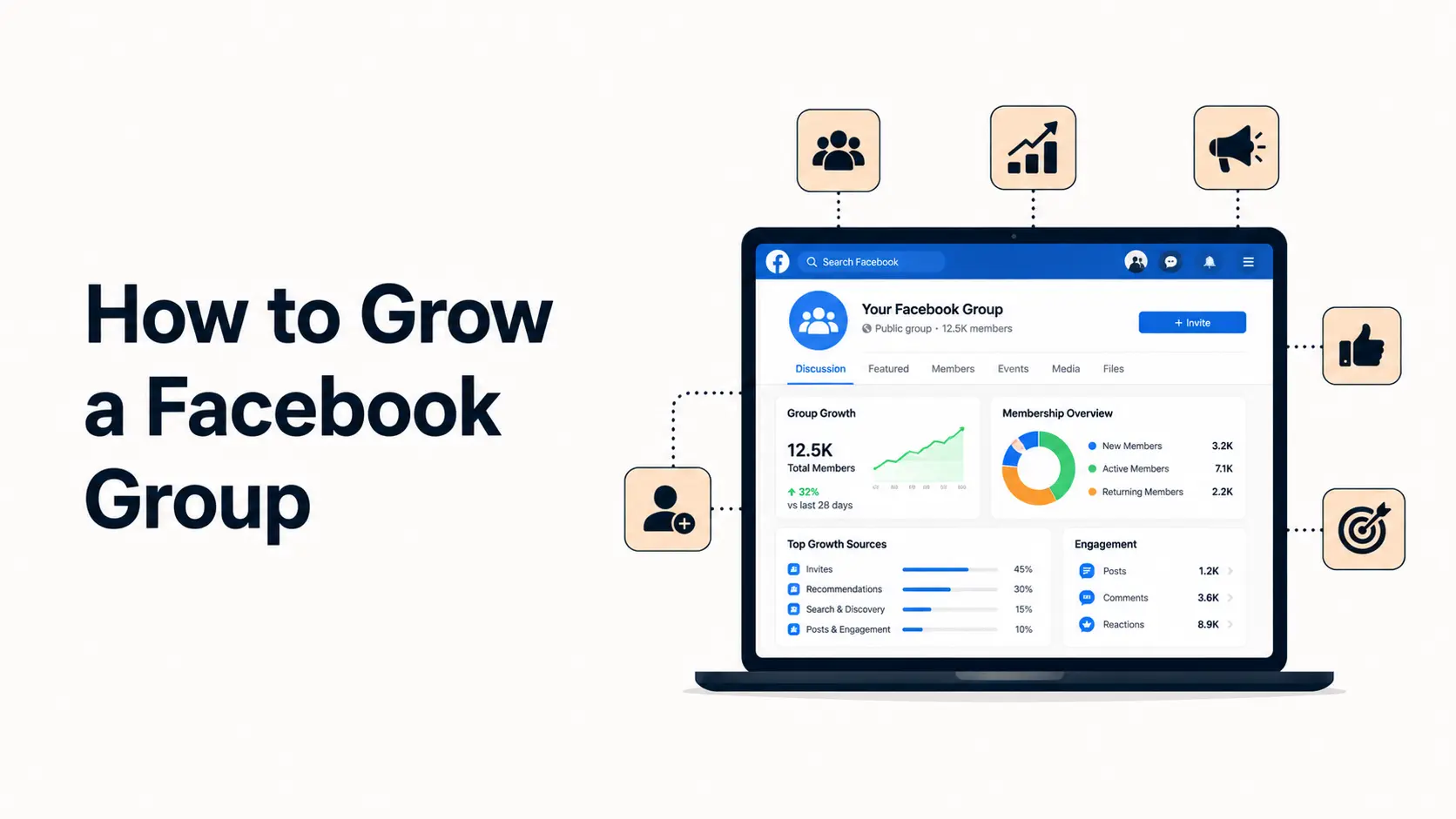

Growing a Facebook Group in 2026 is less about collecting the largest possible member count and more about creating a community people return to. A group with 3,000 active, relevant members can be far more useful than one with 30,000 people who never post, comment, attend an event, or buy anything.
The strongest groups give members a clear reason to join, a reason to participate quickly, and a reason to come back. Facebook gives admins useful tools for this, including visible private groups, membership questions, Page-follower invitations, Admin Assist, events, guides, badges, polls, and Group Insights.
This guide shows how to build that system step by step, whether your group supports a local business, SaaS product, creator brand, customer community, course, professional niche, or hobby audience.
TL;DR
- Choose a narrow group promise that tells the right person exactly why joining is useful.
- Use a visible group when discoverability matters, even if the group itself is private.
- Acquire members from places where trust already exists: your Page, email list, website, customers, content, partners, and related communities where promotion is allowed.
- Activate new members during their first week with welcome posts, prompts, useful resources, and low-friction ways to participate.
- Build recurring content formats so members know what to expect instead of relying on random admin posts.
- Use Admin Assist and clear rules to protect quality as the group grows.
- Track active members, posts, comments, top content, member requests, and participation trends, not total members alone.
What actually makes a Facebook Group grow?
Group growth comes from two connected systems. The first is acquisition: getting the right people to discover and join. The second is retention: giving those people enough value that they participate, return, and recommend the group to others.
If acquisition works but retention is weak, the member count rises while activity stays flat. If retention is excellent but acquisition is weak, you may have a healthy small community that never reaches enough of the market. Sustainable growth needs both.
1. Start with a narrow, useful group promise
A group called “Digital Marketing Community” is broad. A group called “Local SEO for Home Service Businesses” tells a specific audience what they can expect. The narrower promise makes content planning, member acquisition, moderation, and referrals easier.
Your group promise should answer three questions: who is this for, what do members want help with, and why should they join this group rather than just follow a Page or creator?
- Audience: define the people you want, not everyone who could technically join.
- Outcome: identify the progress members want to make.
- Format: clarify whether the value comes from peer discussion, expert help, accountability, networking, resources, product support, or a mix.
- Boundary: define what the group is not for so moderation is easier.
If the Group supports a business, keep the community useful beyond your product. A WordPress plugin company might run a group about workflow automation rather than a group where every post is a promotion for the plugin.
2. Choose the right privacy and visibility settings
Facebook Groups can be public or private. Private groups can also be visible or hidden. A visible private group can still be found in Facebook search and other discovery surfaces, while only members can see private group content. A hidden private group is much harder to grow through organic discovery because only current, invited, and former members can find it.
For many business, professional, education, or interest communities, private + visible offers a useful balance: the group can be discovered, but member discussions stay inside the community. Public groups can make sense when broad reach and open content matter more than privacy.
Do not choose hidden simply because it sounds exclusive. Use hidden groups when privacy or invite-only access is genuinely part of the product or community model.
3. Optimize the group for search and conversion
A potential member may see the group name, description, cover image, member count, activity level, and mutual members before joining. Treat that view like a landing page.
- Use a clear group name with the topic or audience naturally included.
- Write a description that explains who should join, what members get, and what kind of discussion is encouraged.
- Use a clean cover image that reinforces the group promise rather than filling it with tiny promotional text.
- Complete relevant group settings and features so the community does not look unfinished.
- Feature a welcome or start-here post so new members know what to do next.
The same discoverability principles apply across social platforms. Tenfic’s Social Media SEO guide explains how clearer topic signals can improve search visibility and content discovery.
4. Use membership questions to improve member quality
Facebook currently lets group admins ask up to three membership or participation questions. Use them to understand member intent, filter obvious spam, and learn what the community needs.
- What are you hoping to learn, solve, or achieve in this group?
- Which best describes your role or experience level?
- Do you agree to the group rules, including the promotion or self-linking policy?
Do not turn the questions into a long application unless exclusivity is important. Facebook does not require people to answer membership questions, so use them as signals rather than assuming every blank response is malicious. Admin Assist can help automate approval or decline rules based on criteria you set.
5. Seed the group before pushing for growth
An empty group is difficult to grow because new visitors have no evidence that useful discussion happens there. Before a big invitation push, create enough foundational content that a new member can scroll and immediately understand the value.
- A start-here post with the group purpose and rules.
- Three to five educational posts that answer common audience questions.
- At least one discussion prompt that is easy to answer.
- A resource, checklist, guide, or template members can save.
- A member-introduction thread if introductions fit the group culture.
- An event, live Q&A, office hour, or recurring discussion if you can sustain it.
The goal is not to fake activity. It is to remove the cold-start problem so early members have something worth responding to.
6. Invite the audience you already have
Your warm audience is usually the fastest source of relevant early members. Start with people who already know the business, creator, product, newsletter, or topic.
Invite engaged Facebook Page followers
If your Facebook Page is an admin of the group, Facebook lets you invite Page followers to join. Meta’s current help documentation says admins can manually invite up to 1,000 Page followers per week and can enable automatic invitations for recently engaged Page followers for one group at a time.
That does not mean you should invite everyone indiscriminately. A smaller batch of people who already engage with the Page topic is more likely to create meaningful activity than a flood of weak-fit members.
If you are still building the Page itself, use How to Create a Facebook Business Page and the Facebook Marketing for Small Businesses guide as the foundation.
Promote the group through your owned channels
- Add the group to relevant onboarding and customer emails.
- Mention it in your email newsletter when the topic matches.
- Add a website CTA on pages where community support or discussion is relevant.
- Include it in course, membership, SaaS, or customer onboarding where the group adds real value.
- Mention the group naturally in YouTube videos, podcasts, webinars, or other content.
- Use QR codes at physical events or locations when offline community growth matters.
7. Build a recurring content system
Groups become easier to manage when members recognize recurring formats. A predictable rhythm reduces the pressure to invent a new post every day and gives members habits around participation.
Use recurring formats as anchors, not rigid rules. If every Monday post looks identical and adds no new value, members will learn to ignore it.
A broader content pillar strategy can help you plan group topics that support the same audience without becoming repetitive.
8. Make the first week valuable for every new member
The first few days after joining matter. New members are deciding whether the group deserves notification attention, future participation, or a mute.
- Use an automated or recurring welcome post when useful.
- Point new members to a start-here post, guide, or best resources.
- Ask one easy question that lets them contribute without writing an essay.
- Respond quickly when a new member makes a thoughtful first post.
- Avoid immediately pushing a sales pitch after someone joins.
Early response from admins and established members teaches newcomers that participation gets noticed. That is more powerful than a generic welcome graphic.
9. Get members creating the value, not just consuming it
A healthy group eventually becomes more than an admin publishing channel. Members answer questions, share examples, give feedback, recommend resources, celebrate wins, and create discussions that the admin could not plan alone.
You can encourage this by designing prompts around member expertise. Ask for examples, lessons learned, opinions based on experience, or constructive feedback. Then reward useful contributions with thoughtful replies, featured posts, badges where available, or simple public recognition.
- Ask members to share a process, not just an outcome.
- Turn strong comments into follow-up discussion prompts with permission.
- Invite experienced members to answer beginner questions.
- Feature member case studies or wins without making every success story promotional.
- Create feedback threads where members can help each other within clear rules.
10. Use events, live sessions, and challenges
Events give members a time-based reason to return. A recurring monthly Q&A, workshop, critique session, challenge, study room, local meetup, or expert interview can create stronger community memory than a stream of disconnected posts.
Keep the event connected to the group promise. A marketing group does not need random entertainment events simply to create activity. A live landing-page teardown, campaign clinic, or content workshop fits the community and can generate several follow-up discussions afterward.
Facebook still offers group features such as events, live video, polls, guides, files, reels, badges, and other optional tools. Enable the features that support your community model instead of turning everything on by default.
11. Partner with adjacent creators and communities
Partnerships can introduce the group to audiences that already care about the topic. Look for creators, newsletters, podcasts, Pages, businesses, or communities that serve the same people without being direct substitutes.
- Run a joint Q&A or expert session.
- Create a useful co-branded resource for members.
- Invite a specialist to host a discussion inside the group.
- Cross-promote only when both audiences receive a clear benefit.
- Respect the promotion rules of other groups and communities. Do not drop unsolicited group links.
A good partnership transfers trust. A bad one transfers an irrelevant audience and increases moderation work.
12. Connect your Facebook Page and Group strategically
A Facebook Page and Group serve different jobs. The Page is useful for public publishing, business identity, discovery, and advertising. The Group is better for deeper member-to-member discussion and community participation.
Use Page content to surface the problems and conversations your audience cares about, then invite interested followers into a Group that goes deeper. Inside the Group, avoid reposting every Page update. Give members something they cannot get by simply following the Page.
This Page-to-Group loop works particularly well when the Page already has engaged followers. Meta currently supports manual invitations and automatic invitations to recently engaged Page followers when the Page is an admin of the group.
13. Make moderation part of the growth strategy
Growth increases spam, self-promotion, repetitive questions, conflict, and low-effort posts. If quality declines as membership rises, the most useful members often leave first.
Write rules people can actually understand
- Define what kinds of self-promotion are allowed, if any.
- Explain whether affiliate links, job posts, surveys, direct messages, or recruiting are permitted.
- Set expectations for respectful disagreement.
- Explain what counts as low-effort or off-topic content.
- Keep the rule set short enough that members will read it.
Use Admin Assist for repetitive moderation
Meta’s Admin Assist can automate parts of group management using criteria you configure. Depending on available settings, admins can automate membership decisions, reduce likely spam, manage posts and comments, decline links from specified sites, create recurring posts, and create welcome posts for new members.
Automation should enforce clear policy, not replace human judgment in every edge case. Review the Admin Assist activity log and adjust criteria if useful member posts are being caught.
14. Build a moderation team before you desperately need one
Once the group becomes difficult for one person to monitor, identify reliable active members who understand the culture. Facebook lets admins invite active members to become moderators or admins. Give the minimum level of authority needed for the role and document how common situations should be handled.
Do not hand admin access to someone simply because they post frequently. Admins can make substantial changes to the group and its membership, so trust and judgment matter more than raw activity.
15. Do not build a 2026 strategy around Facebook Group Community Chats
Older Facebook Group advice often recommends Community Chats for real-time engagement. Meta’s current Help Center says Community Chats for Facebook Groups are going away and directs communities toward separate Messenger Communities for ongoing chat, announcements, and event coordination.
If real-time chat is important to your community, evaluate Messenger Communities or another chat layer based on your audience. Keep the Facebook Group itself valuable enough that members do not need a separate chat to understand what is happening.
16. Create referral moments
Members refer groups when they can easily explain why another person should join. That is another reason the group promise must be specific.
- After a high-value event, invite members to share the group with one relevant colleague or friend.
- Create resources that members naturally want to discuss with peers.
- Celebrate milestones around member outcomes, not just the member count.
- Make the group link easy to find on your website, newsletter, Page, and onboarding material.
Avoid contests that attract people who only want a prize. A referral mechanic is useful when the referred person is likely to care about the community after the incentive disappears.
17. Use paid promotion carefully
Paid advertising can support a Group growth system, but it should not be the first fix for a weak community. Meta Ads Manager is built around business objectives such as awareness, traffic, engagement, leads, app promotion, and sales, not a dedicated “grow my Group” objective.
A better paid strategy is often to promote useful content, an event, a lead magnet, your Page, or another relevant entry point, then invite qualified people into the Group when the community is a natural next step. This gives prospects a reason to trust the brand before asking them to join another online space.
If you use paid acquisition, measure the quality of members it produces. A campaign that creates many cheap joins but almost no active members is not a strong growth channel.
For the advertising side, use Tenfic’s beginner’s guide to running Facebook Ads.
18. Track Group Insights, not just member count
Facebook Group Insights gives admins data about growth and engagement. Current metrics can include total members, membership requests, posts, comments, reactions, active members, popular days and times, top posts, top contributors, and some member demographics once the group is large enough.
Review trends monthly. A single viral post can distort one week’s numbers, while three months of falling active-member percentage signals a real retention problem.
19. Diagnose why your Facebook Group is not growing
20. Use a 90-day Facebook Group growth plan
Days 1-30: Build the foundation
- Define the group promise, target member, privacy, and visibility.
- Rewrite the name, description, rules, and cover if needed.
- Create membership questions and initial Admin Assist criteria.
- Seed 10 to 15 useful discussions or resources.
- Create two or three recurring content formats.
- Invite a small, relevant warm audience and respond to every useful early contribution.
Days 31-60: Expand acquisition
- Connect the Group to your Page, email, website, customer onboarding, and content channels.
- Use Page-follower invitations where appropriate.
- Run one useful event, challenge, Q&A, or collaborative session.
- Test one partner or creator collaboration.
- Review which acquisition sources produce active members, not just joins.
Days 61-90: Strengthen retention
- Review Group Insights for top posts, active times, and participation trends.
- Turn strong member discussions into recurring formats.
- Identify and recognize high-value contributors.
- Recruit a moderator if the workload requires it.
- Remove content formats and acquisition channels that create low-quality activity.
- Create a referral moment around a resource, event, or community milestone.
Facebook Group growth mistakes to avoid
- Chasing member count. Total size is weak evidence of community health.
- Making a private group hidden without a reason. This removes organic discoverability.
- Inviting everyone you know. Irrelevant members weaken early engagement signals and culture.
- Posting only promotions. Members do not join a Group to see a second advertising feed.
- Overposting generic prompts. Engagement bait can create comments without creating community value.
- Allowing uncontrolled self-promotion. Useful members leave when every discussion becomes a pitch.
- Ignoring newcomers. Members who receive no response to a first contribution learn not to post again.
- Depending on admins for every conversation. Sustainable communities create member-to-member value.
- Using outdated features as core strategy. For example, Meta says Facebook Group Community Chats are being retired.
- Never reviewing Insights. Growth decisions should be based on member behavior, not admin intuition alone.
How a Facebook Group can support a business without becoming promotional
A business-owned Group can create customer research, product education, peer support, loyalty, referrals, and qualified demand. The commercial benefit is strongest when the community remains useful even on days when nobody buys anything.
Disclose the business relationship clearly. Meta recommends that group admins share commercial or business affiliations and update the group if those affiliations change.
When relevant, use the Group to listen for recurring problems, language, objections, and feature requests. Those insights can improve your Facebook marketing strategy, content, product messaging, and customer support.
If managing publishing and community operations across several channels becomes repetitive, Tenfic’s social media automation services can help streamline workflows while keeping moderation and meaningful replies human-reviewed.
Conclusion
The fastest way to grow a Facebook Group sustainably is to stop treating growth as an invitation problem. The real system starts with positioning, then combines discoverability, qualified acquisition, strong onboarding, member-led value, moderation, recurring programming, and measurement.
Start small enough to protect the culture. Make the first 100 members useful to each other before worrying about 10,000. When members consistently get answers, relationships, resources, opportunities, or progress they cannot get from a normal feed, growth becomes easier because the community itself becomes the reason to join.
Frequently asked questions
How do I grow a Facebook Group from zero?
Start with a specific group promise, optimize the name and description, seed useful content, and invite a small warm audience from your Page, email list, customers, website, or existing content channels. Focus on early participation before pushing for large member numbers.
Should my Facebook Group be public or private?
It depends on the community model. Public groups maximize openness. Private groups protect member content. A private group can still be visible in Facebook search, which often provides a useful balance for business and professional communities.
How can people find my private Facebook Group?
Set the private group to visible rather than hidden. Visible private groups can be found in Facebook search and other places on Facebook, while only members can see the private group content.
Can I invite my Facebook Page followers to a Group?
Yes, when the Page is an admin of the Group. Meta currently supports manual invitations to Page followers and automatic invitations to recently engaged followers for one Group at a time, subject to Facebook’s current limits and eligibility.
How often should I post in a Facebook Group?
There is no ideal universal frequency. Post often enough to create useful recurring conversations without crowding out member posts. Use Group Insights, active times, and response quality to adjust the cadence.
What should I post to increase Facebook Group engagement?
Use questions that benefit from member experience, educational breakdowns, feedback threads, member wins, resources, polls, events, Q&As, and recurring topic formats. The best posts create useful member-to-member interaction rather than comments for their own sake.
Is Facebook Group Community Chat still worth using in 2026?
Do not build a long-term strategy around it. Meta’s current Help Center says Community Chats for Facebook Groups are going away and points communities toward separate Messenger Communities for real-time chat and announcements.
What is the most important Facebook Group growth metric?
No single metric tells the whole story, but active members are usually more useful than total member count. Track active-member trends alongside posts, comments, reactions, membership requests, top posts, retention, and the quality of member outcomes.