
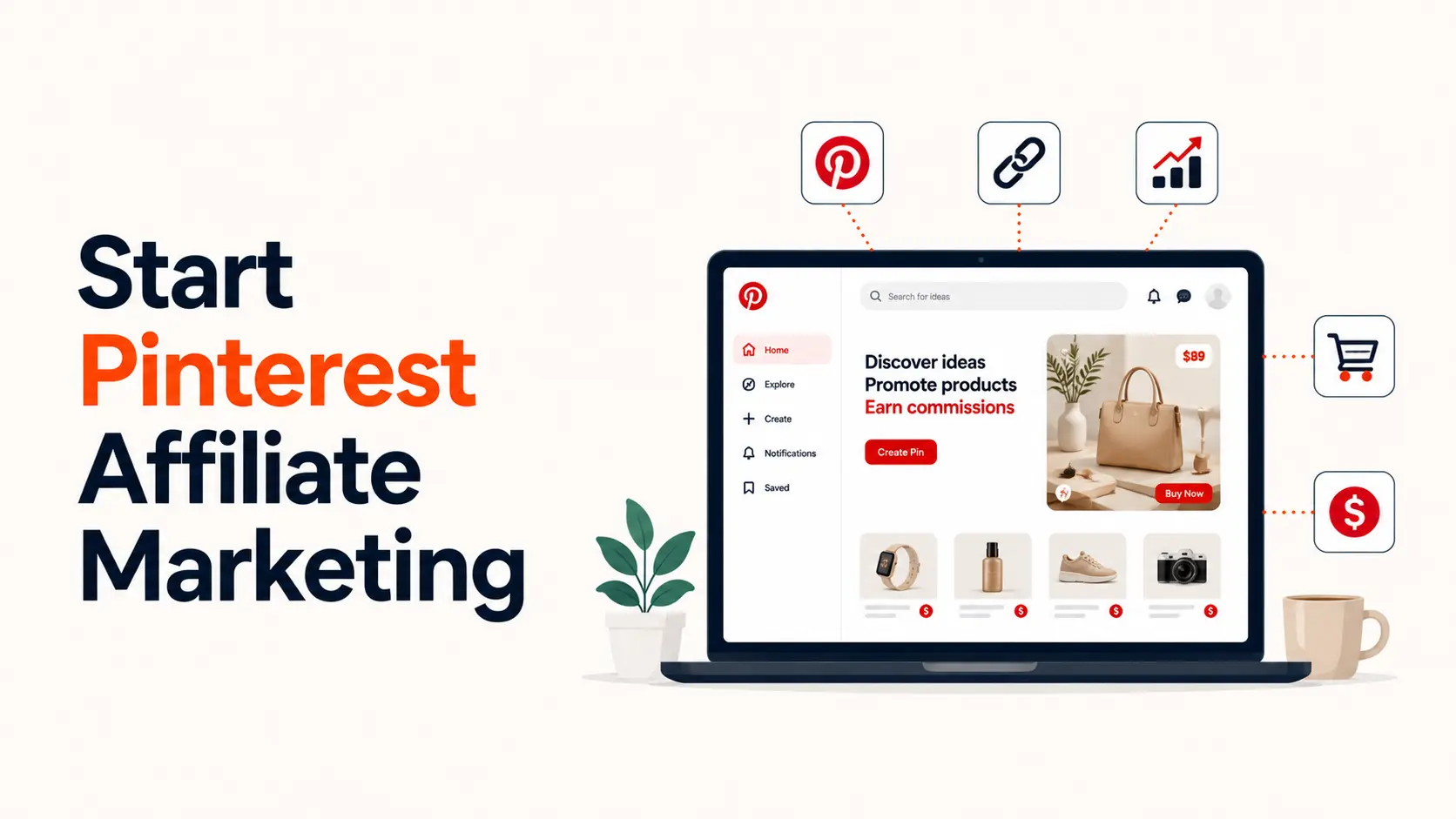


Pinterest affiliate marketing is a way to earn commissions by using Pinterest content to send people to products, services, or helpful pages that contain affiliate links. The basic model is simple: create useful Pins around problems people are already searching for, connect those Pins to a relevant offer or buying guide, and earn a commission when an eligible purchase or action is attributed to you.
Pinterest can fit affiliate marketing especially well because people use the platform to discover ideas, compare options, plan purchases, and save content for later. That does not mean every Pin should be a sales pitch. Pinterest’s current affiliate guidelines require original, useful content, transparency about commercial links, and moderation rather than repetitive high-volume affiliate posting.
This guide explains how to start Pinterest affiliate marketing in 2026 from the ground up, including account setup, niche selection, program research, keyword research, direct affiliate links versus landing pages, disclosures, Pin creation, Pinterest SEO, analytics, content planning, and a practical 90-day launch plan.
TL;DR
- Pinterest affiliate marketing works best when you treat Pinterest as a visual search and discovery channel rather than an affiliate-link dumping ground.
- Choose one commercially useful niche and a small set of offers that genuinely fit the audience.
- Use a free Pinterest business account so you can access Analytics and Pinterest Trends.
- Pinterest permits affiliate links under its commercial-content rules, but you must use them transparently, create original value, avoid spam, and follow the affiliate program’s own traffic rules.
- For many beginners, sending Pins to useful content on a website gives more control over trust, tracking, email capture, and offer comparisons than linking every Pin directly to a merchant.
- Track impressions, saves, outbound clicks, affiliate clicks, conversion rate, approved commissions, and revenue per outbound click.
- Build a library of useful evergreen Pins and improve from data over 90 days instead of expecting instant passive income.
What is Pinterest affiliate marketing?
Pinterest affiliate marketing combines Pinterest content distribution with an affiliate program. You publish a Pin that helps someone discover or evaluate an idea, product, or solution. The Pin links either directly to an affiliate destination or to content you control, such as a review, comparison, tutorial, resource page, or buying guide. If the user later completes a qualifying action under the affiliate program’s attribution rules, you may earn a commission.
If affiliate marketing itself is new to you, start with Tenfic’s complete beginner’s guide to affiliate marketing. The Pinterest model uses the same economics as other affiliate channels, but discovery, visual presentation, seasonal demand, and Pinterest-specific policies change how you execute it.
| Path | How it works | Main advantage | Main tradeoff |
|---|---|---|---|
| Direct affiliate Pin | Pin links straight to an approved affiliate URL | Shortest path to merchant | Less control over the destination, tracking, and pre-sell experience |
| Pin to your website | Pin links to your article or landing page, which contains affiliate links | More trust, SEO value, email capture, and comparison flexibility | Requires a website and more content work |
| Pin to email or lead magnet funnel | Pin sends users to an owned opt-in page before later recommendations | Builds an owned audience | More steps before the affiliate conversion |
Are affiliate links allowed on Pinterest in 2026?
Yes, Pinterest’s current commercial and branded content guidelines explicitly address affiliate links. Pinterest says affiliate content should be original and add unique value, marketers should be transparent about commercial content and link behavior, and affiliate links should be used in moderation. Pinterest also warns against fake accounts, coordinated saves, algorithm manipulation, and repetitive high-volume affiliate Pins.
Pinterest’s policy also says that some link-shortening services are not supported. If a Pin link is blocked, Pinterest advises editing it. For that reason, use the clean destination or tracking format supplied by the affiliate program whenever possible rather than hiding the destination behind an unnecessary shortener.
There is another rule that matters just as much: the affiliate program itself may restrict where its links can be posted. A merchant may allow websites and YouTube but prohibit direct social-media linking, paid ads, coupon traffic, email, trademark bidding, or certain countries. Pinterest permission does not override the merchant’s terms.
Pinterest affiliate marketing rules to follow
- Use one authentic Pinterest presence in line with Pinterest’s affiliate guidance
- Create original Pins that add real value instead of mass-producing near-duplicates
- Disclose the commercial nature of affiliate content clearly
- Do not use fake accounts, save exchanges, coordinated engagement, or artificial traffic tactics
- Use affiliate links in moderation and avoid spammy posting patterns
- Check every affiliate program’s social-media and direct-linking rules before posting
- Do not make product claims you cannot support
- Follow applicable advertising and consumer-protection laws in the countries where you operate
How affiliate disclosures work on Pinterest
Affiliate disclosure is not a decorative legal footer. Users should understand that you can earn money from the recommendation before or when they act on it. Pinterest requires transparency for commercial content, and the US Federal Trade Commission says a material connection should be disclosed clearly and conspicuously, close to the endorsement.
A practical disclosure can be short and direct, such as “Affiliate link: I may earn a commission if you buy through this link, at no extra cost to you.” Avoid vague wording that assumes users already understand terms such as “commissionable link.”
If you send a Pin to your own article, disclose the relationship both where appropriate on the Pin and clearly inside the article near the recommendation or affiliate links. Laws differ by country, so treat FTC guidance as a useful US example rather than a universal substitute for local requirements.
Why Pinterest can work for affiliate marketing
Pinterest is closer to a visual search and planning engine than a chronological social feed. Users search topics, browse recommendations, save ideas to boards, and often return later. That behavior can support affiliate content in niches where people research before buying, such as home, beauty, fashion, travel, food, crafts, productivity, business tools, weddings, education, hobbies, and selected software categories.
The platform also has a long content shelf life compared with many fast-moving social feeds. A useful Pin can keep appearing in searches and recommendations after publication, although distribution is never guaranteed and performance can change over time.
Pinterest is not a shortcut to passive income
Pinterest affiliate marketing still requires market research, creative testing, content production, program compliance, tracking, and ongoing optimization. Some Pins will receive impressions without outbound clicks. Some clicks will not convert. Some affiliate programs reverse commissions after refunds or invalid orders.
A better goal for the first few months is to build a repeatable research-to-Pin-to-click system and identify topics that generate qualified outbound traffic.
Step 1: Choose a Pinterest-friendly affiliate niche
A strong niche sits at the intersection of Pinterest demand, buyer intent, visual content potential, your ability to create useful material, and available affiliate offers. A broad label such as “lifestyle” is usually too vague. A narrower commercial problem gives you clearer keywords, boards, offers, and content.
| Broad niche | More focused affiliate angle |
|---|---|
| Home | Small-space organization, renter-friendly upgrades, home office setups |
| Beauty | Curly-hair routines, skincare for a specific need, nail tools |
| Business | Content tools for creators, ecommerce software, productivity systems |
| Travel | Carry-on gear, family travel planning, destination packing |
| Fitness | Home workout equipment, beginner mobility, running accessories |
| Crafts | Cricut projects, sewing tools, printable craft resources |
| Education | Homeschool resources, study systems, language-learning tools |
Before committing, use market research for an online business to validate the customer, competitors, problems, willingness to pay, and available acquisition channels. The same research discipline applies even if the business model is affiliate-based.
Step 2: Validate demand with Pinterest Trends and search
Pinterest Trends is one of the most useful first-party tools for this channel. Pinterest says Trends can show up to two years of search, save, and shopping trend history for supported regions, and allows comparison of up to four keywords at a time. Business accounts may also see trends specific to their engaged audience.
Look for three types of opportunity: stable evergreen demand, predictable seasonal peaks, and emerging topics with commercial relevance. Do not chase a rising keyword merely because the graph goes up. Make sure you can connect the topic naturally to a useful product or service.
Then search Pinterest manually. Note autocomplete suggestions, recurring phrases in titles, the visual styles dominating the results, common board themes, and whether current Pins actually answer the user’s question well. This is qualitative competitor research, not a reason to copy designs.
Step 3: Create or convert to a Pinterest business account
Pinterest currently offers free business accounts. A business account gives you access to Pinterest Analytics and business features. You can create a new business account or convert an existing personal account.
For affiliate marketing, Analytics is important because you need to distinguish vanity exposure from traffic that can produce revenue. Pinterest Analytics includes impressions, saves, Pin clicks, outbound clicks, outbound click rate, follows, and additional video metrics.
Step 4: Build a profile around one clear topic
Your profile should make it immediately obvious what someone will get by following you. Use a recognizable name, focused description, relevant keywords, and boards that map to real subtopics inside the niche.
Do not create dozens of empty keyword-stuffed boards. Start with a small set that you can populate with strong, relevant Pins.
| Profile element | What to optimize |
|---|---|
| Display name | Brand or creator name plus a natural topic descriptor where appropriate |
| Bio | Who you help, what topics you cover, and the type of value you publish |
| Boards | Clear subtopics people actually search for |
| Board descriptions | Natural topic language rather than keyword stuffing |
| Website | Use your primary owned site if you have one and follow Pinterest’s claiming instructions where relevant |
Step 5: Choose affiliate programs that fit Pinterest traffic
Do not select programs simply because the commission rate looks large. Evaluate audience fit, product quality, merchant reputation, conversion path, commission type, attribution window, payout terms, reversal risk, allowed promotional methods, and whether Pinterest or direct social linking is permitted.
Tenfic’s guide to choosing the best affiliate program includes a detailed scorecard for this decision. For Pinterest, add one extra criterion: can you create genuinely useful visual-search content around the offer without turning every Pin into an advertisement?
Direct programs vs affiliate networks
Affiliate networks aggregate multiple merchants, while direct programs are run by a merchant or software company itself. Neither structure is automatically better. Networks can simplify discovery and reporting, while direct programs sometimes offer stronger merchant relationships, deeper product support, or different commission economics.
Read the actual terms before creating Pins. Rules around social traffic, coupon codes, paid promotion, email, mobile apps, branded keywords, product images, and link cloaking vary by program and can change.
Step 6: Decide between direct affiliate links and content on your own site
Pinterest policy permits affiliate links when its guidelines are followed, but direct linking is only one model. In many niches, a content-first approach gives you more control.
| Use direct affiliate links when… | Use your own content when… |
|---|---|
| The merchant explicitly allows Pinterest or social traffic | The buyer needs explanation or comparison before purchasing |
| The product is simple and visual | You want to compare multiple products fairly |
| The Pin itself provides enough context | You want email capture or retargeting options |
| The program’s tracking works cleanly from Pinterest | You want independent analytics and long-term SEO value |
| You can disclose the commercial relationship clearly | You want to update offers without replacing every old Pin |
A useful article can also protect you from overdependence on one merchant. If a program closes, changes commissions, or becomes less competitive, you can update the article while the Pinterest URL remains the same.
Step 7: Build a keyword map before creating Pins
Pinterest SEO starts with search intent. Group keywords by the problem or decision the user is trying to solve, not just by product names.
- Discovery keywords: broad ideas such as “small home office ideas”
- Problem keywords: “how to organize a tiny desk”
- Comparison keywords: “standing desk vs regular desk”
- Best-product keywords: “best desk lamps for small spaces”
- Use-case keywords: “desk setup for remote work”
- Seasonal keywords: “back to school desk setup”
For a deeper workflow, use Tenfic’s Pinterest SEO guide. The goal is to align the Pin topic, title, description, board context, creative, and destination page with the same search intent.
Step 8: Create content for the full buyer journey
Pinterest affiliate marketing becomes more durable when you publish more than “best product” Pins. Build informational, evaluative, and commercial content around the same problem.
| Journey stage | Pinterest content example | Affiliate role |
|---|---|---|
| Discover | “10 tiny balcony ideas” | Introduce useful categories and solutions |
| Learn | “How to choose outdoor seating for a small balcony” | Explain buying criteria |
| Compare | “Folding chair vs compact bench” | Help users evaluate options |
| Buy | “Best compact balcony furniture for renters” | Recommend suitable products transparently |
| Use | “How to style a tiny balcony without clutter” | Recommend complementary items |
This structure also gives you multiple opportunities to link related Pins and articles instead of repeatedly promoting the same affiliate URL.
Step 9: Design Pins that earn the click without misleading users
The creative should make the benefit, idea, or question obvious at a glance. Use readable text, strong hierarchy, clean product or contextual imagery, and enough contrast for mobile viewing. Do not create a sensational promise that the landing page cannot fulfill.
A good Pin often does one job: promises a specific answer and makes the user curious enough to see the full resource. “12 renter-friendly pantry organization ideas” is clearer than “You need this!”
Should you put prices or discounts on Pins?
Only use current, verifiable information and make sure the affiliate program permits it. Prices, discounts, availability, and bonus terms can change quickly. An evergreen Pin that permanently displays a temporary price can become inaccurate long after publication.
When price is central to the content, consider putting the current details on a page you control so they can be updated without redesigning every Pin.
Step 10: Write useful Pin titles and descriptions
Use the main topic naturally in the title, then explain what the user will find after clicking. Avoid robotic keyword repetition. Pinterest needs contextual relevance, but people still need a compelling reason to act.
For example, a Pin about beginner podcast equipment could use a title such as “Beginner Podcast Setup: What You Actually Need” and a description that mentions microphones, headphones, recording software, and budget considerations naturally.
Step 11: Add affiliate disclosures clearly
Do not bury the disclosure in a profile bio while individual Pins promote commission-earning links. The commercial relationship should be understandable where the endorsement occurs.
If space is limited, a short, plain-language disclosure such as “Affiliate link — I may earn a commission if you purchase” is clearer than an ambiguous abbreviation. If you control the destination article, repeat a clear disclosure there as well.
Step 12: Publish consistently without triggering spam patterns
Pinterest specifically warns affiliates against repetitive or high-volume affiliate Pins and algorithm manipulation. More Pins are not automatically better if they are near-duplicates pointing to the same commission URL.
Build variation through genuinely different ideas, search intents, use cases, visuals, destinations, and helpful angles. A steady content system is safer and more useful than bulk-uploading dozens of minimally changed Pins.
How often should beginners publish?
There is no universal publishing number that guarantees growth. Choose a cadence you can sustain while keeping each Pin useful and distinct. For a beginner, a small number of quality Pins each week can provide enough data to learn without forcing repetitive content.
Increase output only when you have more genuinely distinct topics, creatives, and destination pages to support it.
Step 13: Track Pinterest metrics that connect to affiliate revenue
Pinterest Analytics provides useful top-of-funnel data, especially impressions, saves, Pin clicks, outbound clicks, and outbound click rate. Affiliate dashboards provide downstream data such as clicks, conversions, approved sales, commissions, and reversals.
The valuable analysis happens when you connect those two layers.
| Metric | What it tells you |
|---|---|
| Impressions | How often Pinterest distributed the Pin |
| Saves | Whether users considered it useful enough to keep |
| Outbound clicks | How many actions led to the linked destination |
| Outbound click rate | How effectively impressions become off-platform visits |
| Affiliate clicks | How many destination visitors clicked the tracked offer |
| Conversion rate | How often affiliate clicks became attributed actions |
| Approved commissions | Revenue that survived validation and reversals |
| Revenue per outbound click | How valuable Pinterest traffic is after the click |
A simple Pinterest affiliate revenue formula
Use a model such as: Pinterest impressions × outbound click rate × affiliate click-through rate × merchant conversion rate × average approved commission.
For example, 20,000 Pin impressions at a 1.5% outbound click rate produce 300 site visits. If 30% click an affiliate link, that is 90 affiliate clicks. At a 4% merchant conversion rate, that is 3.6 attributed orders on average. At a $20 approved commission, expected revenue is about $72 before expenses.
The example is not a forecast. Its purpose is to show which part of the funnel needs improvement. If outbound clicks are weak, fix the Pin and search intent. If affiliate clicks are weak, improve the article and offer fit. If merchant conversions are weak, reassess the program or product.
Step 14: Use multiple Pins for proven destination pages
Once a destination has shown that it can earn qualified clicks or commissions, create additional Pins for genuinely different search intents and creative concepts. Do not simply change one color and republish the same message at scale.
One article about home office lighting, for example, can support Pins around desk lamps for small spaces, eye-friendly lighting, renter-friendly lighting, video-call lighting, and workspace lighting mistakes if the article genuinely covers those needs.
Step 15: Build an owned audience where it makes sense
Pinterest traffic is rented distribution. Affiliate programs are also third-party relationships. Building an email list or useful website reduces the risk of depending entirely on two platforms you do not control.
A helpful lead magnet, newsletter, or content series can turn one Pinterest visit into a longer relationship. Follow the email and promotional rules of the affiliate programs you use before placing affiliate links in email.
Best Pinterest affiliate marketing niches
The strongest niches are not simply the ones with the highest commissions. They need Pinterest demand, enough useful visual or instructional content, products people genuinely buy, and affiliate programs that permit your promotional methods.
| Niche | Why Pinterest can fit | Example affiliate angles |
|---|---|---|
| Home and organization | Highly visual, project-based searches | Storage, furniture, decor, tools |
| Beauty and personal care | Tutorial and routine content | Tools, accessories, eligible products |
| Travel | Planning and checklist behavior | Luggage, accessories, booking services where permitted |
| Crafts and DIY | Project-led discovery | Tools, materials, templates |
| Food and kitchen | Recipe and equipment discovery | Cookware, appliances, kitchen tools |
| Business and creator tools | Planning and workflow searches | Software, templates, courses, equipment |
| Fashion | Visual discovery and seasonal demand | Clothing, accessories, styling products |
| Education and productivity | Planning and system-focused content | Courses, apps, study tools, planners |
Can you do high-ticket affiliate marketing on Pinterest?
Yes, if the product, program, traffic rules, and user intent fit. High-ticket offers usually need more trust and education than a low-cost impulse purchase. Sending a single aesthetic Pin directly to an expensive service is rarely enough.
A better funnel may use Pinterest to attract the right problem-aware user, then send them to a detailed comparison, implementation guide, case study, webinar, or email sequence. Tenfic’s high-ticket affiliate marketing guide explains that model in more depth.
Can you start Pinterest affiliate marketing without a website?
Yes. Pinterest allows affiliate links subject to its guidelines, and some affiliate programs allow direct social traffic. But a website is often strategically useful because it gives you control over content, comparisons, disclosures, analytics, search visibility, lead capture, and future offer changes.
If you start without a website, choose programs that explicitly permit Pinterest traffic and be especially careful about transparent disclosure, link behavior, and spam rules.
Common Pinterest affiliate marketing mistakes
- Choosing programs before researching what Pinterest users actually want
- Publishing near-duplicate affiliate Pins in large volumes
- Using vague or hidden disclosures
- Promoting products you have not researched sufficiently
- Ignoring merchant rules for social or direct-link traffic
- Chasing impressions instead of outbound clicks and approved commissions
- Using temporary prices or offers in evergreen creative without updating them
- Sending every Pin directly to a merchant even when the buyer needs more information
- Building around one affiliate program with no backup plan
- Copying competitor Pin designs rather than developing original value
A 90-day Pinterest affiliate marketing plan
| Period | Primary goal | What to do |
|---|---|---|
| Days 1–15 | Research and setup | Choose one niche, create a business account, study Pinterest Trends and search, build 5–8 focused boards, shortlist affiliate programs, read their traffic rules |
| Days 16–30 | Build the first content library | Publish foundational informational and commercial content, create multiple original Pins, add clear disclosures, set up tracking |
| Days 31–60 | Find winning topics | Review impressions, saves, outbound clicks, affiliate clicks and conversions; improve weak Pin-to-page alignment; create new angles around the strongest topics |
| Days 61–90 | Deepen what works | Expand successful keyword clusters, create more valuable destination pages, test stronger offers, build email capture where appropriate, reduce reliance on weak programs |
What to aim for in the first 90 days
The goal is not a specific income number because niche economics, traffic volume, commission structure, conversion rates, and publishing capacity vary widely. Aim to prove three things: Pinterest can distribute your content, some of that audience will click through, and at least one content-offer combination can produce measurable commercial intent.
Once you have that evidence, scaling becomes a data problem rather than a guessing game.
How to improve Pinterest affiliate results over time
Review performance by topic, creative, board, destination page, and offer. A Pin with high saves but few outbound clicks may be inspirational but weak commercially. A Pin with modest impressions but a high outbound click rate can be more valuable.
On the affiliate side, track approved revenue rather than raw commissions alone. Refunds, cancellations, invalid actions, and attribution rules can change what you actually receive.
Use Pinterest as part of a wider content system
Pinterest works better when it supports an owned content engine rather than standing alone. Your website can rank in Google, your email list can retain visitors, your social channels can build trust, and Pinterest can continue generating discovery traffic.
If you are building a broader Pinterest strategy, read Tenfic’s Pinterest for business guide and guide to making money on Pinterest. For a wider acquisition strategy, see how to grow on social media.
When Pinterest affiliate marketing is a poor fit
Pinterest may be a weak primary channel if your niche has little visual or planning behavior, almost no Pinterest search demand, extremely short-lived offers, programs that prohibit social traffic, or a sales process that requires relationship-based outbound selling.
In that case, SEO, YouTube, LinkedIn, communities, email, paid search, or direct sales may better match the buying journey.
Pinterest affiliate marketing checklist
- Pick one specific audience and commercial problem
- Validate Pinterest demand and seasonality
- Create or convert to a business account
- Build focused boards around real subtopics
- Choose reputable affiliate programs and read all traffic rules
- Decide which offers can be linked directly and which need a content page
- Create original Pins for distinct search intents
- Use clear affiliate disclosures
- Track outbound clicks and downstream affiliate performance
- Review results monthly and expand only the combinations that show qualified demand
Conclusion
Pinterest affiliate marketing in 2026 is viable, but the durable model is not “post affiliate links and wait.” Pinterest expects original value, transparency, authentic behavior, and moderation. Affiliate programs add their own traffic and disclosure rules on top of that.
Start with one focused niche, build a useful Pinterest business profile, research keywords and trends, choose programs carefully, publish content across the buyer journey, and track outbound traffic through to approved commissions. Direct affiliate Pins can work when the program and user intent fit, but owned content usually gives you more control as the business grows.
Treat the first 90 days as a validation cycle. Find the topics that attract qualified clicks, the destinations that create trust, and the offers that convert. Then build more around evidence rather than volume.
Frequently asked questions about Pinterest affiliate marketing
Can you use affiliate links directly on Pinterest in 2026?
Yes. Pinterest’s current affiliate guidelines permit affiliate links when you follow its commercial-content rules, create original value, disclose the commercial relationship, avoid spam and manipulation, and use affiliate links in moderation. You must also check that the individual affiliate program permits Pinterest or direct social traffic.
Do I need a website for Pinterest affiliate marketing?
No, a website is not technically required for every affiliate setup, because Pinterest permits affiliate links under its guidelines and some programs allow direct social linking. A website is still useful for comparisons, trust, analytics, email capture, SEO, disclosures, and changing offers later without replacing old Pins.
Do I need a Pinterest business account for affiliate marketing?
Pinterest does not describe a business account as the condition that makes affiliate links legal, but a free business account is strongly recommended because it provides Pinterest Analytics and business tools. Analytics lets you track impressions, saves, Pin clicks, outbound clicks, and outbound click rate.
How do I disclose affiliate links on Pinterest?
Use clear language that tells users you may earn a commission, and place the disclosure where the commercial recommendation is understandable. Pinterest requires transparency, and FTC guidance for US audiences says material connections should be disclosed clearly and conspicuously close to the endorsement.
How many affiliate Pins should I post per day?
There is no universal daily number that guarantees results. Pinterest specifically warns against repetitive or high-volume affiliate Pins. Choose a sustainable cadence and prioritize useful, original Pins for genuinely different topics, search intents, creatives, and destination pages.
What are the best affiliate products to promote on Pinterest?
The best products are those that match your niche, Pinterest search demand, buyer intent, visual or instructional content, reputable merchants, and affiliate terms that allow your traffic source. Product fit and conversion economics matter more than simply choosing the highest commission rate.
How long does Pinterest affiliate marketing take to work?
There is no fixed timeline. Distribution, clicks, and conversions depend on niche demand, keyword selection, creative quality, content depth, program conversion rates, seasonality, and publishing consistency. Use the first 90 days to validate whether Pinterest can generate qualified outbound traffic and whether that traffic converts.
Can beginners make money with Pinterest affiliate marketing?
Yes, beginners can earn affiliate commissions from Pinterest, but results are not guaranteed. Start with a narrow niche, research demand, choose programs carefully, publish original useful content, disclose affiliate relationships, and track the entire funnel from Pinterest impressions to approved commissions.