
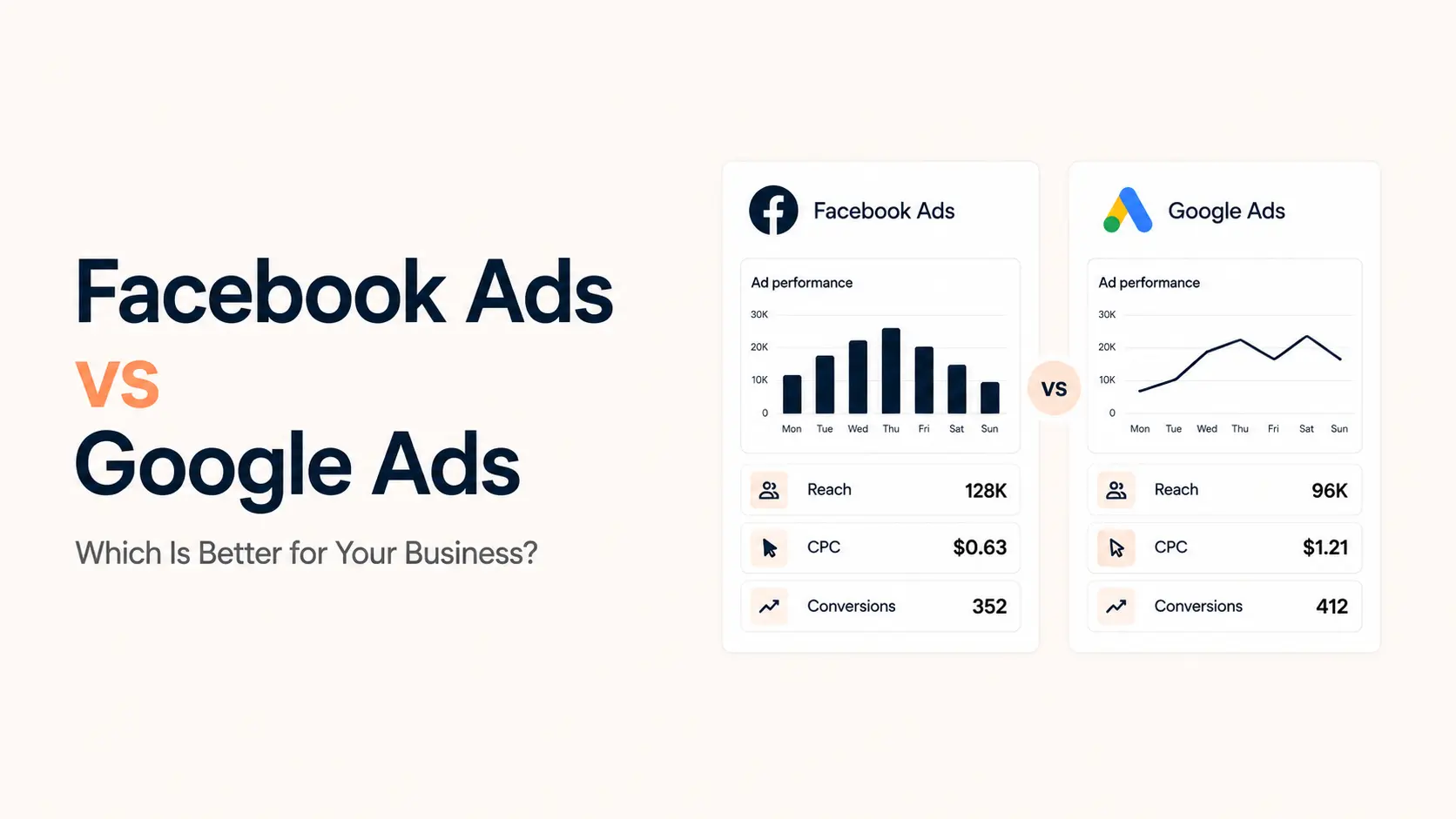


Google Ads is usually the better first choice when people are already searching for what you sell. Facebook Ads is usually better when the product needs to be discovered, demonstrated, or repeatedly seen before someone wants it. That distinction is more useful than asking which platform has the cheaper click.
The comparison is also less binary than it used to be. Google Ads now reaches beyond search through Shopping, YouTube, Display, Maps, Demand Gen, and Performance Max. Meta Ads can do more than awareness through sales campaigns, retargeting, lead forms, customer audiences, and conversion-focused delivery across Facebook and Instagram.
So the right decision in Facebook Ads vs Google Ads comes down to customer intent, search demand, creative strength, sales cycle, tracking quality, and how much budget you can give one platform long enough to learn. This guide compares those factors and gives a practical starting point for ecommerce, local services, B2B, SaaS, professional services, and small businesses.
TL;DR
Google Ads captures demand. Facebook Ads creates and shapes demand. Start with Google when buyers already search for your solution and the search has clear commercial intent. Start with Facebook when a strong image, video, offer, or demonstration can make the right audience want something they were not actively searching for. Use both once you can measure revenue or qualified leads accurately.
- Choose Google Ads first for urgent local services, high-intent searches, branded demand, many professional services, and products people already research by name or category.
- Choose Facebook Ads first for visual ecommerce, new products, lifestyle offers, events, low-search-volume categories, and offers that benefit from demonstration or storytelling.
- Do not choose by CPC alone. A cheaper click can still produce a more expensive customer.
- Google Search benchmark: the 2026 median CPC was $5.42, conversion rate 8.18%, and CPL $66.69 across 13,474 US search campaigns in WordStream/LocaliQ’s dataset.
- Meta benchmark: the latest broad benchmark reports $0.70 CPC for traffic campaigns and $27.66 CPL for lead campaigns, but those are different objectives and datasets, so they are not direct apples-to-apples comparisons.
- Tracking matters on both. Use clean conversion events, first-party data, and offline revenue or lead-quality feedback where possible.
- For many established businesses, the best answer is both: Meta creates attention and remarkets; Google captures the searches and high-intent demand that follows.
Facebook Ads vs Google Ads: quick comparison
| Factor | Google Ads | Facebook Ads (Meta Ads) |
|---|---|---|
| Primary strength | Capturing existing demand and high-intent searches | Creating demand, visual discovery, prospecting, and retargeting |
| Best first question | Are people already searching for this? | Can creative make the right audience stop and care? |
| Main targeting signals | Search terms, keywords, location, audiences, customer data, conversion signals | Audience controls, customer data, engagement, conversion signals, creative response |
| Strongest formats | Search, Shopping, Maps, YouTube, Performance Max, Display | Feed, Reels, Stories, carousel, collection, video, lead forms |
| Creative burden | Lower for Search; higher for YouTube, Display, Demand Gen, Performance Max | High. Creative quality and refresh rate strongly affect performance |
| Typical buying moment | Problem-aware or solution-aware | Often earlier in the journey, though retargeting can be very high intent |
| Local services | Usually strong when search demand exists | Useful for awareness, offers, lead generation, and retargeting |
| Ecommerce | Strong for Shopping, branded/category search, and Performance Max | Strong for discovery, visual products, prospecting, and retargeting |
| B2B | Strong when prospects search for the problem, product, category, or competitor | Useful for awareness, retargeting, content offers, and some lead generation |
| Best success metric | Revenue, qualified leads, profit, conversion value, CAC | Revenue, qualified leads, profit, CAC, incremental demand |
The table shows the default strengths, not hard platform limits. A Google YouTube campaign can create demand, and a Meta retargeting campaign can reach someone who is already close to buying. The most useful comparison is the customer moment you are buying.
The core difference: search intent vs discovery
Google Search is strongest when the customer expresses intent directly. A person who searches “emergency plumber near me,” “best payroll software for small business,” or “buy running shoes size 10” has already revealed a need. The advertiser is competing to be one of the answers at that moment.
Facebook and Instagram work differently. Most people open the apps to browse content, not to search for a vendor. Meta has to predict who is likely to respond to an offer, then the creative has to earn attention. A strong product demonstration, before-and-after, customer story, visual hook, or clear problem can create interest before the buyer would have searched.
This is why the simple phrase Google captures demand, Facebook creates demand is useful, but incomplete. Google can create demand through YouTube and other visual inventory, while Meta can capture warm demand through retargeting, customer audiences, product catalogs, and conversion-focused campaigns. Treat it as a starting model, not a rule.
What Google Ads actually includes in 2026
Google Ads is not one ad type. Search remains the clearest intent-capture channel, but the same account can reach customers across Google Search, Shopping, Maps, YouTube, Discover, Gmail, Display inventory, and other placements depending on campaign type.
- Search campaigns: text ads triggered around search intent. In 2026, AI Max acts as an optimization layer for Search and can expand matching and tailor assets using real-time signals.
- Shopping and retail campaigns: product-led placements built from Merchant Center data, useful when shoppers compare products and prices.
- Performance Max: a goal-based campaign that can use Google inventory across Search, YouTube, Display, Discover, Gmail, and Maps from one campaign.
- YouTube and Demand Gen: stronger when the business needs video, visual storytelling, consideration, or audience expansion rather than only keyword demand.
- Maps and local inventory: important for businesses where location, directions, calls, or nearby intent affect the sale.
That breadth matters when comparing Google Ads vs Facebook Ads. A business can begin with Search because it has proven demand, then expand inside Google rather than immediately moving budget to another network.
What Facebook Ads actually includes in 2026
“Facebook Ads” usually means advertising through Meta Ads Manager, with delivery across Facebook and Instagram plus eligible Meta placements. The platform is built around audience prediction, creative response, conversion signals, and automated delivery rather than search keywords.
- Sales campaigns: optimize toward purchases or other sales outcomes using website, app, catalog, or messaging journeys where supported.
- Lead generation: collect leads through instant forms, website forms, calls, or messaging flows depending on setup.
- Reels, Stories, Feed, video, carousel, and collection formats: give advertisers more ways to demonstrate a product or make an offer visual.
- Retargeting: reach people who visited, engaged, watched, added to cart, joined a list, or match another first-party audience condition.
- Customer and lookalike-style audience signals: first-party lists and high-quality conversion data help Meta understand the kinds of people the business values.
Meta has also moved further toward automated delivery and broader audience expansion. That makes clean conversion data and strong creative more important than trying to win through dozens of tiny interest-based ad sets.
Facebook Ads vs Google Ads cost: the numbers need context
Cost comparisons are where many articles become misleading. Google Search clicks are usually more expensive because the advertiser is buying access to an explicit search. Meta traffic clicks are often cheaper because the user was browsing a feed. Those clicks are not the same product.
The most recent broad benchmark data makes the difference visible, but it should be used as context rather than a forecast for your account.
| Metric | Google Search benchmark | Meta benchmark | What it means |
|---|---|---|---|
| Cost per click | $5.42 median in 2026 | $0.70 traffic CPC; $1.92 lead-campaign CPC in the latest 2025 benchmark | Meta clicks can cost less, but campaign objectives and intent differ |
| Click-through rate | 6.64% median in 2026 | 1.71% traffic; 2.59% lead campaigns | Search users are actively responding to a query; feed users are not |
| Conversion rate | 8.18% median in 2026 | 7.72% for lead campaigns | Conversion definitions and destinations differ, so this is not a direct contest |
| Cost per lead | $66.69 median in 2026 | $27.66 for lead campaigns | A lower platform CPL is useful only if lead quality and revenue hold up |
The Google figures come from WordStream/LocaliQ’s 2026 search benchmark, which analyzed 13,474 US search campaigns running from April 2025 through March 2026. The Meta figures come from its latest Facebook Ads benchmark, based on separate US traffic and lead-campaign samples running through June 2025.
Do not turn those averages into a budget promise. Industry, geography, competition, conversion event, landing page, sales process, offer, audience size, account history, and creative can move the result far more than the platform average.
A $12 Google click that becomes a $2,000 customer can be better than a $0.60 Facebook click that never buys. The business metric is not CPC. It is the cost and profit of acquiring the right customer.
Which platform has better targeting?
Google has the clearest advantage when the customer tells you what they want through a search. Keywords, search terms, location, device, audience signals, customer lists, landing-page relevance, and conversion data all contribute to delivery. Modern Search is also more automated than the old model of manually controlling every query. Google’s AI Max for Search can expand search-term matching and optimize assets while keeping Search campaign controls.
Meta’s advantage is prediction before explicit search intent. It can use audience controls, customer lists, engagement, conversion history, creative interaction, and automated audience expansion to find people likely to respond. In practice, the ad creative itself becomes a targeting signal: the people who stop, watch, click, and convert teach the system who responds to that message.
For a niche service with obvious keywords, Google targeting is easier to reason about. For a broad consumer product where buyers share behaviors but do not search consistently, Meta can find demand that keyword lists cannot.
Which platform needs better creative?
Facebook Ads has the higher creative requirement. A Meta ad competes with posts, videos, creators, friends, entertainment, and other ads inside a fast feed. The first seconds of a video, the image, the product demonstration, the offer, and the angle can change performance dramatically.
Google Search creative matters too, but differently. The advertiser must match the query, communicate the offer clearly, use relevant assets, and send the click to a landing page that continues the same promise. A visually average business can still win a high-intent search if the message and landing page are highly relevant.
Google becomes more creative-heavy once you move into YouTube, Demand Gen, Display, or Performance Max. At that point, the difference between Google and Meta is smaller: both systems benefit from a varied library of strong images, video, copy, offers, and clean conversion signals.
Which platform is better for lead quality?
Google Search often produces stronger initial intent because the prospect actively asked for a solution. That can be valuable for lawyers, contractors, medical services, agencies, SaaS, consultants, and other businesses where the search itself signals urgency or problem awareness.
Meta can generate cheaper leads, especially with instant lead forms, but lead volume and lead quality should be separated. A low-friction form can increase submissions while also increasing people who are early, curious, or less committed. The fix is not automatically to abandon Meta. Use qualification questions, stronger offer language, CRM feedback, and optimization toward qualified leads or revenue rather than the cheapest form submit.
For either platform, connect ad data to what happens after the lead arrives. A campaign that creates 50 leads is not better than one that creates 20 if the smaller group produces more sales and gross profit.
Facebook Ads vs Google Ads by business type
| Business type | Better starting point | Why |
|---|---|---|
| Emergency or urgent local service | Google Ads | The buyer often searches immediately with location and service intent |
| Non-urgent local service | Google first, then Meta | Search captures active demand; Meta can build familiarity and retarget |
| Visual ecommerce brand | Facebook Ads + Google Shopping | Meta creates product discovery; Google captures product and brand searches |
| New or unfamiliar product category | Facebook Ads | Search demand may not exist yet; demonstration and storytelling matter more |
| Established product people research | Google Ads + Meta | Google captures comparison and purchase intent; Meta expands and retargets |
| B2B service or SaaS with clear search demand | Google Ads | Problem, category, competitor, and solution searches can reveal intent |
| B2B category with little search volume | Meta can support demand creation | Content, proof, video, and retargeting can introduce the problem before search exists |
| Restaurant, venue, or local event | Meta + Google | Meta is strong for visual discovery; Google/Maps captures nearby and branded intent |
| High-ticket considered purchase | Usually both | Google captures active research while Meta supports repeated exposure and retargeting |
| App or consumer subscription | Depends on discovery path | Use the platform where the strongest acquisition signal and creative fit exist |
When Google Ads is the better first investment
Start with Google Ads when the business already has search demand and can turn that demand into a profitable lead or sale. The clearest signal is not industry. It is the existence of valuable queries that describe the problem, service, product, location, or purchase intent.
- People search for the service when they need it.
- The product has meaningful category, brand, model, or comparison searches.
- A single qualified lead is valuable enough to support competitive CPCs.
- You have a landing page that directly matches the search and offer.
- Calls, bookings, purchases, or qualified leads can be tracked reliably.
- You want to protect branded searches or capture competitor/category consideration.
If you are new to Meta advertising, Tenfic’s Facebook Ads beginner guide covers campaign setup and the decisions that matter before launch.
When Facebook Ads is the better first investment
Start with Facebook Ads when the customer needs to see the offer before they would search for it. The platform is especially useful when product appeal can be communicated quickly through visual proof, a demonstration, an emotional angle, a strong offer, or a recognizable customer problem.
- The category has low search volume or customers do not know what to call the solution.
- The product is visual, demonstrable, lifestyle-oriented, or impulse-friendly.
- You can produce several credible creative angles instead of relying on one ad.
- Your audience is broad enough for Meta’s delivery system to learn.
- You have first-party customer or conversion data that can improve optimization.
- You need prospecting and retargeting around an ecommerce or lead-generation funnel.
For smaller businesses, Facebook Ads works better when it sits inside a broader channel plan rather than operating as an isolated campaign. Tenfic’s Facebook marketing guide for small businesses explains how paid campaigns can support an existing Facebook presence.
When you should run Facebook Ads and Google Ads together
Once one platform works and tracking is reliable, the two channels can reinforce each other. Meta can introduce a brand or product to someone who would never have searched for it. That exposure can create branded or category search later. Google can then capture the user when intent becomes explicit.
The reverse path also matters. Someone can click a Google ad, compare the offer, and leave. Meta can keep the business visible through retargeting while that person considers alternatives. For longer sales cycles, this repeated exposure is often more realistic than expecting one click to close the sale.
A simple combined funnel
- Discovery: Meta video, Reels, Feed, or Google YouTube/Demand Gen introduces the problem and offer.
- Intent capture: Google Search and Shopping capture category, product, service, and branded searches.
- Consideration: Meta retargeting and Google audience-based campaigns keep useful proof and offers visible.
- Conversion: landing pages, product pages, calls, lead forms, or booking flows turn the traffic into a measurable action.
- Revenue feedback: ecommerce purchase data or CRM outcomes tell both platforms which conversions actually matter.
How should a small business split the budget?
Do not automatically split a small budget 50/50. Two underfunded campaigns usually teach you less than one focused test. Start where the customer intent is clearest, get conversion tracking working, and give the platform enough volume to evaluate lead quality or sales.
Use this order of decisions instead of a fixed percentage:
- Step 1: confirm demand. If valuable searches already exist, Google Search deserves the first test. If search demand is weak and the offer is visual, start with Meta.
- Step 2: define the business conversion. Purchase, booked call, qualified lead, completed application, or another outcome tied to revenue.
- Step 3: fund one clean test. Avoid spreading a small budget across too many campaigns, audiences, and objectives.
- Step 4: judge quality, not volume. Track qualified leads, close rate, revenue, gross margin, repeat purchases, and CAC.
- Step 5: add the second platform when it has a clear job. That job might be retargeting, demand creation, branded search, Shopping, or expanding beyond the first channel’s ceiling.
Measurement in 2026 matters more than platform preference
Both Google and Meta rely increasingly on automated bidding and delivery. That makes the conversion signal you feed them more important. If the campaign is optimizing toward a weak event, the platform can become very efficient at finding more weak events.
For Google, enhanced conversions now use a unified account-level setting that can accept user-provided data from website tags, Data Manager, and API connections. For Meta, the Pixel and Conversions API can be used together so browser and server-side events provide a more reliable view of customer actions.
Lead-generation businesses should also send down-funnel outcomes back when possible. A form submit is useful, but a qualified opportunity, booked appointment, accepted quote, or closed sale is a better optimization signal. Ecommerce businesses should evaluate contribution margin and repeat purchase behavior, not only platform-reported ROAS.
Common mistakes when comparing Google Ads vs Facebook Ads
- Choosing the cheaper CPC. Click cost does not tell you customer value.
- Running Meta without enough creative. One image and one message are not a durable testing strategy.
- Running Google Search without search-term control. Automation still needs conversion data, exclusions, landing-page relevance, and performance review.
- Sending every ad to the homepage. The landing page should continue the exact promise and intent of the ad.
- Optimizing for leads without checking quality. Cheap leads can hide poor close rates.
- Splitting a small budget too early. Concentration gives you a clearer test.
- Trusting platform attribution as the only truth. Compare platform data with analytics, CRM, ecommerce, call, and revenue data.
- Ignoring the second platform after the first succeeds. Search demand and discovery often reinforce each other.
Facebook Ads vs Google Ads: final verdict
Google Ads is better when the customer is already looking. Facebook Ads is better when the customer needs to notice, understand, or want the offer before searching. That is the most reliable starting rule for deciding where to spend first.
For urgent local services, high-intent professional services, established categories, and clear commercial searches, Google usually deserves the first test. For visual ecommerce, new products, events, lifestyle offers, and categories that need demonstration, Facebook often has the stronger opening.
For an established business with enough budget and reliable tracking, the better strategy is usually not Facebook Ads or Google Ads. Give each platform a different job. Use Meta to create and nurture demand, Google to capture explicit intent, and measure both against qualified revenue rather than clicks.
If paid acquisition is one part of a wider growth plan, Tenfic’s growth strategies guide covers additional acquisition, retention, conversion, and experimentation ideas that can work alongside advertising.
Frequently asked questions about Facebook Ads vs Google Ads
Which is better, Facebook Ads or Google Ads?
Google Ads is usually better when people already search for your product or service with commercial intent. Facebook Ads is usually better when the offer needs visual discovery, education, or repeated exposure. Many established businesses use both for different stages of the customer journey.
Are Facebook Ads cheaper than Google Ads?
Facebook clicks are often cheaper than Google Search clicks, but cheaper traffic does not automatically mean cheaper customers. Current benchmark datasets show lower Meta CPCs, while Google Search buys a different and often higher-intent interaction. Compare qualified CPL, CAC, revenue, and profit instead of CPC alone.
Is Google Ads better for small businesses?
Google Ads can be an excellent first channel for a small business when customers actively search for the service, especially local and high-intent services. If the business sells something visual or unfamiliar with little search demand, Facebook Ads may be the better first test.
Is Facebook Ads better for ecommerce?
Facebook Ads is strong for visual product discovery, prospecting, offers, and retargeting. Google Shopping and Performance Max are strong when shoppers search for products, brands, and categories. Ecommerce businesses often benefit from using Meta for discovery and Google for demand capture.
Which platform is better for local services?
Google Ads usually has the edge for urgent or search-led local services because people reveal the service and location they need. Facebook Ads is useful for awareness, promotions, lead generation, and retargeting, especially for services that are less urgent or visually demonstrable.
Which is better for B2B, Google Ads or Facebook Ads?
Google Ads is often stronger when B2B buyers search for a defined problem, category, software type, competitor, or service. Facebook Ads can support awareness, retargeting, content offers, and some lead-generation workflows when the target audience can be reached effectively.
Should I run Facebook and Google Ads at the same time?
Run both when each channel has a clear role and you have enough budget and tracking to evaluate them. If budget is limited, start with the platform closest to the customer’s buying behavior, prove the economics, then add the second channel for a specific job.
What metrics should I compare between Facebook Ads and Google Ads?
Use cost per qualified lead, customer acquisition cost, conversion rate, close rate, revenue, gross profit, lifetime value, and incremental sales. CPC, CPM, CTR, and platform-reported ROAS are useful diagnostic metrics, but they should not be the final business decision.