
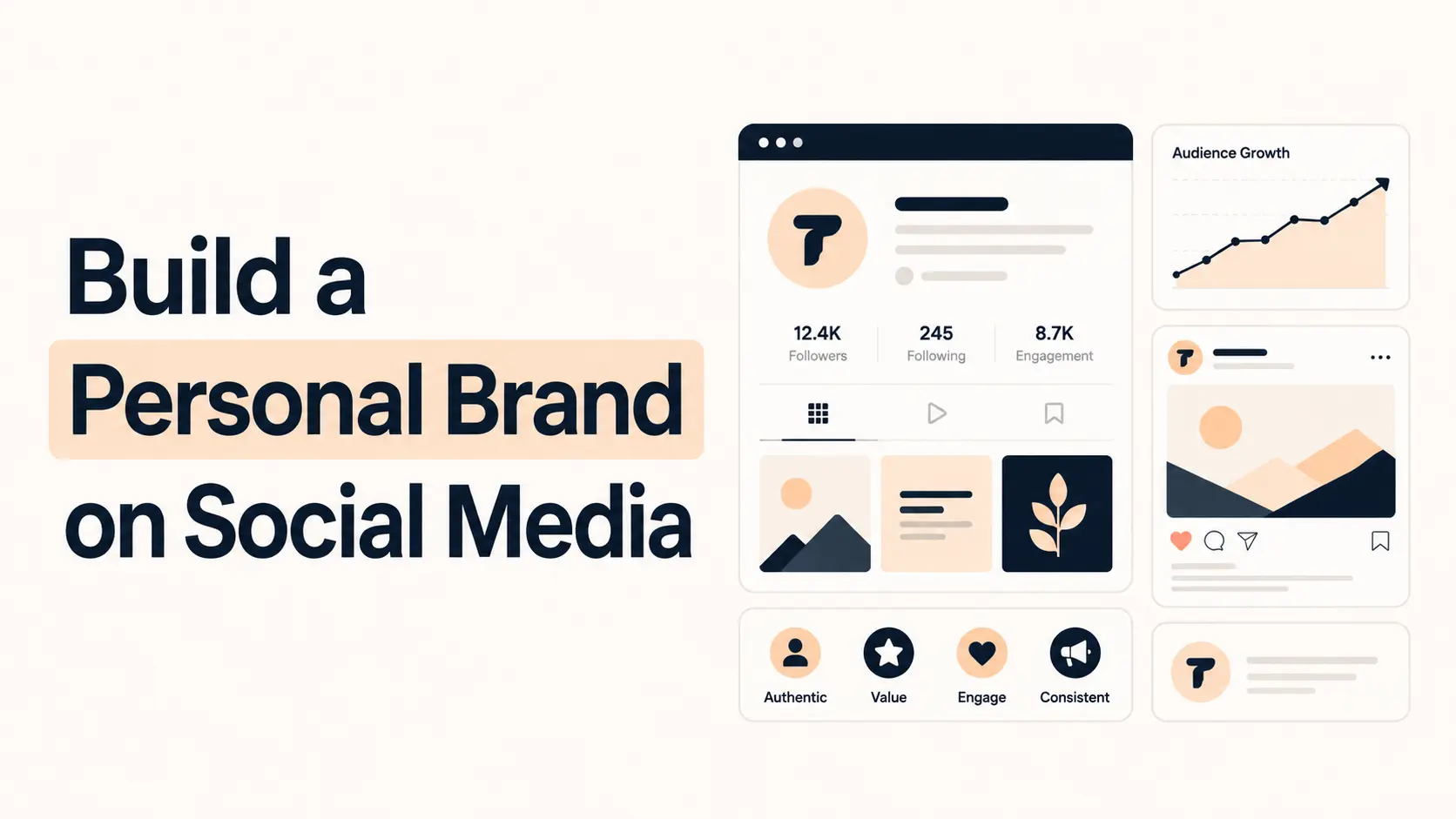


To build a personal brand on social media, become known for one useful thing by a specific group of people. Make that positioning obvious in your profile, publish content that proves what you know, show enough of your experience and point of view to be memorable, and stay consistent long enough for people to associate your name with the topic.
You do not need to become an influencer or post on every platform. A strong personal brand can be a consultant known for practical LinkedIn advice, a developer who explains WordPress performance, a designer who shares teardown videos, or a founder who documents how a product is being built. The goal is recognition and trust, not follower count by itself.
The process is simpler when you treat personal branding on social media as a system: positioning, profile, platform, content, proof, relationships, and measurement. This guide shows how to build that system without turning your social accounts into a full-time job.
TL;DR
A personal brand works when people can quickly understand what you know, who you help, and why your perspective is worth following. Start narrow, publish useful proof, and expand only after the positioning is clear.
- Define one clear position: who you help, what you help with, and what makes your approach different.
- Choose one primary platform: build depth where your audience already spends time before spreading effort across several networks.
- Use 3–4 content pillars: teach, show your work, share experience, and add a clear point of view.
- Build proof into the content: examples, results, processes, screenshots, lessons, and real work are stronger than unsupported claims.
- Make your profile do a job: tell visitors what you do, give them a reason to follow, and show the next step if they want to work with you.
- Measure recognition and business outcomes: profile visits, qualified followers, replies, saves, inbound leads, opportunities, and conversions matter more than vanity metrics.
What a personal brand on social media actually is
A personal brand is the reputation attached to your name. Social media makes that reputation visible and repeatable. Every profile, post, comment, video, case study, opinion, and interaction adds evidence about what you know and how you think.
That means personal branding is not mainly a logo, color palette, or polished headshot. Those elements can make your presence consistent, but they do not create authority. Authority comes from repeated signals: the problems you discuss, the quality of your explanations, the work you can show, the people who trust you, and the decisions you are willing to explain.
A useful test is simple: if someone sees three of your recent posts and your profile, can they explain what you are known for? If the answer is vague, the brand needs clearer positioning before it needs more content.
Step 1: Define the position you want to own
Start by deciding what you want your name to be associated with. “Marketing,” “business,” “design,” or “technology” is usually too broad. A stronger position combines an audience, a problem, and an area of expertise.
Use this formula: I help [specific audience] achieve [specific outcome] using [skill, experience, or approach]. You do not have to publish this sentence word for word. It is a decision filter for the content you create.
- Too broad: I talk about digital marketing.
- Clearer: I help small ecommerce brands improve paid social campaigns.
- Too broad: I am a WordPress expert.
- Clearer: I help content-heavy WordPress sites improve speed, SEO, and conversion.
- Too broad: I share career advice.
- Clearer: I help junior product designers build portfolios that get interviews.
Do not force yourself into a niche so narrow that you have nothing useful to say. Pick a core subject with enough room for related themes. You can expand later after people already understand the main reason to follow you.
Step 2: Turn your profile into a clear landing page
A social profile should answer three questions within a few seconds: who are you, what do you talk about, and what should someone do next? Treat the profile as the front page of your personal brand, not as a biography that tries to include every job and interest.
- Name and photo: use a consistent professional name and a recognizable photo across your main platforms.
- Headline or bio: state your role, topic, audience, or outcome in plain language. Avoid strings of vague labels such as “visionary,” “growth hacker,” or “thought leader.”
- Proof: mention a credible result, role, project, publication, company, or area of experience when it helps establish context.
- Featured or pinned content: keep your strongest introduction, case study, guide, portfolio item, or offer easy to find.
- Link: send people to one useful destination, such as your site, portfolio, newsletter, booking page, product, or contact page.
If LinkedIn is your primary platform, the same principle applies to the headline, About section, Featured area, and experience. Tenfic’s LinkedIn profile optimization guide covers that setup in more detail.
Step 3: Choose one primary social platform first
You can maintain several profiles, but building a personal brand is easier when one platform receives most of your original thinking. Choose it based on audience behavior and the type of content you can produce consistently.
| Platform | Best fit | Content that usually fits |
|---|---|---|
| Professionals, founders, consultants, B2B experts, job seekers | Text posts, documents, case studies, professional lessons, industry analysis | |
| Creators, designers, coaches, lifestyle businesses, visual experts | Reels, carousels, stories, visual proof, behind-the-scenes | |
| TikTok | Discovery-led creators, educators, consumer topics, personality-driven expertise | Short video, demonstrations, explanations, reactions, series |
| X (Twitter) | Writers, founders, developers, analysts, news-driven niches | Short opinions, threads, commentary, links, conversations |
| YouTube | Experts who benefit from depth, search, demonstrations, tutorials | Long-form video, tutorials, reviews, breakdowns, interviews |
A primary platform does not mean ignoring the others. It means creating the original idea once, then adapting strong ideas for secondary channels. If you manage several accounts, use a workflow that keeps the message consistent without posting the same format everywhere. See Tenfic’s guide to managing multiple social media accounts.
Step 4: Build 3–4 content pillars
Content pillars stop your personal brand from becoming random. They are recurring subject areas that support your positioning and give the audience a predictable reason to follow.
A useful mix is not simply “educational, inspirational, entertaining.” Make the pillars specific to your actual expertise. For example, a freelance SEO consultant might use technical SEO, content strategy, client case studies, and business lessons. A product designer might use interface critiques, portfolio advice, design process, and career experience.
Keep each pillar broad enough to produce dozens of ideas. Then create different formats inside the pillar: how-to posts, mistakes, checklists, breakdowns, opinions, case studies, questions, before-and-after examples, and lessons from current work. Tenfic’s guide to content pillars explains how to organize these themes without repeating the same post.
Step 5: Publish proof, not just advice
The fastest way to make a personal brand credible is to show how you know what you know. Generic advice is easy to copy. Experience is harder to copy.
- Show the process: explain how you approached a project, decision, experiment, or problem.
- Share examples: use real pages, campaigns, designs, workflows, code, dashboards, drafts, or deliverables when you are allowed to share them.
- Break down results: explain what changed, why it changed, and what you learned instead of posting a number with no context.
- Teach from mistakes: a useful failure analysis often builds more trust than a polished success story.
- Document active work: share observations from what you are building or testing now rather than waiting until you have a perfect case study.
You can still publish opinion and personal stories, but connect them to the reason people follow you. A story about a difficult client becomes useful when it teaches how you now scope projects. A career story becomes relevant when it explains a decision your audience may face.
Step 6: Develop a recognizable point of view
Expertise makes content useful. A point of view makes it memorable. You do not need to manufacture controversy, but you should be willing to explain what you believe works, what you avoid, and why.
Instead of posting “five tips for better content,” explain which common content tactic you stopped using and what replaced it. Instead of repeating a trend, show where the trend works and where it fails. Specific reasoning gives the audience something to associate with your name.
Keep the voice close to how you actually communicate. A personal brand becomes hard to maintain when every post sounds like a different copywriter. Clear vocabulary, recurring themes, and a consistent level of formality matter more than creating a forced “brand voice.”
Step 7: Make the visual identity consistent, not complicated
You need recognition, not a complete corporate brand system. Use the same profile photo, similar bio language, and a small set of repeatable visual patterns for carousels, thumbnails, or quote graphics. If you publish video, a consistent framing style, caption treatment, or opening format can help people recognize the content before reading your name.
Do not let design slow down publishing. For an expertise-led personal brand, the idea and proof should carry more weight than decorative templates. Clean typography, readable contrast, and consistent presentation are enough.
Step 8: Create a publishing cadence you can sustain
Consistency is useful because it creates repeated exposure. It does not mean posting seven times a day or forcing a daily schedule that collapses after two weeks.
Choose a minimum cadence you can keep for several months. For many professionals, two to four useful posts a week on the primary platform is more sustainable than trying to fill every day. A creator who works mainly through short-form video may publish more often. The correct cadence depends on production effort, audience response, and how quickly you can maintain quality.
Batch the parts that benefit from batching: research, idea capture, outlines, visuals, editing, and scheduling. Keep timely comments and conversations flexible. If you need a broader operating system, Tenfic’s social media growth strategy covers planning, publishing, engagement, and measurement.
Step 9: Build relationships in the same niche
Personal brands grow through conversations, not only broadcasting. Follow people your target audience already trusts. Add useful comments when you have something specific to contribute. Reply to people who engage with your work. Credit ideas and sources. Join discussions where your expertise genuinely helps.
Do not turn comments into disguised self-promotion. A strong comment can earn profile visits because the idea is useful on its own. Over time, repeated intelligent participation also creates relationships with peers, potential collaborators, clients, employers, journalists, and other creators.
Step 10: Make your content easy to find
Social platforms increasingly act as search and discovery engines. Use clear topic language in profile fields, post copy, video titles, captions, spoken content, and on-screen text when it fits naturally. If you want to be found for “WordPress speed optimization,” repeatedly talking only about “better websites” weakens the signal.
This is not an excuse to stuff keywords into every caption. Write for people first, but name the subject clearly. Tenfic’s social media SEO guide covers profile keywords, captions, searchable content, and cross-platform visibility in more depth.
Step 11: Measure whether the brand is becoming useful
Follower growth can indicate reach, but it does not tell you whether the right people remember or trust you. Track metrics that match the goal of the personal brand.
- Recognition: direct profile visits, branded searches, mentions, tags, and people repeating your ideas back to you.
- Content quality: saves, shares, watch time, meaningful replies, and repeat engagement from relevant people.
- Audience quality: whether new followers include the clients, employers, peers, customers, or partners you want to reach.
- Business outcomes: qualified inquiries, newsletter signups, booked calls, job opportunities, partnerships, speaking invitations, sales, or referrals.
- Efficiency: which topics and formats create useful outcomes without consuming unsustainable production time.
Review patterns monthly. Double down on topics that create both attention and useful outcomes. A viral post that attracts the wrong audience may be less valuable than a smaller post that generates three relevant conversations.
A practical 30-day personal branding plan
You do not need a complicated launch. Use the first month to make the positioning clear, establish a repeatable content system, and learn what the audience responds to.
- Days 1–3: write your positioning statement, choose the primary platform, update the profile, and define the action you want profile visitors to take.
- Days 4–7: choose 3–4 content pillars and write at least 20 specific post ideas based on questions, projects, mistakes, examples, and opinions you already have.
- Week 2: publish three useful posts in different formats or angles. Spend time replying to comments and contributing to relevant conversations.
- Week 3: publish a proof-heavy post such as a case study, teardown, process breakdown, tutorial, or lesson from real work. Repurpose one strong idea for a secondary platform.
- Week 4: review profile visits, saves, shares, replies, qualified followers, and any inbound opportunities. Keep the topics that created the clearest signal and plan the next month around them.
The first month is not about proving that your personal brand “worked.” It is about building enough consistency to see what deserves another 60 or 90 days.
Common personal branding mistakes to avoid
- Trying to talk to everyone: broad content makes it difficult for anyone to know why they should follow you.
- Posting only polished wins: proof is useful, but context, process, and lessons make the proof believable.
- Copying another creator’s personality: formats can be borrowed; voice and experience should not be.
- Changing topics every week: repetition around a useful theme builds association. Constant reinvention weakens it.
- Being visible without a next step: if the brand supports a business or career goal, make the relevant site, portfolio, contact method, or offer easy to find.
- Automating the human parts: scheduling is useful; generic automated comments and replies usually damage trust.
- Measuring only followers: a smaller audience with the right people can create more opportunities than a large unrelated audience.
Final takeaway
Building a personal brand on social media is mostly a clarity problem before it is a content-volume problem. Decide what you want to be known for, make that obvious when someone visits your profile, and publish enough useful evidence for people to trust the association.
Start with one platform, a few strong content pillars, and a cadence you can sustain. Show real work, explain your decisions, engage with people in the same space, and measure whether the audience is becoming more relevant. Once the core reputation is clear, expanding to more platforms becomes much easier.
Frequently asked questions about building a personal brand on social media
How do I start building a personal brand on social media?
Start by defining one audience and one area you want to be known for. Update your profile so that positioning is obvious, choose one primary platform, create 3–4 content pillars, and publish useful content that demonstrates your experience rather than only claiming expertise.
Which social media platform is best for personal branding?
The best platform is where your target audience already pays attention and where your strongest content format fits. LinkedIn is strong for professional and B2B expertise, Instagram and TikTok for visual or creator-led brands, X for commentary and ideas, and YouTube for deeper searchable expertise.
Do I need to post every day to build a personal brand?
No. A sustainable schedule is more useful than a daily schedule you cannot maintain. Choose a cadence that lets you publish strong ideas consistently for several months, then increase frequency only when the production system can support it.
What should I post for a personal brand?
Post content that teaches what you know, shows how you work, proves results or experience, explains your point of view, and answers recurring questions from the audience you want to reach. Use a small set of content pillars so the topics stay recognizable.
Can I build a personal brand without showing my personal life?
Yes. Personal branding does not require sharing private details. You can build a strong brand around expertise, work, values, decisions, process, and professional stories while keeping family, relationships, location, or other personal information private.
How long does it take to build a personal brand on social media?
There is no fixed timeline. Recognition usually comes from repeated exposure over months, not a single viral post. The speed depends on how clear the positioning is, how useful the content is, how often the right audience sees it, and whether you already have relevant experience or relationships.
How do I know if my personal brand is working?
Look beyond follower count. Useful signs include more profile visits from relevant people, repeated engagement, saves and shares, people associating your name with a topic, qualified inquiries, job or partnership opportunities, referrals, newsletter signups, and sales.