
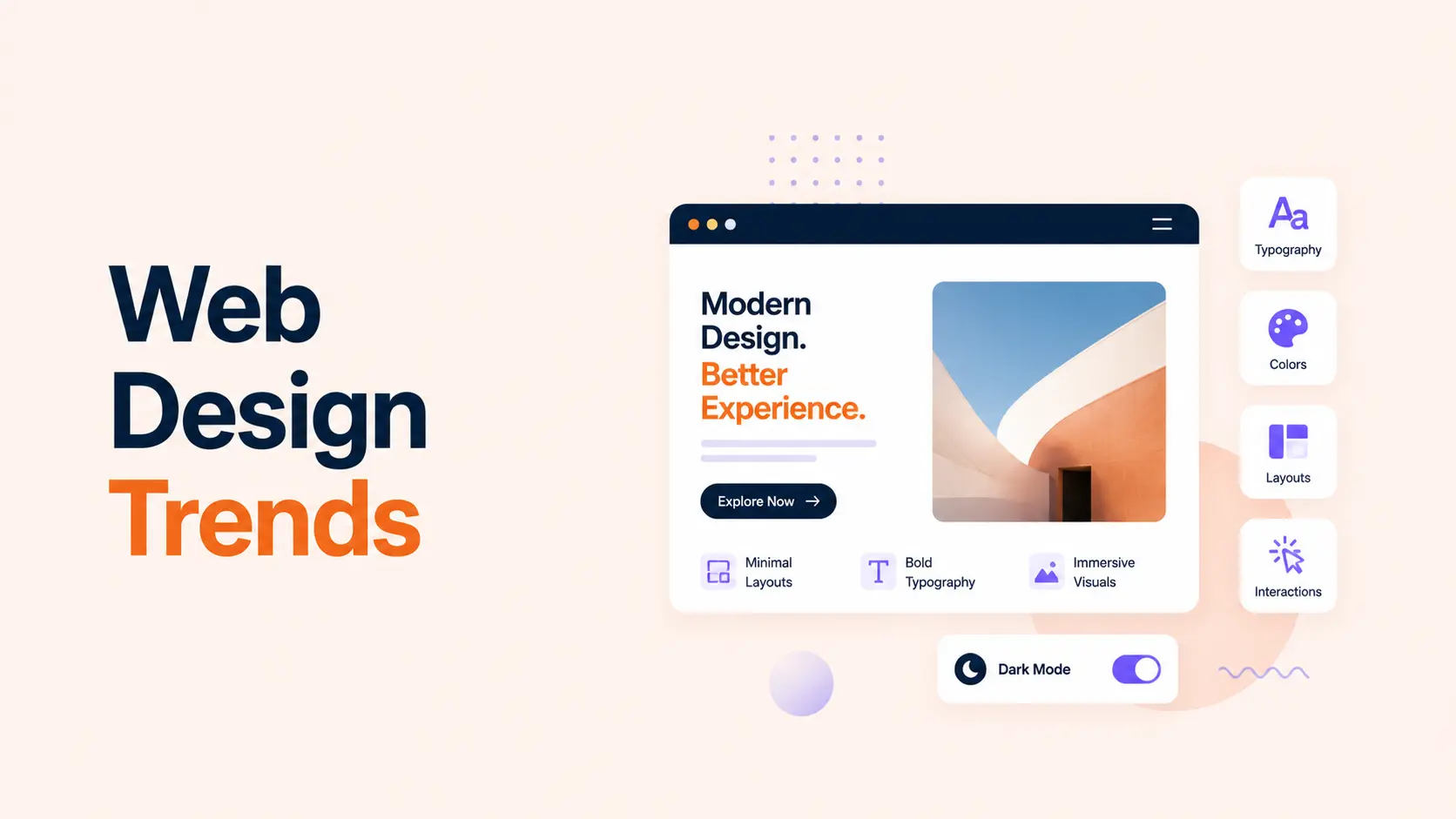


Web design trends in 2026 are moving in two directions at once: websites are becoming more expressive visually, but the strongest business sites are also becoming faster, easier to use, more accessible, more connected to business systems, and easier for both people and AI-driven search tools to understand.
A modern business website is no longer just a digital brochure. It may generate leads, sell products, answer questions, personalize content, connect to a CRM, support AI search visibility, and act as the front end of a wider automation stack. The useful trends are the ones that improve one of those jobs without making the site harder to use.
TL;DR
The most important web design trends for 2026 combine visual identity with performance, accessibility, AI, and business operations.
- AI-driven personalization and agentic experiences are becoming part of website UX, but they need clear boundaries and reliable data.
- AI search visibility is influencing page structure, content clarity, schema, and internal linking.
- Performance and accessibility are design requirements, not cleanup tasks after the visual work is finished.
- Bold typography, asymmetric layouts, organic shapes, motion, and 3D work best when they support hierarchy and brand identity.
- Reusable design systems and component-level responsiveness make websites easier to scale without visual drift.
- The website itself is becoming more connected to CRM, ecommerce, payments, automation, analytics, and first-party customer data.
- Businesses should adopt trends selectively. A faster, clearer site with strong conversion paths is more valuable than a fashionable site that creates friction.
What Changed in Web Design in 2026?
The biggest change is that web design is becoming less separate from the rest of the business. In Webflow’s 2026 State of the Website report, based on 1,000 marketing and technology leaders, 52% of marketing leaders said they would prioritize optimization for AI-driven search and summaries in 2026. The report also says 97% of technical leaders feel technical debt significantly affects website management, while 92% of organizations report website update requests are growing in size and complexity.
Wix’s 2026 State of Websites report, built from data across more than 300 million users, frames the shift similarly: AI is changing how websites are created, discovered, and used by businesses. So the trends below are not only about visual style. They reflect how teams build, maintain, discover, and monetize modern websites.
15 Web Design Trends Shaping Modern Business Websites
1. AI-Personalized and Agentic Website Experiences
AI is moving from a behind-the-scenes content tool into the website experience itself. A site may adapt recommendations, surface the right service path, answer product questions, summarize complex information, or help a visitor complete a task. Elementor’s 2026 web design trends report describes this as a shift toward agentic experiences that respond and act rather than remaining static. For business sites, the useful version is narrow and accountable: solve a real decision or support problem instead of adding a chatbot simply because it looks modern.
2. Design for AI Search and Answer Engines
Search behavior is changing as AI-generated summaries and conversational search become more common. That makes clear information architecture, descriptive headings, concise answers, structured data, strong internal linking, and original evidence more valuable. The visual design should support that clarity instead of hiding key information inside vague brand copy or overcomplicated interactions. For WordPress sites, the technical foundations in our WordPress SEO checklist still matter alongside newer AI-search considerations.
3. Performance-First Creativity
In 2026, performance is part of the design decision. High-resolution video, scroll effects, custom fonts, large JavaScript bundles, and 3D assets can create strong visual impact, but every one of them has a cost. Google’s current Core Web Vitals guidance defines a good Largest Contentful Paint as 2.5 seconds or less, Interaction to Next Paint as 200 milliseconds or less, and Cumulative Layout Shift as 0.1 or less at the 75th percentile. Those metrics influence which design choices survive production.
4. Accessibility-First Design
Accessibility is increasingly considered while layouts, components, colors, forms, navigation, and motion are designed rather than after the site is built. That means visible focus states, logical heading order, keyboard-accessible controls, adequate contrast, usable tap targets, descriptive form labels, zoom-friendly layouts, and reduced-motion support. The business benefit is wider than compliance: a site that is easier to read and operate tends to create less friction for everyone.
5. Token-Based Design Systems and Reusable Components
Modern web teams are moving away from page-by-page styling toward variables, tokens, reusable classes, and components. Colors, spacing, typography, radii, buttons, forms, cards, and layout rules are defined once and reused. This is especially useful for growing businesses because updates can be made systematically instead of correcting visual drift across dozens of pages. The designer’s job increasingly includes defining a system that can scale, not just making individual screens look good.
6. Bigger, More Expressive Typography
Large typography remains important in 2026, but the better implementations use type to control hierarchy rather than simply making the hero enormous. Variable fonts, tighter display leading, stronger weight contrast, selective italics, and deliberate line breaks can make a brand distinctive without adding heavy graphics. For business websites, readability still wins. Service details, pricing context, product information, and calls to action need comfortable body text and sensible line length.
7. Asymmetric and Anti-Grid Layouts
Strictly centered sections and repeated three-card rows have become easy to recognize as templates. More designers are using offset grids, uneven columns, cropped edges, overlaps, and intentional whitespace to create rhythm. Elementor also highlights anti-grid layouts as part of the move toward more human digital aesthetics. The key is intentionality: reading order, heading hierarchy, and mobile collapse still need to be obvious.
8. Organic Shapes, Texture, and a More Human Visual Language
As AI-generated interfaces become common, perfectly clean geometric layouts can feel anonymous. Organic masks, textured surfaces, irregular crops, hand-drawn details, softer gradients, and more natural photography are being used to give brands a recognizably human layer. This trend works best when it comes from the brand itself. A law firm, SaaS company, fashion label, and children’s education site should not all use the same soft shapes and grain overlay.
9. Purposeful Motion and Micro-Interactions
Motion is shifting from spectacle toward feedback. Hover states confirm interactivity, buttons respond when pressed, menus reveal hierarchy, progress indicators show system status, and subtle transitions help users understand what changed. Elementor describes this 2026 direction as function over flash. Use motion to explain state, hierarchy, or cause and effect. Avoid animation that delays reading, hijacks scrolling, moves important controls, or ignores reduced-motion preferences.
10. Selective 3D and Scroll-Based Storytelling
Immersive product views, spatial transitions, interactive 3D models, and scroll-led storytelling are more accessible to design teams than they were a few years ago. Wix Studio now positions interactive 3D, parallax, and scroll-based experiences as mainstream tools for professional client sites. That does not make every homepage a candidate for cinematic scrolling. 3D is useful when it explains a physical product, architecture project, complex device, or premium brand story. Otherwise it can add cost without helping the decision.
11. Component-Level Responsive Design
Responsive design is becoming more component-aware. Instead of styling only for a few viewport breakpoints, components can react to the space they actually receive. Container queries are a major part of that shift, and web.dev’s Baseline 2026 tracks additional container-query capabilities becoming broadly available across modern browsers. This helps reusable product cards, testimonials, pricing blocks, and content modules adapt to full-width sections, sidebars, archives, and embedded contexts without maintaining separate versions.
12. Conversion-Focused Clarity
One of the less flashy 2026 trends is stronger restraint. Business websites are simplifying navigation, tightening hero copy, making primary calls to action more obvious, reducing competing messages, and separating proof from promotion. The result can look minimal, but the real goal is decision clarity. If you are deciding how the platform itself affects design flexibility, our comparison of WordPress vs Shopify vs Webflow looks at those trade-offs beyond visual design alone.
13. Modular Editorial Storytelling Instead of Repeated Card Grids
Business websites are borrowing more from editorial design: strong section openings, varied content density, pull quotes, large proof points, media breaks, comparison tables, diagrams, and alternating content rhythms. The goal is to make long pages easier to follow without reducing every idea to another identical card. This works especially well for case studies, service pages, reports, product education, and high-consideration landing pages.
14. The Website as a Connected Business Hub
The website is increasingly the front end of a larger operating system. Forms can create CRM records, purchases can trigger fulfillment, booking flows can update calendars, lead activity can notify sales, and customer data can inform email or support workflows. Elementor’s 2026 trend reporting calls this the connected stack: the site becomes a business hub rather than a standalone asset. This is one reason modern web design and development needs to consider integrations early instead of treating forms, payments, CRM, analytics, and automation as afterthoughts.
15. Privacy-Aware Personalization and First-Party Data
Personalization is becoming more useful at the same time that businesses need to be more deliberate about the data behind it. Better websites ask what information is actually needed to improve the experience, conversion path, support process, or measurement model. A returning customer may benefit from saved preferences, while a B2B visitor might get a more relevant service path after explicitly selecting company size or goals. Personalization should make the site more useful without feeling unexplained or intrusive.
Which Web Design Trends Should a Business Actually Use?
Do not redesign a website around a list of trends. Start with the business problem. If visitors cannot understand the offer, improve information hierarchy and conversion clarity. If teams struggle to maintain pages, strengthen the design system. If the site is slow, simplify media and scripts. If traffic is shifting toward AI-generated discovery, improve content structure and machine-readable signals.
- For higher lead conversion: prioritize conversion clarity, stronger proof, purposeful motion, and connected CRM workflows.
- For faster performance: prioritize lighter media, fewer scripts, reusable components, and performance budgets.
- For better discoverability: prioritize clear editorial hierarchy, technical SEO, accessibility, performance, and AI-readable page structure.
- For stronger brand differentiation: use expressive typography, asymmetry, organic visual language, or selective 3D where they fit the brand.
- For easier scaling: prioritize design systems, component-level responsiveness, and a well-planned connected stack.
If WordPress is the platform, its flexibility can make these patterns easier to implement across content, integrations, and reusable templates. Our guide to the benefits of WordPress for website development explains where that flexibility helps and where disciplined implementation still matters.
Web Design Trends to Avoid Copying Blindly
- Huge hero headlines that push the actual offer and CTA below the first screen.
- Scroll-jacking or cinematic transitions that make basic navigation slower.
- Glass effects, gradients, and glowing surfaces used without a brand reason.
- AI chatbots that cannot answer accurately or hand the visitor to a real person.
- 3D scenes or background video that damage load time for a small decorative benefit.
- Minimal navigation that hides important pages in the name of visual cleanliness.
- Over-personalization based on weak data or unclear consent.
- A complete visual redesign when the real problem is content, positioning, performance, or conversion flow.
The Best 2026 Web Design Trend Is Better Decision-Making
The strongest business websites in 2026 are not the ones using the most effects. They are the ones that know where to be expressive and where to be quiet. AI can make a site more useful. Motion can clarify interaction. 3D can explain a product. Asymmetry can create identity. But speed, accessibility, clear content, and strong conversion paths still determine whether the experience works.
Treat trends as a toolkit. Choose the few that solve a real problem for the audience or the business, build them into a consistent system, and measure what changes after launch.
Frequently Asked Questions
What are the biggest web design trends in 2026?
The biggest 2026 trends include AI-personalized experiences, AI search-ready content structure, performance-first design, accessibility, reusable design systems, expressive typography, asymmetric layouts, purposeful motion, selective 3D, component-level responsiveness, connected business workflows, and privacy-aware personalization.
Is minimalism still a web design trend in 2026?
Yes, but the useful version is closer to clarity than extreme minimalism. Business sites are reducing competing messages and visual noise while keeping enough information, proof, navigation, and context for visitors to make a decision.
How is AI changing web design in 2026?
AI is affecting both website creation and the visitor experience. It can assist with design systems, content, testing, personalization, search, support, and guided journeys. Businesses still need human oversight for brand decisions, factual accuracy, privacy, accessibility, and high-impact actions.
Are 3D websites a good idea for business websites?
Sometimes. 3D is valuable when it explains a physical product, architecture, spatial concept, or premium brand story. It is less useful when it adds load time and interaction complexity without helping the visitor understand or choose anything.
What matters more, web design trends or website speed?
Speed and usability should set the limits for visual trends. A design effect is worthwhile only if its value is greater than its performance and interaction cost. Performance-first design treats those trade-offs as part of the creative process.
Should a business redesign its website every year to follow trends?
No. A strong website can evolve through targeted improvements to typography, components, content hierarchy, performance, accessibility, and conversion paths. Redesign when the current system no longer supports the brand, users, technology, or business goals, not because the calendar changed.
What is the most practical web design trend for small businesses?
For most small businesses, conversion-focused clarity is the highest-value starting point: a clear offer, simple navigation, strong proof, fast pages, accessible forms, obvious calls to action, and a website that connects cleanly to lead or booking workflows.