
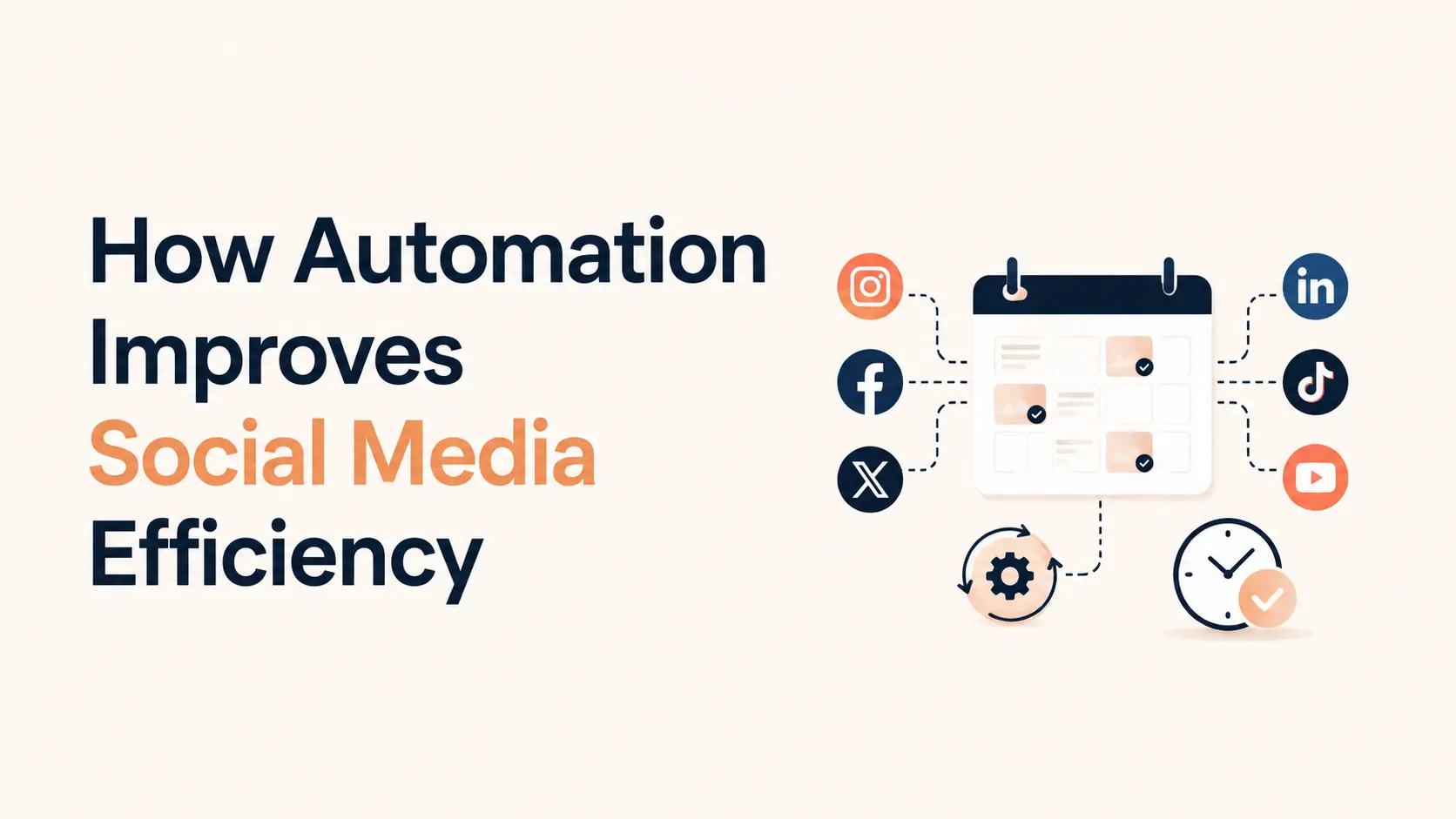

Social media automation improves efficiency when it removes repetitive execution without removing the decisions that still need human judgment. The biggest gains usually come from scheduling, cross-channel publishing, approvals, content repurposing, lead routing, notifications, and reporting. Strategy, customer conversations, sensitive replies, and final factual review should stay human-led.
The goal is not to automate every action. It is to reduce avoidable admin work so marketers can spend more time on research, creative quality, audience conversations, campaign decisions, and analysis. A good automation system makes the workflow faster and more consistent while keeping clear ownership when something needs attention.
TL;DR
Social media automation is most useful when it handles predictable, repeatable steps and hands exceptions back to people.
- Automate scheduling and publishing so approved content does not depend on someone being online at the right moment.
- Automate routine distribution, repurposing, notifications, and reporting before trying to automate creative judgment.
- Use approval stages for brand-sensitive, regulated, high-value, or difficult-to-reverse actions.
- Route leads and important social interactions to the right person instead of letting them sit in inboxes.
- Keep customer complaints, crisis responses, nuanced community engagement, and final fact-checking human-led.
- Measure time saved, turnaround time, publishing consistency, response time, error rate, and business outcomes rather than counting automated actions.
What Does Social Media Efficiency Actually Mean?
Efficiency is not the same as publishing more posts. A team can increase output and still become less efficient if approvals take longer, mistakes increase, leads are missed, or reporting consumes more time. Social media efficiency means producing and distributing useful content with less unnecessary work, fewer handoffs, faster response, and better visibility into what happened.
| Manual friction | Useful automation | Efficiency gain |
|---|---|---|
| Logging into several networks to publish | Central scheduling and publishing | Fewer repeated publishing steps |
| Waiting in chat for approvals | Defined review and approval stages | Shorter, trackable turnaround |
| Copying every lead into a CRM | Lead capture and routing workflow | Faster follow-up and less data entry |
| Building the same report every week | Scheduled reporting and alerts | More time for analysis |
| Rewriting one idea from scratch for every channel | Structured repurposing with review | Higher reuse without blind duplication |
Where Automation Improves Social Media Efficiency Most
Start with tasks that are frequent, rule-based, measurable, and easy to reverse. These are usually the safest places to automate because the workflow is already predictable. If a process is unclear when done manually, automating it usually makes the confusion faster rather than solving it.
1. Scheduling and Publishing
Scheduling removes the need for a marketer to stop other work just to publish at a specific time. Approved posts can be prepared in batches, assigned to the correct accounts, and queued for the appropriate date. This is especially useful for teams working across time zones or managing several profiles.
Native platforms already automate parts of this process. For example, LinkedIn lets users and Page admins schedule eligible posts in advance. A multi-network scheduler goes further by giving teams one calendar, shared queues, approvals, and account-level controls. Our comparison of the best social media schedulers explains where SaaS tools and WordPress-based options differ.
2. WordPress Content Distribution
Website publishing creates a predictable trigger: a new blog post, product, offer, or custom post type goes live. Instead of copying the URL, image, title, and caption into several social networks manually, that event can trigger social distribution.
For WordPress teams, Bit Social can automatically share newly published WordPress posts to connected social accounts and can also schedule WordPress content for later distribution. That is a practical automation because WordPress already holds the source content. The marketer can define what should be shared, where it should go, and how the message should be customized, while the system handles the repeated publishing step.
3. Content Repurposing and First Drafts
Automation can turn a finished source asset into a structured set of draft outputs. A webinar transcript might become proposed short-video hooks, LinkedIn post angles, an Instagram caption, a carousel outline, and questions for community posts. The important word is proposed. The source material can be reused automatically, but the final post still needs editorial judgment.
This works best when the workflow includes a clear brief: target audience, platform, content pillar, source facts, tone, prohibited claims, and CTA. Our guide to writing engaging social media captions shows what the final copy still needs to get right, while the AI tools for social media marketing comparison covers tools that can speed up drafting and repurposing.
4. Reviews and Approvals
Approval delays are often an operations problem rather than a content problem. Automation can notify the reviewer when a draft reaches the review stage, remind them when an item is overdue, record who approved it, and move the post to scheduling only after approval.
The workflow should become stricter as risk increases. A routine educational post may need one content review. A paid campaign, legal claim, financial promotion, customer story, or crisis response may need specialist approval. Automation should enforce the required review path, not bypass it.
5. Lead Capture and Routing
Social campaigns often produce leads through forms, landing pages, direct messages, ad lead forms, webinar registrations, or booking pages. The inefficient version requires someone to copy the contact into a spreadsheet or CRM and then tell sales that the lead exists.
A better workflow validates the incoming data, creates or updates the CRM record, tags the source campaign, assigns the lead based on territory or service, and alerts the responsible person. High-intent leads can be routed immediately while lower-intent contacts enter a nurture process. The marketing team still decides qualification rules; automation applies them consistently.
6. Notifications and Community Triage
Automation is useful for deciding what deserves attention, but it should be conservative about speaking on behalf of the brand. Mentions containing purchase intent, product problems, high-value customer names, or sensitive keywords can trigger an alert or task. Routine messages can be categorized so the community manager sees the highest-priority items first.
Fully automated public replies are riskier because context changes quickly. Sarcasm, complaints, legal issues, misinformation, harassment, and emotionally charged conversations often need a person. A safer pattern is detect, classify, notify, draft if useful, then require human review before sending.
7. Reporting and Performance Monitoring
Reporting becomes inefficient when marketers repeatedly export the same data, rebuild the same spreadsheet, and spend more time formatting numbers than interpreting them. Automation can collect recurring metrics, update dashboards, calculate agreed KPIs, and deliver scheduled summaries.
Alerts are often more useful than another dashboard. For example, notify the team if publishing fails, paid lead cost rises beyond a defined threshold, a post receives unusual negative feedback, or a campaign stops generating conversions. The system surfaces the exception; the marketer decides why it happened and what to change.
What Should Not Be Fully Automated?
- Brand strategy, positioning, audience selection, and campaign priorities.
- Final approval of factual, legal, medical, financial, pricing, or other high-risk claims.
- Customer complaints, crisis communication, sensitive moderation, and nuanced community replies.
- Original customer stories, testimonials, case-study facts, or performance claims that have not been verified.
- Creative decisions where the value depends on taste, timing, cultural context, or a strong point of view.
- Actions that are difficult to reverse, such as deleting records, issuing public statements, changing access, or publishing to high-risk accounts without approval.
Automation works best as an execution layer around a clear social media marketing plan. The plan defines the goal, audience, platforms, content pillars, owners, and KPIs. Automation then reduces the repeated work required to execute that plan.
How to Measure Whether Social Media Automation Is Actually Helping
| Metric | What it reveals |
|---|---|
| Time per published post | Whether repetitive production and publishing work is decreasing |
| Approval turnaround time | Whether review bottlenecks are shrinking |
| Publishing consistency | Whether planned posts go live when expected |
| Failed or incorrect posts | Whether automation is creating operational errors |
| Lead response time | Whether high-intent contacts reach the right person faster |
| Content reuse rate | Whether strong source content is being repurposed efficiently |
| Qualified traffic, leads, pipeline or revenue | Whether operational efficiency still supports business outcomes |
Do not use “number of automated posts” as the main success metric. Automation can increase output while quality falls. Compare the workflow before and after automation: time spent, error rate, missed deadlines, response time, and the business result attached to the channel.
A Practical Way to Introduce Social Media Automation
- Map the current workflow from idea to published post, including approvals, publishing, engagement, lead handling, and reporting.
- Mark repetitive tasks, delays, duplicate data entry, missed handoffs, and steps that regularly depend on someone remembering to act.
- Automate one low-risk workflow first, such as approved-post scheduling or WordPress-to-social distribution.
- Add logs, failure alerts, ownership, and a manual fallback before expanding the automation.
- Measure the process for several weeks, then automate the next bottleneck only if the first workflow is stable.
This phased approach is usually safer than building a large automated system at once. If you manage many profiles, also define account ownership, permissions, and recovery procedures. The operational issues are covered in our guide to managing multiple social media accounts.
What a Useful Social Media Automation Stack Looks Like
You do not need one tool to automate everything. Most teams are better served by a small stack where each layer has a clear job: a planning system for briefs and approvals, a scheduler for publishing, an editing tool for creative production, a CRM for leads, and an automation platform when data must move between systems.
- Planning and ownership: content calendar, briefs, campaign goals, approval status.
- Publishing: native schedulers, SaaS social management tools, or a WordPress scheduler such as Bit Social.
- Creative production: editing, caption drafting, resizing, transcription, and repurposing with human review.
- Lead operations: forms, CRM, qualification rules, assignment, notifications, and follow-up.
- Reporting: dashboards, scheduled summaries, failure alerts, and campaign KPI monitoring.
- Workflow orchestration: connect systems only where a clear trigger, rule, and destination already exist.
For video-heavy teams, the production layer can become its own bottleneck. Our comparison of video editing software for social media focuses on tools for short-form editing, captions, repurposing, browser collaboration, and professional workflows.
Common Social Media Automation Mistakes
- Automating a broken workflow before defining who owns each decision.
- Cross-posting identical creative and copy to every platform even when the context differs.
- Allowing AI-generated captions or replies to publish without factual and brand review.
- Building automations with no logs, failure notifications, or way to retry safely.
- Using automation to increase volume without checking whether content quality or lead quality is falling.
- Giving automation tools broader account permissions than they need.
- Ignoring platform changes, expired permissions, API limits, or account connection failures until posts are missed.
Automation Should Make the Team More Responsive, Not More Distant
The best social media automation removes invisible admin work. Followers should notice more consistency and faster useful responses, not a brand that feels mechanically generated. Use automation to prepare, route, schedule, notify, and measure. Keep people responsible for judgment, relationships, and the decisions that affect trust.
A good first automation is usually boring: one repeated task, one clear trigger, one predictable outcome, and an alert when it fails. Once that process is reliable, expand from there. For broader business processes that connect marketing with forms, CRMs, notifications, and other systems, the same principle applies to workflow automation.
Frequently Asked Questions
What is social media automation?
Social media automation uses software and predefined rules to handle repeatable tasks such as scheduling, publishing, notifications, lead routing, data transfer, reporting, or first-draft generation. It should automate predictable execution while keeping human review for strategy, sensitive communication, and high-risk decisions.
How does automation improve social media efficiency?
It reduces repeated manual steps, shortens handoffs, improves publishing consistency, speeds up lead routing, and makes recurring reporting easier. The efficiency gain is strongest when the workflow is already clear and the automated task follows stable rules.
What social media tasks should I automate first?
Start with low-risk repetitive tasks such as scheduling approved content, distributing WordPress posts, sending approval notifications, collecting recurring metrics, or routing form leads. These tasks are easier to measure and usually have a clear manual fallback if something fails.
Should social media comments and messages be automated?
Triage can be automated more safely than final replies. Software can categorize messages, detect priority keywords, and alert the right person. Sensitive complaints, crisis situations, unusual questions, and public replies that could affect trust should normally receive human review.
Can AI automate social media content creation?
AI can speed up research organization, hooks, outlines, caption drafts, repurposing, transcription, and variations. It should not be trusted to invent facts, customer results, product capabilities, or final brand claims. Use source material and a clear brief, then review the output before publishing.
Is social media scheduling the same as social media automation?
Scheduling is one type of social media automation. A wider automation system may also include approvals, WordPress auto-posting, repurposing, lead routing, notifications, reporting, CRM updates, and exception handling.
How do I know if social media automation is saving time?
Measure the workflow before and after automation. Track time per post, approval turnaround, publishing consistency, failed posts, response time, lead-routing speed, content reuse, and the business KPIs tied to social media. The goal is lower operational friction without reducing quality.